
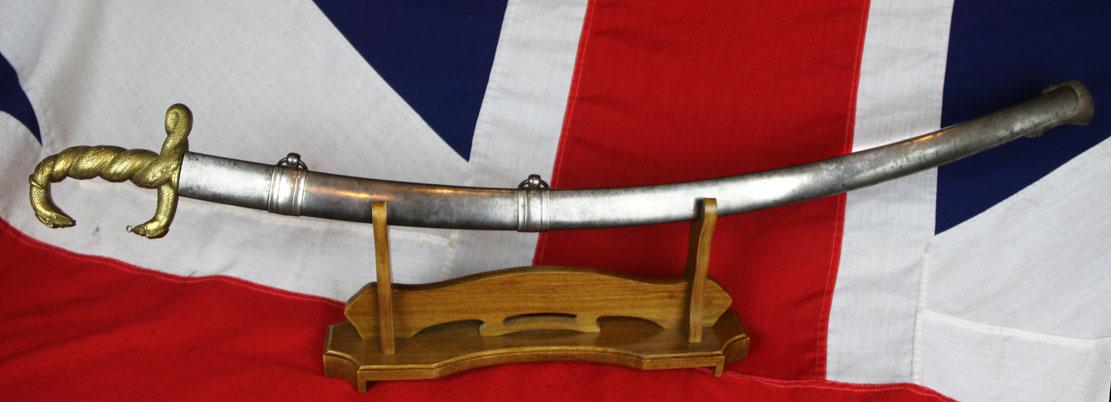
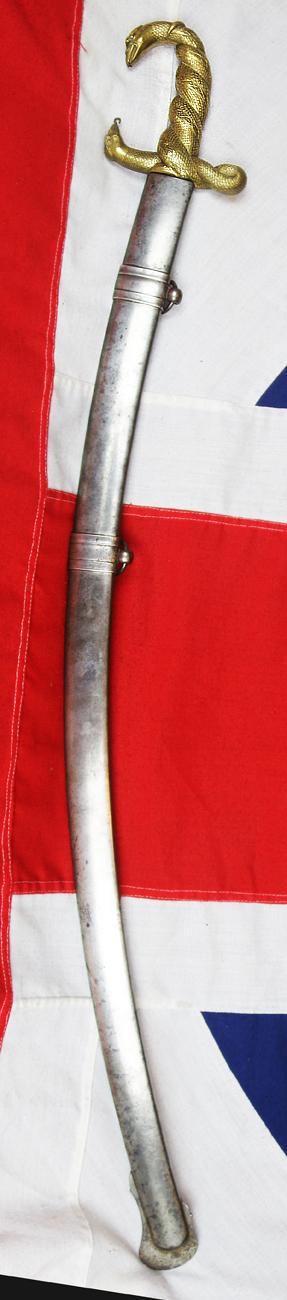
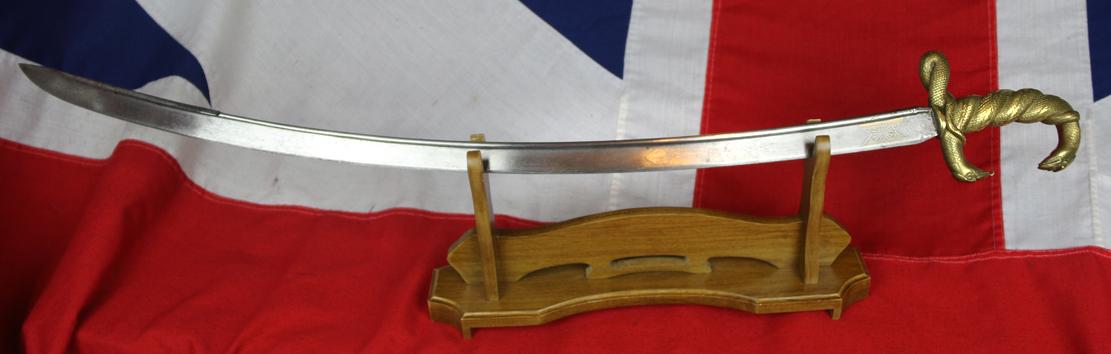
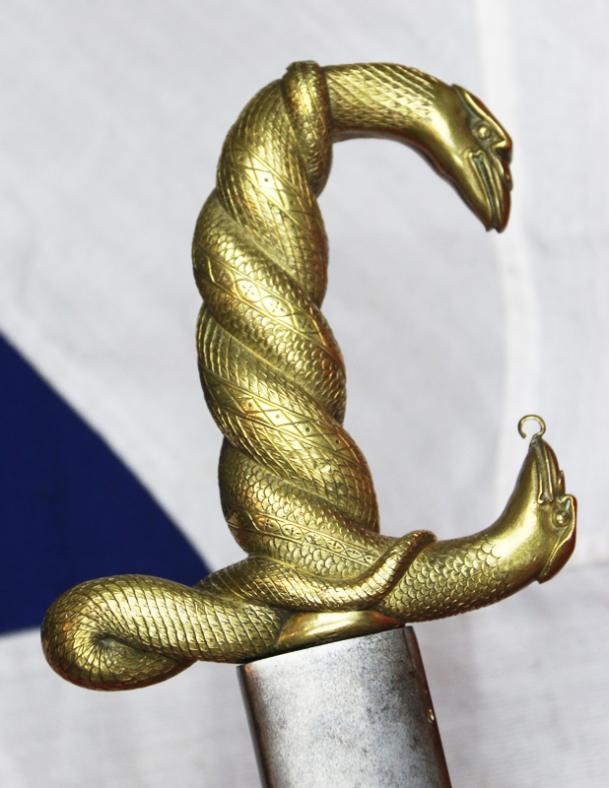
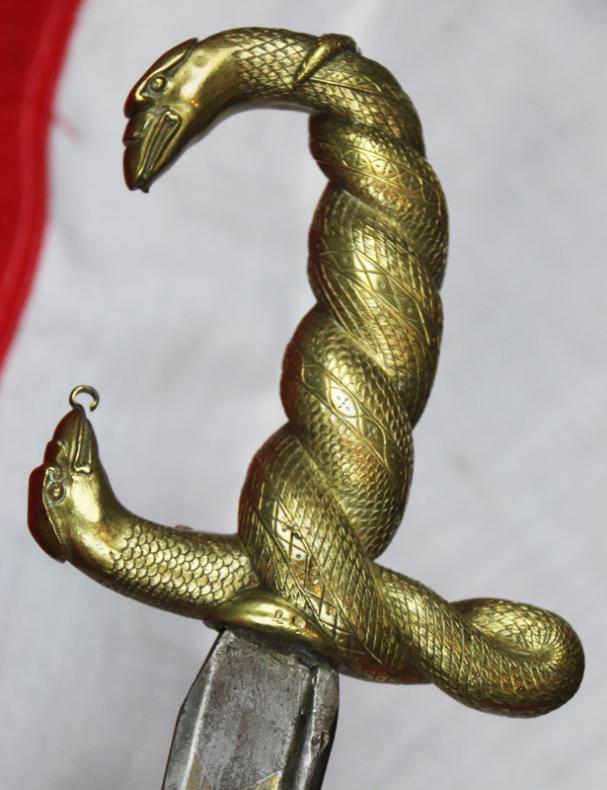
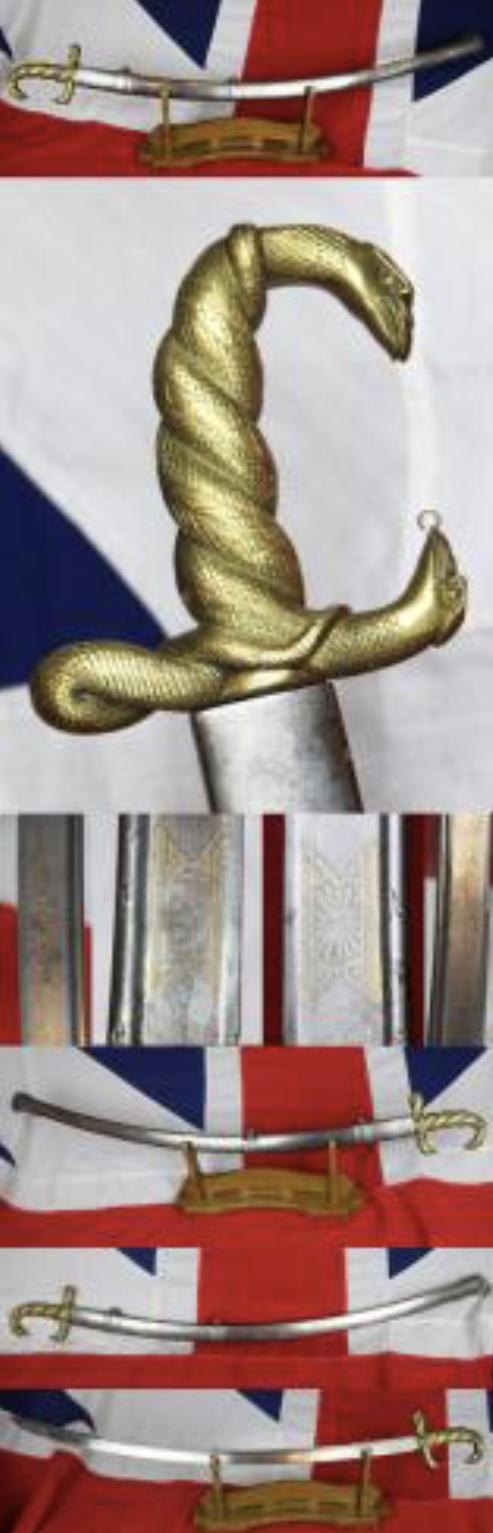
Superb Napoleonic Wars, British Officer's Sabre With Captured French 'Trophy' Mamluk Consular Guard Officer's Damascus Blade, With An Ancient Egyptian Serpent Goddess Hilt. For an Officer Who Served in The Nile Campaign
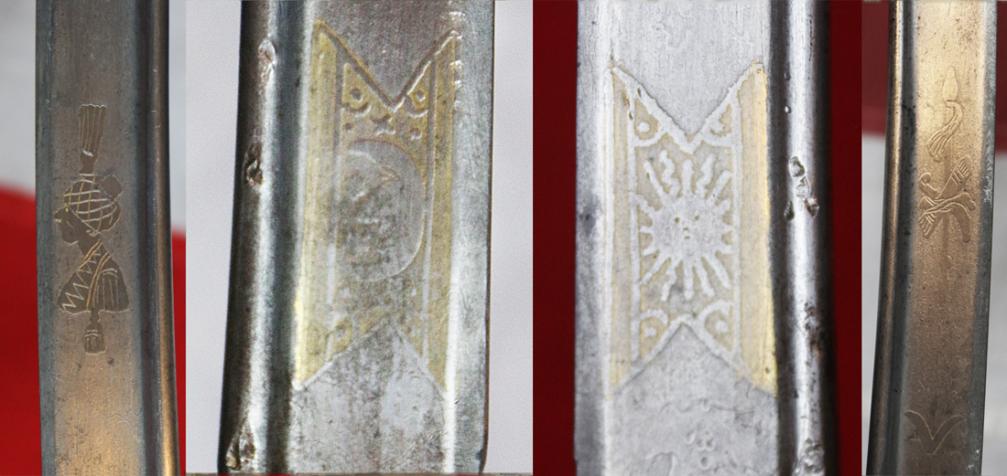
New photographs added to include the identical Damascus blade, bearing a Mamluk officer's portrait bust within its design, of the Philippe Missilier Collection exceptionally rare sword of an officer of the Mamluk Imperial {formerly Consular} Guard, Ist Empire, {see photo 9 in the gallery}
Gilt bronze entwined twin serpent zoomorphic hilt, influenced by the Egyptian Goddess Wadget, chisselled in great detail and of very fine quality. Talisman symbolic, Napoleonic Damascus blade, of an officer of the elite Napoleonic Mamluke Guard Circa 1800. There is another blade known, an identical example, on another sword from an officer of the French Napoleonic Mamluke Guard, formerly in the Philippe Missillier collection, that appears in Aries seminal work on French Napoleonic swords, and Michel Pétard's work of similar renown, with all the same iconography within the design, and, also upon a damascus blade {see photo 9 in the gallery}.
This sword is extraordinarily rare, as the officer corps of Napoleon's Mamluk Consular Guard would likely number less 15. For example in 1802 there were just 13 officers recorded who would have carried this sword, and how many survive to today, may possibly be less than two or three.
Certainly a war trophy blade and scabbard used by a British officer that served at the Battle of the Nile, thus, it also has Nile Club connections. There are numerous examples of snakes depicted in zoomorphic hilted Napoleonic swords, such as the Lloyds Patriotic Fund swords, but usually combined with other beasts, such as lions, tigers or hounds, but to have two opposing entwined serpents is very rare indeed. Without a doubt this hilt design was inspired by Wadjet, the ancient Egyptian serpent goddess, in order to reflect the direct connection to a Battle of the Nile British officer veteran.
Snake sculpture - the Staff of Aesculapius, the Staff of Mercury, and the Embodiment of Wisdom Snakes are fairly frequent in Georgian sculpture, and of course from other periods. In art generally in fact from medieval times onwards, the snake is also associated with wisdom, and in this capacity is often found with statues of Prudence. The way this sword is constructed shows it is a trophy blade, of a Mamluk officer, thus captured in combat by the British, and then re-mounted. The Mamluk officer’s sword, was etched with talismanic symbols of a crescent moon, sun, a Mamluks turbaned officers portrait bust head, and a stand of arms, upon fine Damascus pattern steel.
In fact the whole sword may indeed now be described as iconically talismanic. The blade is in superb condition, with its original steel combat scabbard, also in excellent condition, and the English zoomorphic hilt is, furthermore, excellent too .
Egyptian gods and goddesses, much famed in ancient Egypt, become hugely popular throughout Western artistic culture in the early 19th century.
Europe became beguiled by ancient Egyptian art and architecture in all its forms, and furniture designers and sculptors particularly, eagerly created the ‘Egyptian style’ in the Regency period England, and the Consular and Directoire period in France.
The Nile Club" (often referred to historically as the Egyptian Club) was an exclusive group of senior British officers who fought under the command of Rear-Admiral Sir Horatio Nelson at the decisive Battle of the Nile on August 1–3, 1798.
Key details regarding this group and its connection to the Napoleonic Wars include:
Following their massive victory at Aboukir Bay, which stranded Napoleon in Egypt, the captains of Nelson’s fleet formed this most exclusive club to celebrate and commemorate the action.
The club included the captains of the ships present at the battle, such as Captains Sir F. Berry (Vanguard), T. Trowbridge (Culloden), R.W. Miller (Theseus), and A.J Ball (Alexander).
The "Nile" Dirks/Swords: Members were entitled to wear a special sword or dirk featuring a zoomorphic Nile Crocodile on the hilt to signify their participation. Marines and Army may have had the associated Egyptian zoomorphic snake god hilt, or, another option, the zoomorphic camel head hilted sabre. We had a zoomorphic Nile Club camel head hilted officer’s sword a few years ago that we sold to an esteemed American dealer.
These weapons are now considered very rare historical artifacts.
Connection to Trafalgar: Many of the officers in the Nile Club continued to serve under Nelson and were likely present at the Battle of Trafalgar in 1805, where they would have worn their Nile-associated swords with pride.
The Mamluks service in the Napoleonic Wars;
At the Battle of Austerlitz, the Mamluks were in the reserve, under Rapp, with the rest of the Imperial Guard cavalry, when the Russian cavalry charged onto the Pratzen Heights and dispersed two French regiments of the Vandamme division. After an unsuccessful counterattack by two squadrons of mounted chasseurs supported by three squadrons of mounted grenadiers, Napoleon ordered Rapp to charge at the head of the last two squadrons of chasseurs and the Mamelukes in order to restore the situation. The Mamelukes threw themselves into the mêlée, but the impact of their charge was mitigated by the mass of men and horses. Lieutenant Renno rushed at a Russian square and opened a breach, which was quickly exploited by the Mamelukes, who broke through the formation and took 120 prisoners. Encouraged by this success, Rapp's cavalrymen seized a battery before contributing to the rout of the Russian Imperial Guard cavalry. Following this victorious engagement, two Mamelukes each came to throw an enemy standard at Napoleon's feet. The company's losses amounted to one dead and five wounded.
In 1808, Napoleon ordered Marshal Murat to enter Spain and occupy Madrid. The Mamluks took part in this expedition. Staunchly Catholic, the Spanish people remembered the period of Muslim rule in the Iberian Peninsula by the Moors, and was offended by the presence of the Mamluks who entered the capital on 24 March 1808. The abdication of King Charles IV and then of his son Ferdinand in favour of Joseph Bonaparte, the Emperor's brother, exacerbated tensions between the Spanish and the French.
In April, the company of Mamluks numbered 86 men. Seeking to expand this force, chef d'escadron Daumesnil, commanding the detachment of chasseurs of the Guard in Spain, asked permission to enlist foreigners, former Mamelukes but also Greeks or Spaniards, which Napoleon refused: "I created this corps to reward those men who served me in Egypt, and not to make a collection of adventurers." On 2 May, the people of Madrid revolted and attacked isolated soldiers. Murat then ordered the cavalry to enter the city to suppress the riot. The mounted chasseurs of the Guard led by Daumesnil advanced first, followed by the Mamelukes and the rest of the Guard cavalry. Passing through Alcalá Street, where they had rocks thrown at them, the French cavalrymen reached the Puerta del Sol where many Spaniards had gathered.
The Mamluks arrival marked the beginning of merciless fighting. The Madrid rebels assaulted the horsemen with knives, jumped onto their mounts behind them and tried to dismount them. For their part, the Mamluks responded with scimitar strikes and skillfully cut off heads, a hundred "in an instant" according to Marbot. In the mêlée, Lieutenant Chahin saved chef d'escadron Daumesnil, who had fallen to the ground after having his horse killed from under him, before being struck in turn; the residents of a house on San Geronimo Street were also massacred by the Mamluks in retaliation for the killing of two of their comrades. At the end of the fighting, the company had its five officers injured as well as three horsemen killed or mortally wounded, losses that Ronald Pawly considered as "relatively limited" compared to the painter Goya's depictions. Edward Ryan instead mentions only two killed.
See picture 8 in the gallery to see Admiral Nelson with his Nile Club zoomorphic hilted sword
Overall in superb condition, Small scabbard throat mount lacking to the scabbard. Overall 39 inches long, blade 32 inches
Code: 23387
5950.00 GBP