
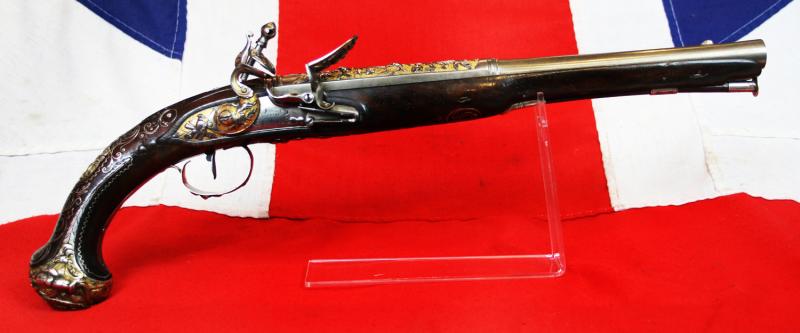
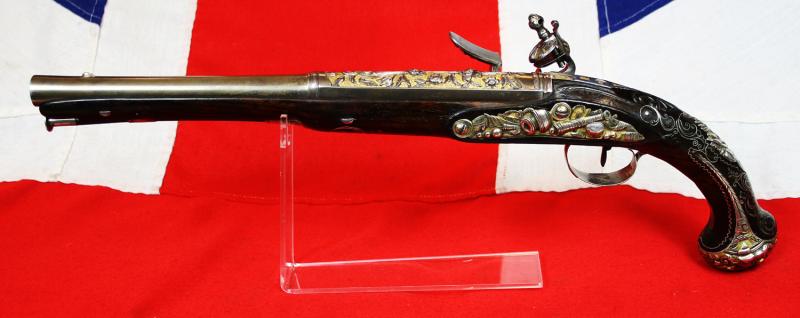
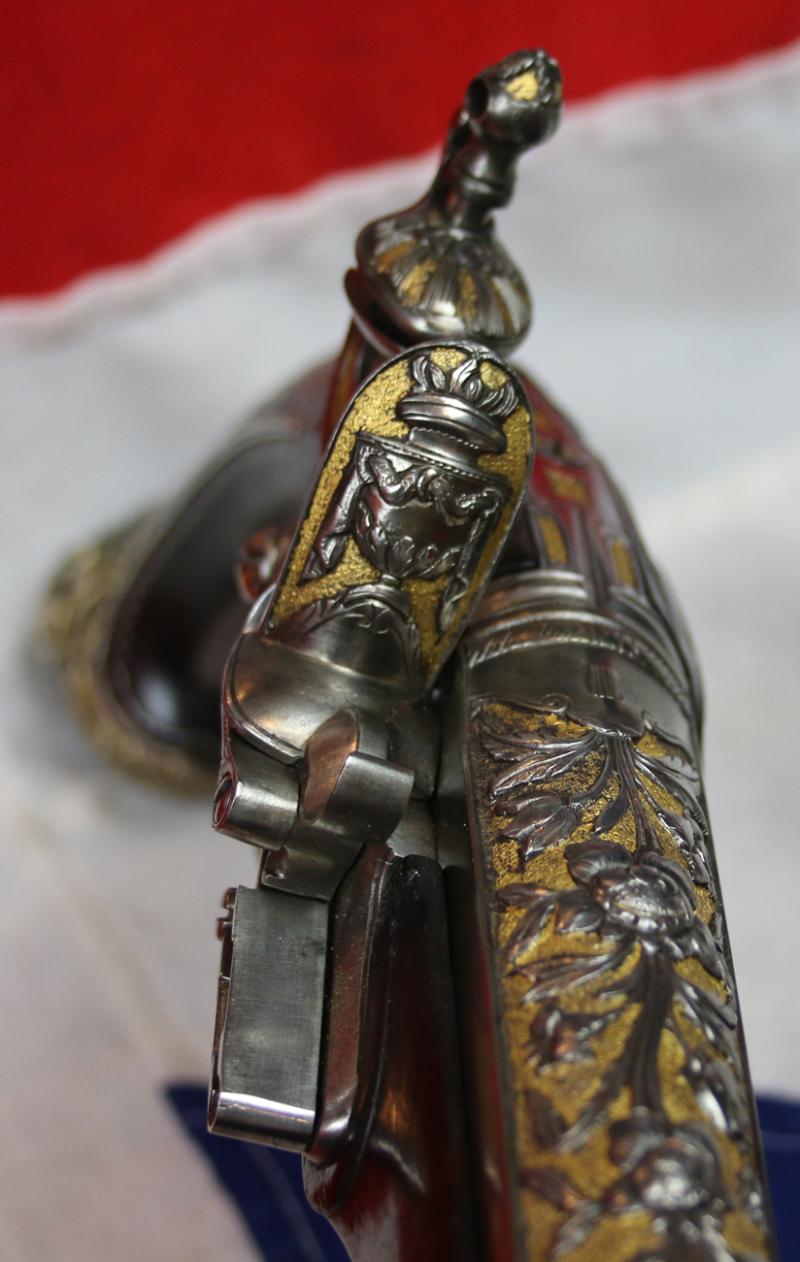
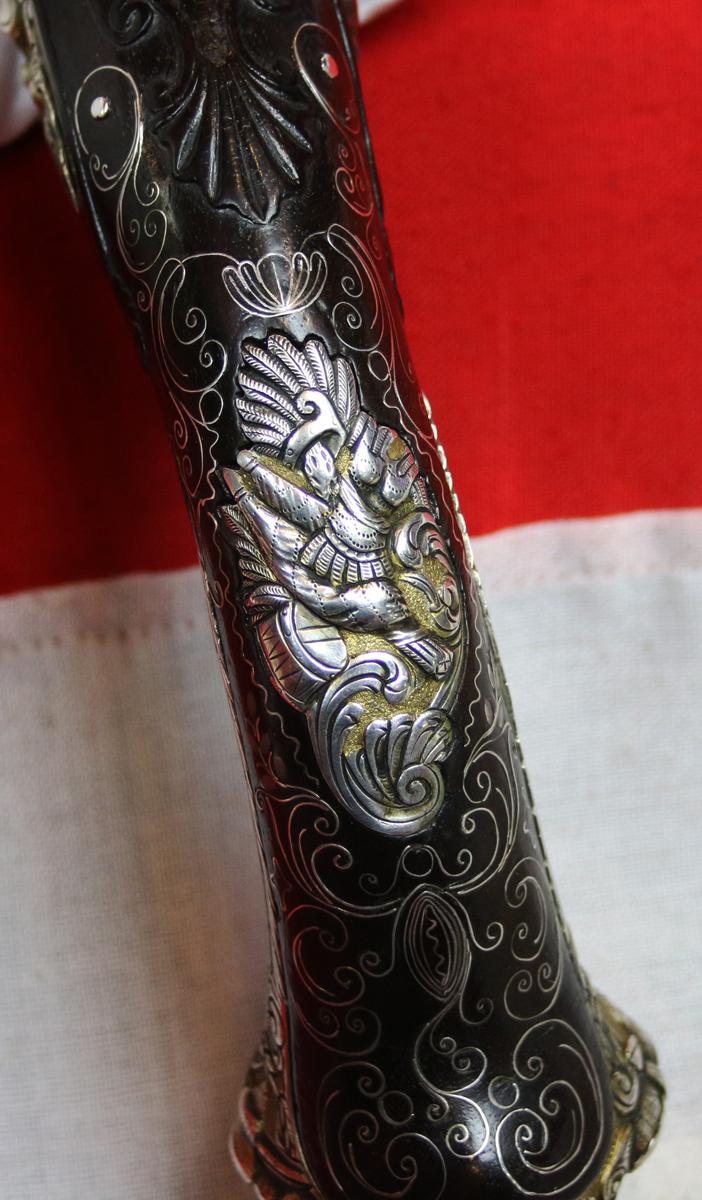
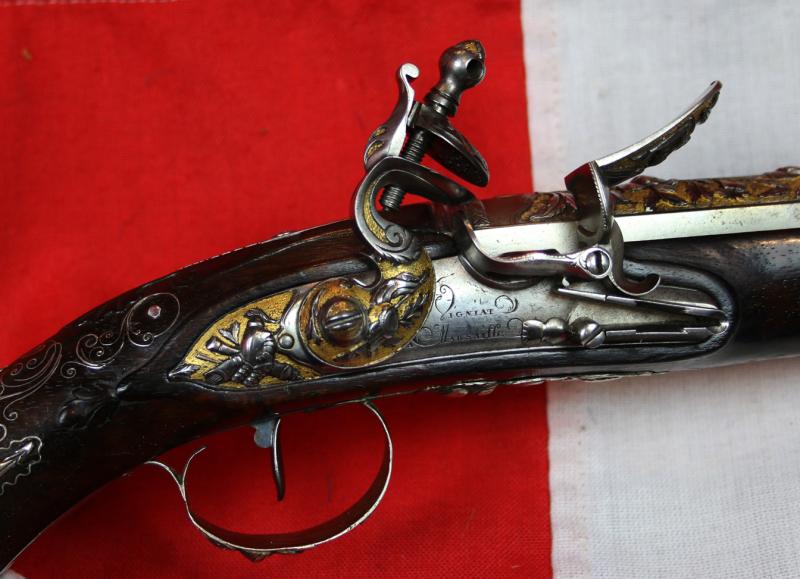
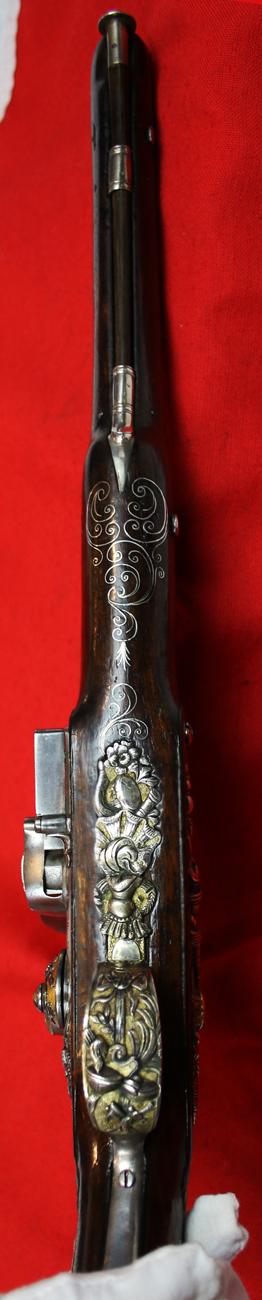
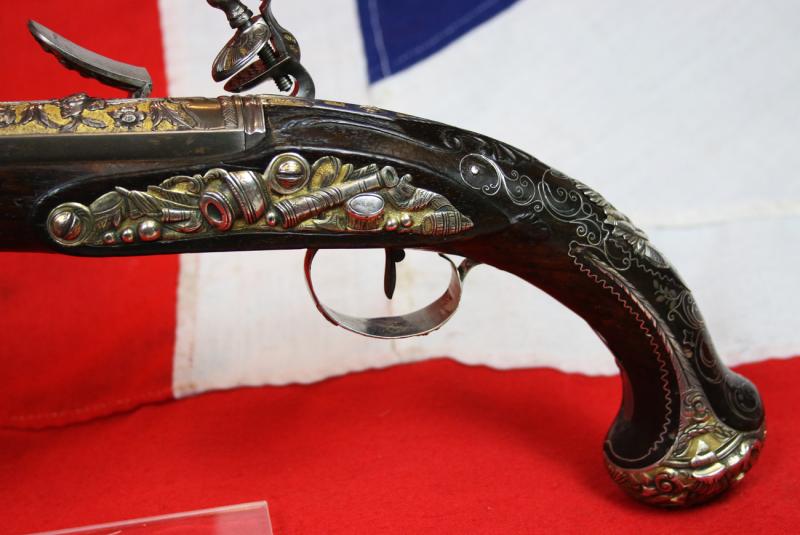
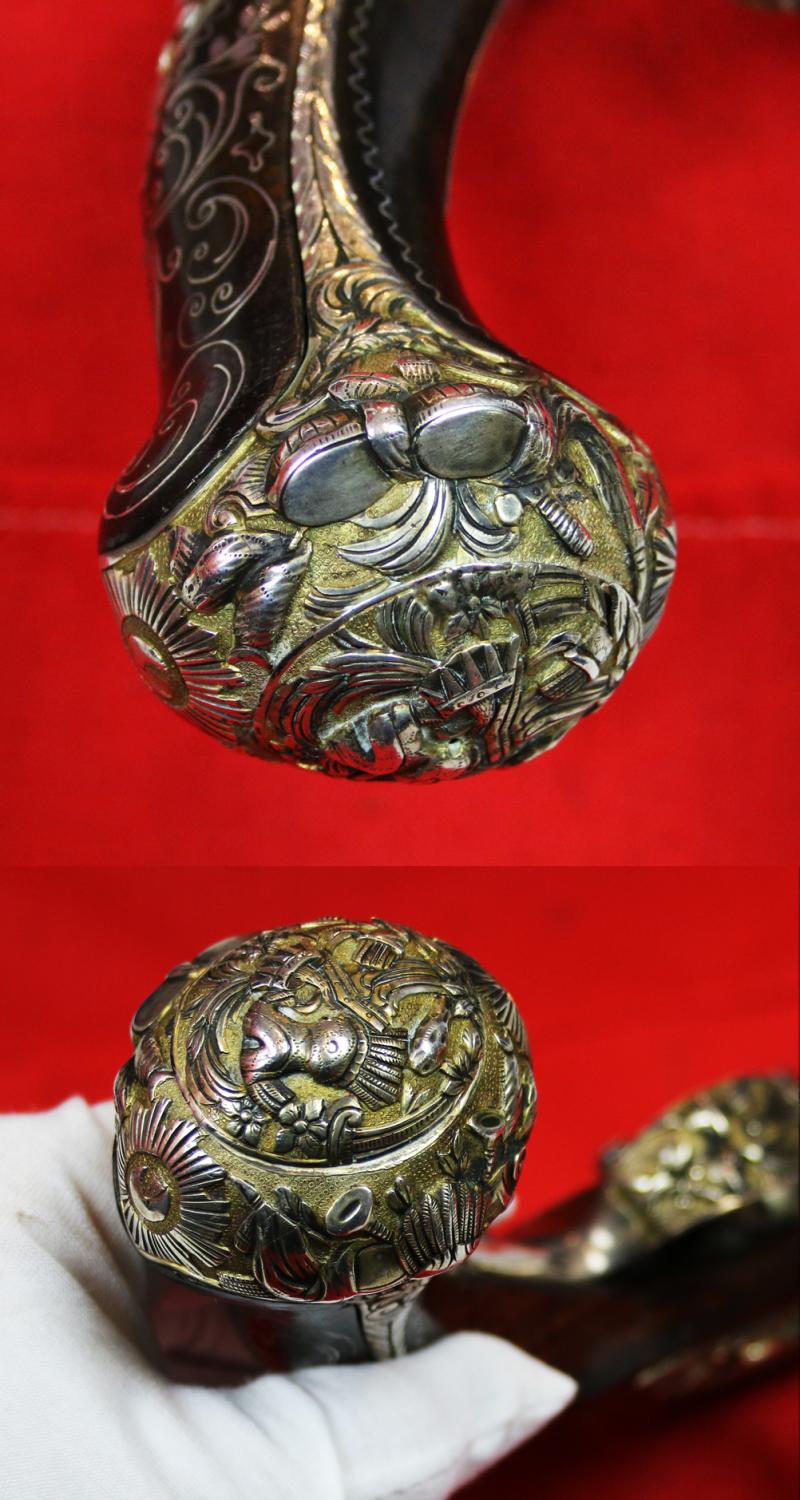
One Of The Finest Quality Museum Grade French Napoleonic Flintlock Pistols One Will Ever See Outside Of The World Renowned Musee De l’armee Les Invalides Paris. Exactly The Quality As Was Presented By Emperor Napoleon To His Royal Allies & Marshals
A singularly fabulous Napoleonic wars period French presentation pistol of the highest possible grade, made during the French Consular and First Empire period, a flintlock worthy of Napoleon himself.
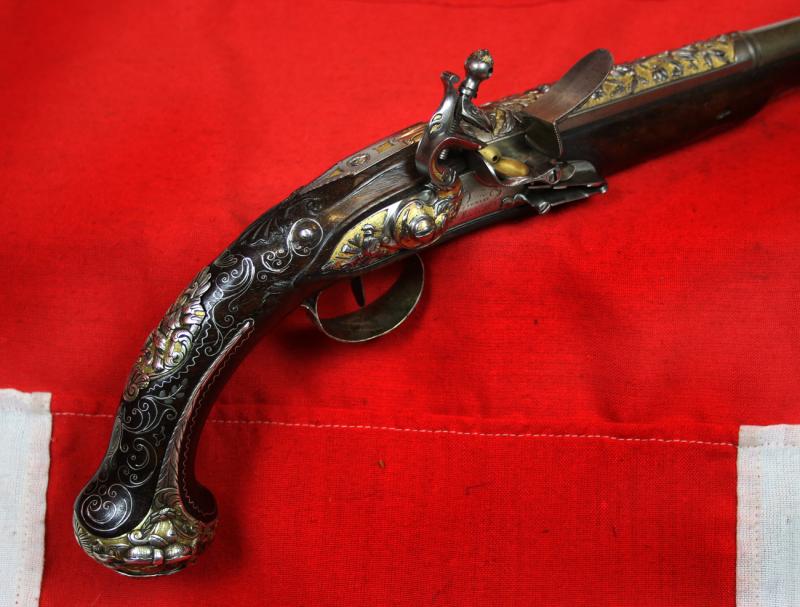
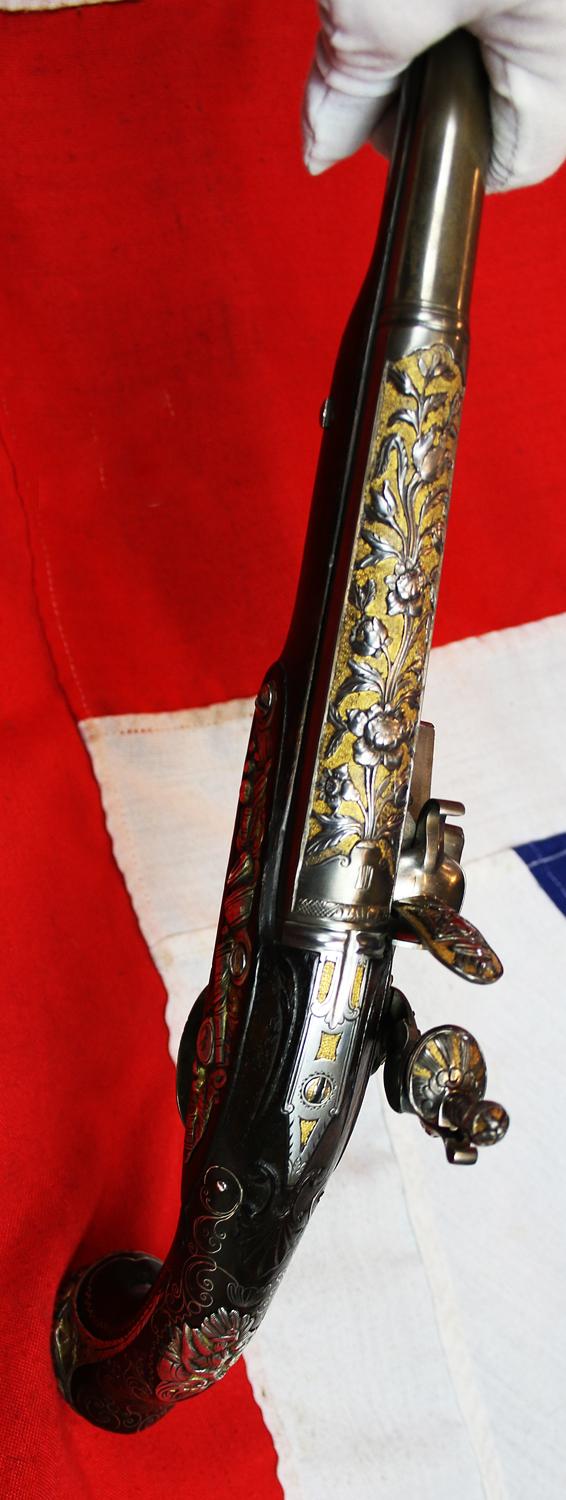
Made by highly respected French master gunsmith, this is a museum piece pistol overflowing with solid silver gilt mounts, with further scrolls of silver inlaid within the stock, and to compliment the solid silver gilt all the steel is also stunningly chiselled with pure gold embellishments and highlights throughout all of the lock and the barrel. Chiselled with trophies of arms against a ring matted gold ground, a gold lined rainproof pan, and swamped barrel, with a beleen and silver tipped original ramrod. Every aspect and parts of this breathtaking museum piece are in near mint condition. It is without question the very best of its type, and within this elevated category they are made further exceptional by the lavish use of such technical artistry embellished with purest gold..
This flintlock is a remarkable object d’art, and truly thoroughly executed throughout to a superb standard, quite simply in every single aspect, a virtuoso work of a master of his craft, and the subtle differences in the chiselled silver and steel designs are very much an exhibition of his imagination and sublime skill.
Even by the standards of unrestrained luxury that is associated with the royal and Imperial court at Versailles & Paris, the use of solid silver gilt in the mounting of luxurious French firearms and swords was very rare. From the evidence of a small handful of surviving examples in museum collections.
Of course, a masterpiece of this level could, and will, never be created again, however, if one could, only the gold and steel master gunsmiths such as the finest craftsman employed by such as Purdey of London, might even attempt to. And the cost? without doubt, around £300,000 {plus}. Their standard bespoke sporting guns now start at around £150K
Leading world museums have examples of pistols of this grade and quality personally presented by Napoleon to his marshals, generals, and his brothers, Joseph (King of Naples and Spain), Lucien, Louis (King of Holland), and Jérôme (King of Westphalia), and it would be identical as presented to the great Ottoman ruler Ali Pasha, former firm ally of Napoleon { to aid his ambitions in Italy}. When Napoleon's fortunes waned, the ever pragmatic Ali Pasha, later switched allegiances to make an alliance with Britain.
It would likely be impossible to find a more glorious and fabulous quality pistol to improve upon this one, in any of the greatest gun collections of the world. A pistol that would be at home in the British Royal Collection, the Metropolitan Museum, or the Louvre in Paris
Napoleon was famed for presenting the finest and priceless French pistols and sporting guns to his favourite Marshals and Generals of the Grand Armee of France. And especially so for rulers, kings and Grand Sultans, to cement alliances in order to expand Napoleon’s Empire and influence even beyond its expansive borders. And especially so, in order to confound the influence of his greatest nemeses, the British. All his efforts were, in one way or another, to cement his power throughout the whole of Europe, by excluding and denying the powerhouse of English trade throughout Europe. Napoleon’s empire, like Alexander’s and The Great Khan’s before him, was concentrated on military might, and thus conquest, to submit every country taken to his will. The British was always a nation and empire based on trade, certainly not simply conquest, and was backed up by the most powerful navy the world had ever seen. The vital arteries to expand trade throughout the world, and thus, the intention was to improve the lot of all, not just the occupiers. Napoleon looted his way across his conquered lands, in fact even demanded it by necessity, by the simple method of limiting food supplies to his armies baggage trains, however, Wellington’s high morals demanded an early version of ‘hearts and minds’, where looting by his men was punishable by the severest penalties, and even execution. It was Napoleon’s strategy of supplying provisions to his invading armies by their looting from the occupied countries, as they progressed, was the premise that cost him the disaster that was the invasion of Russia, and the entire loss of his hundreds of thousands strong Grand Armee. The Czar of Russia realised Napoleon’s looting strategy was, potentially, his greatest weakness, across the vast unending lands of Russia, and he simply ordered the destruction of literally everything, before the French invader, both property, crops and food, so there was nothing for Napoleon to loot, and not a shelter to be had. The gripping and unrelenting Russian winter was a force no-one could ever conquer, not even Napoleon. That mistake, effectively, cost him his empire. Just as it did Hitler, 130 years later.
The House of Bonaparte (originally Buonaparte) is a former imperial and royal European dynasty of French and Italian origin. It was founded in 1804 by Napoleon I, the son of Corsican nobleman Carlo Buonaparte and Letizia Buonaparte (née Ramolino).
Napoleon was a French military leader who rose to power during the French Revolution and who, in 1804, transformed the French First Republic into the First French Empire, five years after his coup d'état of November 1799 (18 Brumaire). Napoleon and the Grande Armée had to fight against every major European power (except for the ones he was allied with, including Denmark-Norway) and dominated continental Europe through a series of military victories during the Napoleonic Wars. He installed members of his family on the thrones of client states, expanding the power of the dynasty.
The House of Bonaparte formed the Imperial House of France during the French Empire, together with some non-Bonaparte family members. In addition to holding the title of Emperor of the French, the Bonaparte dynasty held various other titles and territories during the Napoleonic Wars, including the Kingdom of Italy, the Kingdom of the Spain and the Indies, the Kingdom of Westphalia, the Kingdom of Holland, and the Kingdom of Naples. The dynasty held power for around a decade until the Napoleonic Wars began to take their toll. Making very powerful enemies, such as Austria, Britain, Russia, and Prussia, as well as royalist (particularly Bourbon) restorational movements in France, Spain, the Two Sicilies, and Sardinia, the dynasty eventually collapsed due to the final defeat of Napoleon I at the Battle of Waterloo and the restoration of the Bourbon dynasty by the Congress of Vienna.
During the reign of Napoleon I, the Imperial Family consisted of the Emperor's immediate relations – his wife, son, siblings, and some other close relatives, namely his brother-in-law Joachim Murat, his uncle Joseph Fesch, and his stepson Eugène de Beauharnais.
We show in the gallery a cased, but far plainer pair, presented personally by Napoleon to the Grand Chamberlain of the King of Rome
Code: 26034
19995.00 GBP