


A Stunning, Early, Signed Munemitsu, Bizen School Koto Blade Katana With Hi Circa 1480. A Most Beautiful And Incredibly Elegant Ancient Samurai Sword By a Master Smith Of the 15th Century, Of The Reign Of The Emperor Go-Tsuchimikado (後土御門天皇)
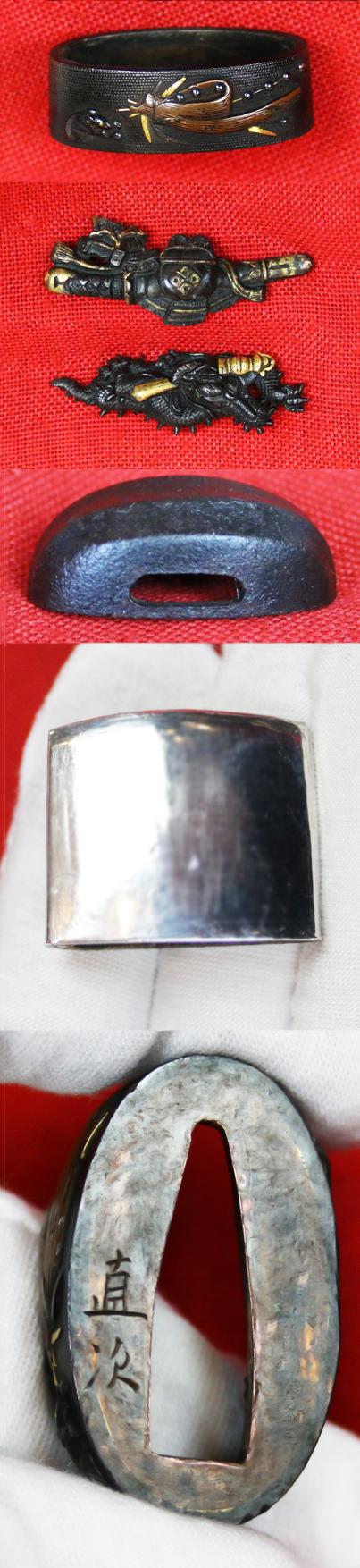
Beautiful, and original, Edo period koshirae {sword mounts and fittings}
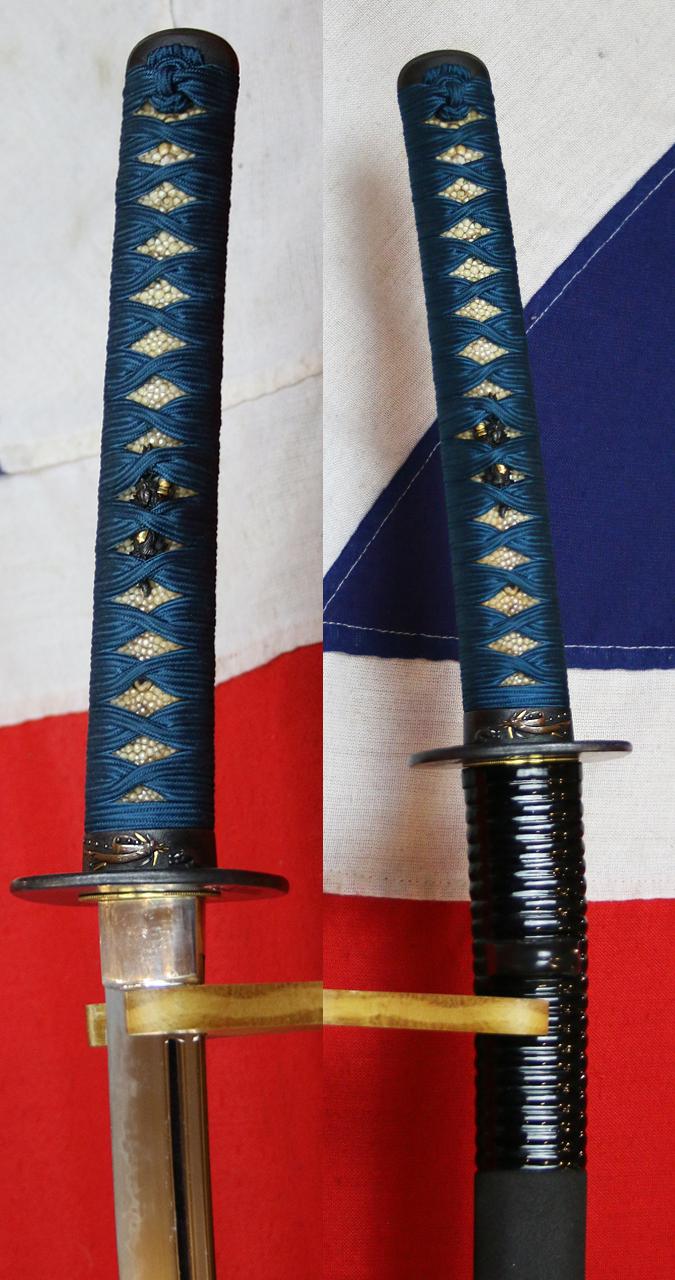
The rich mid blue-torqoise tsuka-ito has just been beautifully restored, as has the black saya, with a ribbed top section, and ishime {stone finish} lacquer to the rest, and as hoped it once again looks absolutely fabulous. A true beauty of an early, signed, samurai art and combat sword, around 550 years old, and a signally fine piece, worthy of any museum grade collection.
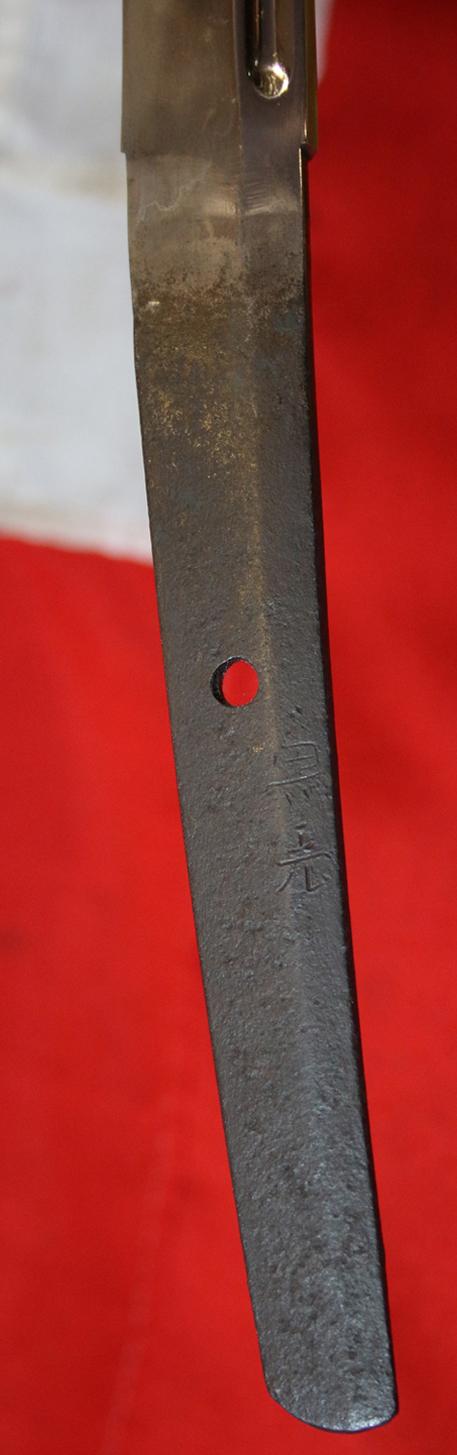
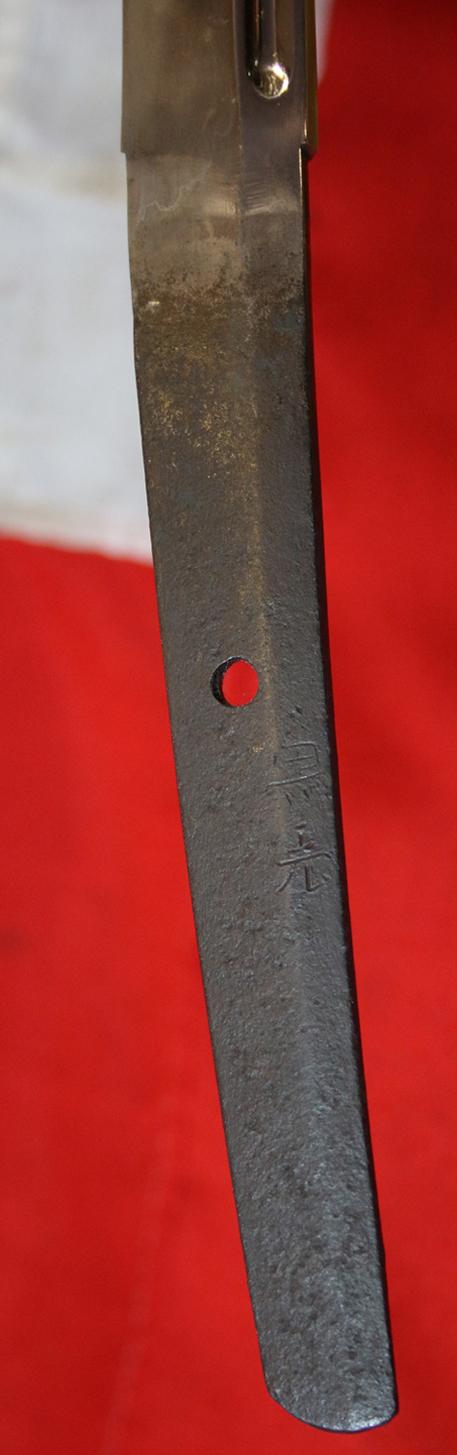
Possibly by Bishu Osafune Munemitsu {a smith from the Bunmei reign in the Koto era, making swords for the samurai involved in such as the Ōnin War}
The earliest samurai, that carried this beautiful masterpiece, fought in the Japan's Warring States Period, or Sengoku Jidai (c. 1467–1603) It was a tumultuous era of intense civil war, political upheaval, and social change, marked by the collapse of central authority and the rise of powerful regional lords (daimyo) fighting for control over fractured Japan.
Triggered by the Ōnin War (1467), it saw constant conflict, the introduction of firearms, castle building, and eventually, the emergence of three great unifiers—Oda Nobunaga, Toyotomi Hideyoshi, and Tokugawa Ieyasu—who gradually reunified the country after the Battle of Sekigahara
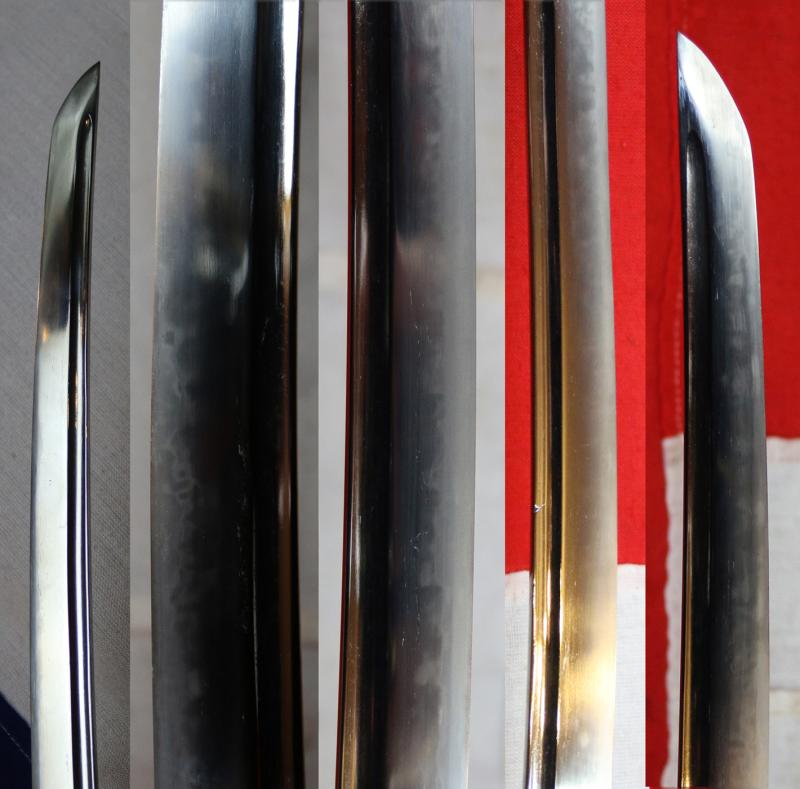
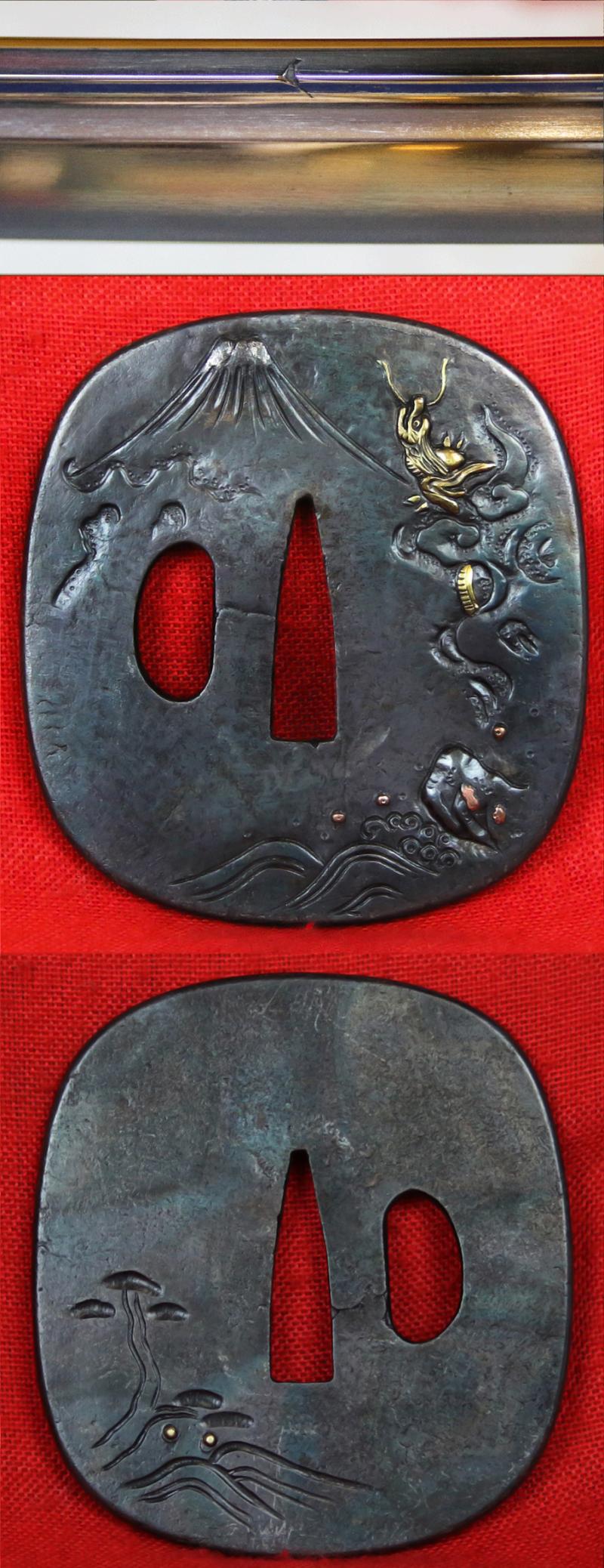
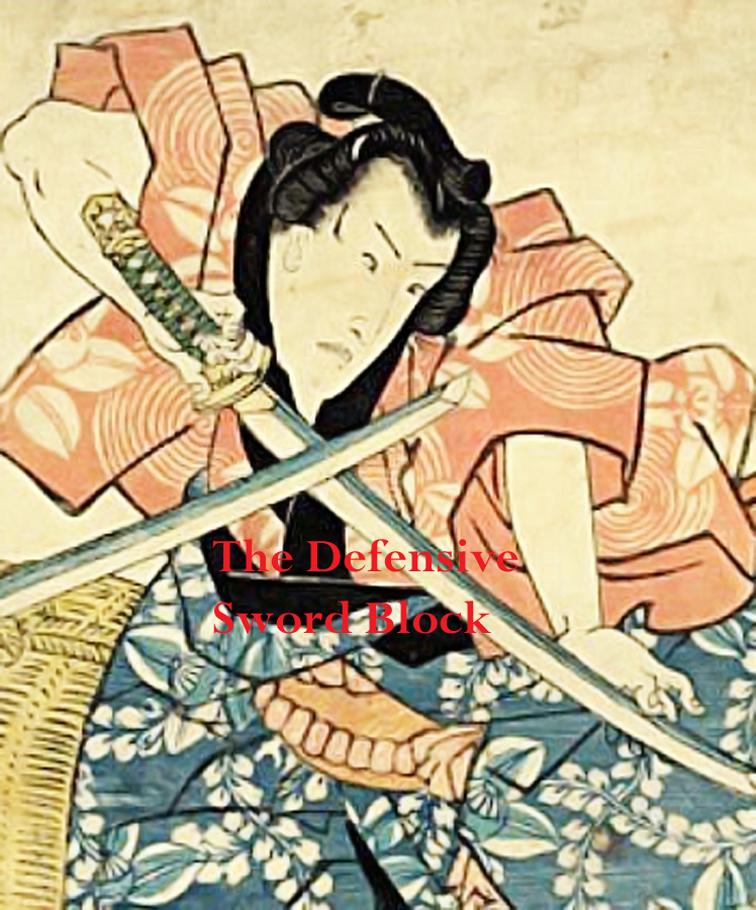
The blade is absolutely beautiful, with hirazukuri, iori-mune, very elegant zori, chu-kissaki and carved with broad and deep hi on both sides, the forging pattern is beautiful, and a gunome-midare of ko-nie, deep ashi, hamon, the tang is original, and full length, and it is mounted with a silver habaki. The blade has a fabulous blocking cut on the mune, a most noble and honourable battle scar that is never removed and kept forever as a sign of the combat blocking move that undoubtedly saved the life of the samurai, and will thus be never removed.
The tsuka has an iron Higo school kashira, a beautiful signed shakudo-nanako fuchi with very fine quality takabori decoration. The menuki {photographed before the tsuka-Ito {binding} was restored}
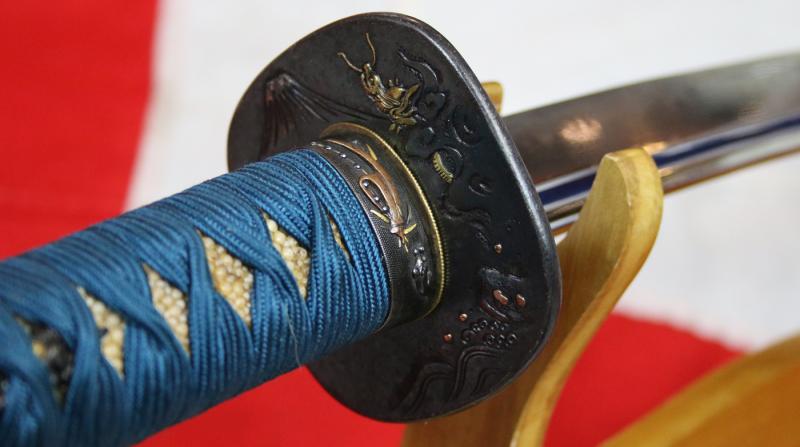
Its tsuba is beautiful with a takebori design of Mount Fuji with dragon flying in the sky above, with highlights in gold, silver and copper. The Edo menuki are of a shakudo and gold takebori representation of a group of samurai armour upon a tachi, and a shakudo and gold dragon clutching an ancient Ken double edged straight sword with lightning maker, a Ken maki Ryu zu, in gold.
What with the defensive cut, its shape and form, this fabulous sword has clearly seen combat, yet it is in incredibly beautiful condition for its great age, and it is a joy to behold.
The Bunmei era (1469–1487) in Japanese history was a period during the Muromachi period defined by the latter, more destructive phase of the Ōnin War (1467–1477) and its aftermath, characterized by widespread civil conflict and the breakdown of central authority.
Key battles and conflicts associated with the Bunmei era include:
Conclusion of the Ōnin War (1469–1477): While beginning in 1467, the fighting continued heavily into the early Bunmei era. This was a brutal, decade-long struggle primarily in Kyoto between the Hosokawa and Yamana clans, reducing the capital to ashes.
Destruction of Shōkoku-ji (1467/early Bunmei era): Though it began slightly before, this major battle saw the destruction of the Shōkoku-ji temple in Kyoto by Yamana forces.
Rise of the Ikkō-ikki (1471): The Ikkō-ikki Buddhist sect gained significant strength in the North, with Asakura Toshikage becoming Constable of Echizen, changing the power dynamics in the region.
The Ōuchi Withdrawal (1477): The departure of the Ōuchi clan from Kyoto in 1477 marked the effective end of the main Ōnin War, though conflict continued.
Yamashiro Country Uprising (1485): Following the war, in 1485, agrarian uprisings (yamashiro no kunikki) took place in the Yamashiro region as local residents and lower-level samurai sought to control their own lands.
Consolidation of Power by Hōjō Sōun (Late 1480s/1490s): Following the war, Hōjō Sōun began his rise, becoming master of Izu in 1492 and capturing Odawara in 1495, setting the stage for the Sengoku period.
After another century of the turbulent Warring States Sengoku era, this katana would have almost certainly seen its samurai master fight in the greatest and bloodiest of all the samurai battles, at Sekigahara in 1600
Sekigahara was a village located in a mountainous valley at the intersection of a few major roads. Ieyasu’s army of nearly 89,000 soldiers entered the valley from the Nakasendō in the east with Fukushima Masanori at the vanguard; Ii Naomasa commanded a key division of shock troops. Having arrived at Sekigahara first, the western army placed a significant portion of its forces west of the village under the command of Ukita Hidei in the center, with Shimazu Yoshihiro to the north and Ōtani Yoshitsugu to the south. Kobayakawa Hideaki and his soldiers were positioned on the slopes of Mount Matsuo just south of the Ōtani forces, while Mōri Hidemoto and his vassals waited with Chōsokabe Morichika on Mount Nangū southwest of Ieyasu’s rear guard. Together, they made up a force of just under 82,000 men. Mitsunari’s strategy was to have Ukita, Shimazu, and Ōtani soldiers hold Ieyasu’s army in the valley until he gave the signal for the Kobayakawa and Mōri clans to descend on that army from the mountains, effectively trapping Ieyasu and his men on all sides. What Mitsunari did not know, however, was that Hideaki had secretly communicated to Ieyasu that he would fight for the Tokugawa when the time came. Kikkawa Hiroie had also been in communication with eastern generals, having informed them that the Mōri clan would not move during the battle. Both daimyō had been slighted by Mitsunari and so resolved to defy his orders at Sekigahara.
On the morning of October 21, a thick fog blanketed the valley until 8:00 AM, at which time Naomasa’s shock troops circumvented their own vanguard command and made contact with the Ukita forces. Masanori followed close behind to support Naomasa. Shortly thereafter Ieyasu moved his left flank forward to engage with the Ōtani soldiers and directed nearly 20,000 men from his right flank to directly assault Mitsunari’s position, which was behind a series of fortifications adjacent to the Shimazu clan. Mitsunari ordered Shimazu Yoshihiro to move his troops forward, but the daimyō insisted on moving when he felt it was appropriate and refused to budge. At around 10:00 AM the Tokugawa rear guard attacked some of the western divisions stationed on Mount Nangū. The fighting was most intense at the center, where the western coalition began to drive Ieyasu’s army back.
At 11:00 AM Mitsunari lit the signal fire for Kobayakawa Hideaki to flank the eastern army. Hideaki did not advance, either for the west or for the east. His inaction concerned Ōtani Yoshitsugu, who rotated half of his men to face Hideaki in anticipation of betrayal. Ieyasu also saw that Hideaki had yet to move. To test his loyalty, the daimyō ordered some of his arquebusiers to fire on the Kobayakawa soldiers. Shortly after noon Hideaki responded by sending his force of 15,000 men down the mountainside and into the Ōtani lines, which were now hemmed in on two sides. Four additional western divisions defected and attacked the Ōtani forces from a third side. Recognizing that his position was untenable, Yoshitsugu asked one of his retainers to kill him.
Kobayakawa troops thoroughly disposed of the remaining Ōtani forces and proceeded to smash into the Ukita flank, prompting Ukita Hidei himself to flee the battlefield. Meanwhile, Ii Naomasa had engaged Shimazu Yoshihiro in his stationary position. At 1:30 PM Yoshihiro and his men began to retreat, but not before a volley of arquebus fire struck Naomasa and forced him to stop pursuing them. Yoshihiro fell back behind Mount Nangū, passing the Chōsokabe rear guard as they fled and informing them that the battle was going poorly. As promised, Kikkawa Hiroie refused to move his divisions for the west, and the Mōri and Chōsokabe clans were forced to follow suit, preventing some 20,000 men from possibly turning the tide of the battle. Mitsunari realized the extent of his army’s defections and retreated north into the mountains. At 2:00 PM, after six hours of fighting, Tokugawa Ieyasu declared his army victorious.
There are many reasons why people enjoy collecting swords. Some people are drawn to the beauty and craftsmanship of swords, while others appreciate their historical and cultural significance. Swords can also be a symbol of power and strength, and some collectors find enjoyment in the challenge of acquiring rare or valuable swords.
One of the greatest joys of sword collecting is the opportunity to learn about the history and culture of different civilisations. Swords have been used by warriors for millennia, and each culture has developed its own unique sword designs and traditions. By studying swords, collectors can gain a deeper understanding of the people who made and used them.
Another joy of sword collecting is the sheer variety of swords that are available. There are swords in our gallery from all over the world and from every period of history. Collectors can choose to specialize in a particular type of sword, such as Japanese katanas or medieval longswords, or they can collect a variety of swords from different cultures and time periods. No matter what your reasons for collecting swords, it is a hobby that can provide many years of enjoyment. Swords are beautiful, fascinating, and historically significant objects.
Every item is accompanied with our unique, Certificate of Authenticity. Of course any certificate of authenticity, given by even the best specialist dealers, in any field, all around the world, is simply a piece of paper,…however, ours is backed up with the fact we are the largest dealers of our kind in the world, with over 100 years and four generation’s of professional trading experience behind us.
The world of antique sword collecting is a fascinating journey into the past, offering a unique lens through which to view history and culture. More than mere weapons, these artifacts serve as tangible connections to the societies and ancient times where they originated. Each blade tells a story, not just of the battles it may have seen but of the craftsmanship, artistic trends, and technological advancement of its time.
The swords mountings can be equally telling. Engravings and decorative elements may enhance the sword’s beauty and hint at its historical context. The materials used for them can reveal the sword’s age
Collecting antique swords, arms and armour is not merely an acquisition of objects; it’s an engagement with the historical and cultural significance that these pieces embody. As collectors, we become custodians of history, preserving these heritage symbols for future generations to study and appreciate.
We are now, likely the oldest, and still thriving, arms armour and militaria stores in the UK, Europe and probably the rest of the world too. We know of no other store of our kind that is still operating under the control its fourth successive generation of family traders
As once told to us by an esteemed regular visitor to us here in our gallery, Victor Harris, in order to study and discuss our extensive collection, and he used the same words that are repeated in his book below;
“In these textures lies an extraordinary and unique feature of the sword - the steel itself possesses an intrinsic beauty. The Japanese sword has been appreciated as an art object since its perfection some time during the tenth century AD. Fine swords have been more highly prized than lands or riches, those of superior quality being handed down from generation to generation. In fact, many well-documented swords, whose blades are signed by their makers, survive from nearly a thousand years ago. Recognizable features of the blades of hundreds of schools of sword-making have been punctiliously recorded, and the study of the sword is a guide to the flow of Japanese history.”
Victor Harris
Curator, Assistant Keeper and then Keeper (1998-2003) of the Department of Japanese Antiquities at the British Museum. He studied from 1968-71 under Sato Kenzan, Tokyo National Museum and Society for the Preservation of Japanese Swords
Code: 26072
6450.00 GBP