
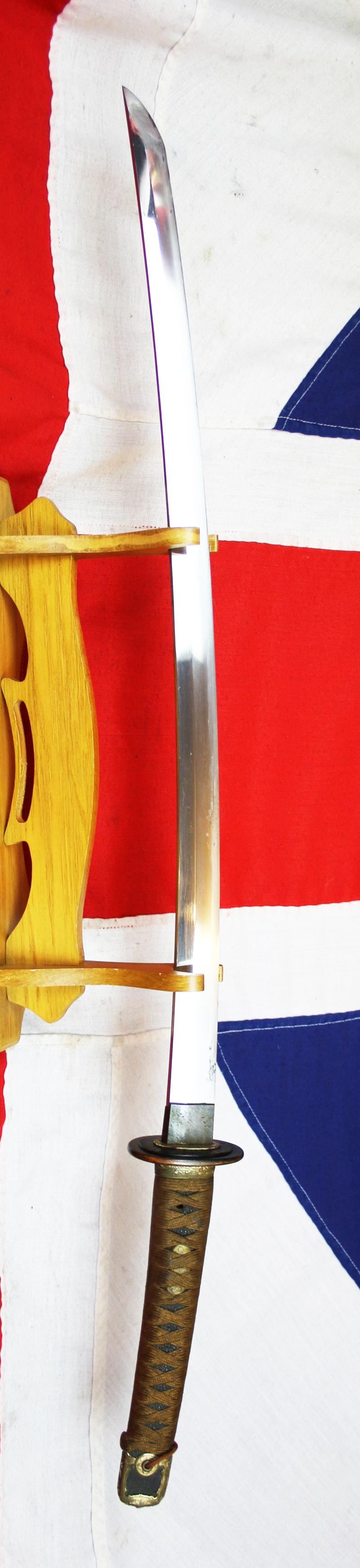


A Totally Conserved Original Japanese WW2 Kaigunto Officer's Sword By Fukuoka – “Chikugo Miike-jūnin Kawamura Yukimitsu Saku” (筑後三池住幸光作). A Pacific War Souvenir of A Former English, Japanese POW
Just returned after having a no expense spared thorough *museum grade, hand cleaning, polishing and conservation for over 60 hours. The deluxe saya was covered in polished samegawa rayskin, that had separated from its wooden base, underneath its stitched foul weather cover, but our expert spent two full days removing the foul weather cover, then removing the samegawa, then re-affixing the samegawa ray skin, using the exactly same specialist Japanese method of boiled fish glue, that was used 90 years ago, and he has done a fabulous job, that is absolutely invisible in every way.
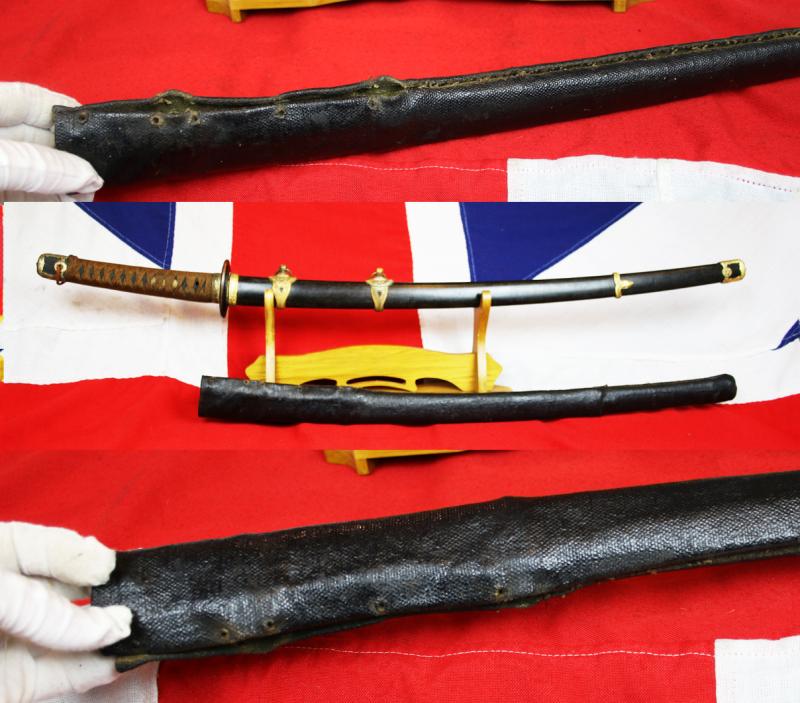
We have photographed the unstitched Japanese Naval foul weather cover, which is included with the sword, as it's important to keep with its history.
These covers are incredibly rare to find, not valuable of course, but incredibly interesting. Army examples are very common, and made from leather hide.
The black foul weather cover would be created aboard the officer's ship, from former sail canvas, that was coated in boiled bitchumen, to be brush covered in order to make it as waterproof as possible, and then tightly hand stitched along its entire length. Exactly the same way as foul weather covers and caps etc. were made at sea in Admiral Nelson's time.
Nothing on the sword was restored, repaired, replaced etc. It was painstakingly conserved only, throughout.
As England’s favourite Military Antiques & Collectables Gallery, and likely the worlds leading specialist original Japanese Samurai arms and armour dealers outside of Japan {and probably within it} we acquire collections, of all kinds, and add them to our website, every, single day.
Purchased directly from grandson of a former WW2 POW nurse, who was captured and interred in Hong Kong's 'Stanley POW Compound'. Until she was liberated in 1945.
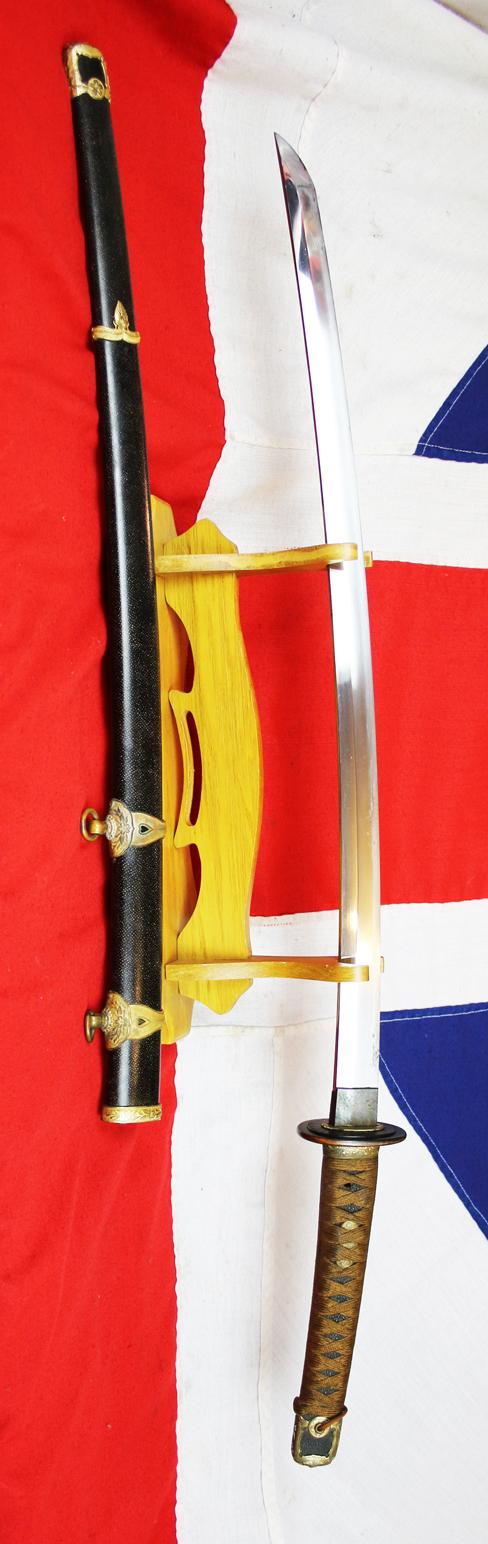
This is a very nice wartime production original deluxe Japanese Naval Officer’s Katana in the Pattern 1937 Kai-Gunto setting. A Kai-Guntō (海軍刀, naval sword) is a weapon and symbol of rank used by the Imperial Japanese Navy during the WWII Period.
It has a super blade, and Japanese Kai-Gunto naval officers swords are somewhat rare to survive, given that they usually went down with the ships with their officers, that suffered badly from the continued well deserved assaults from the allied navies, though, to a degree mostly from the US Navy, with the British Pacific Fleet from 1944, with the Australian navy. This particular example has the typical WW2 pattern fittings
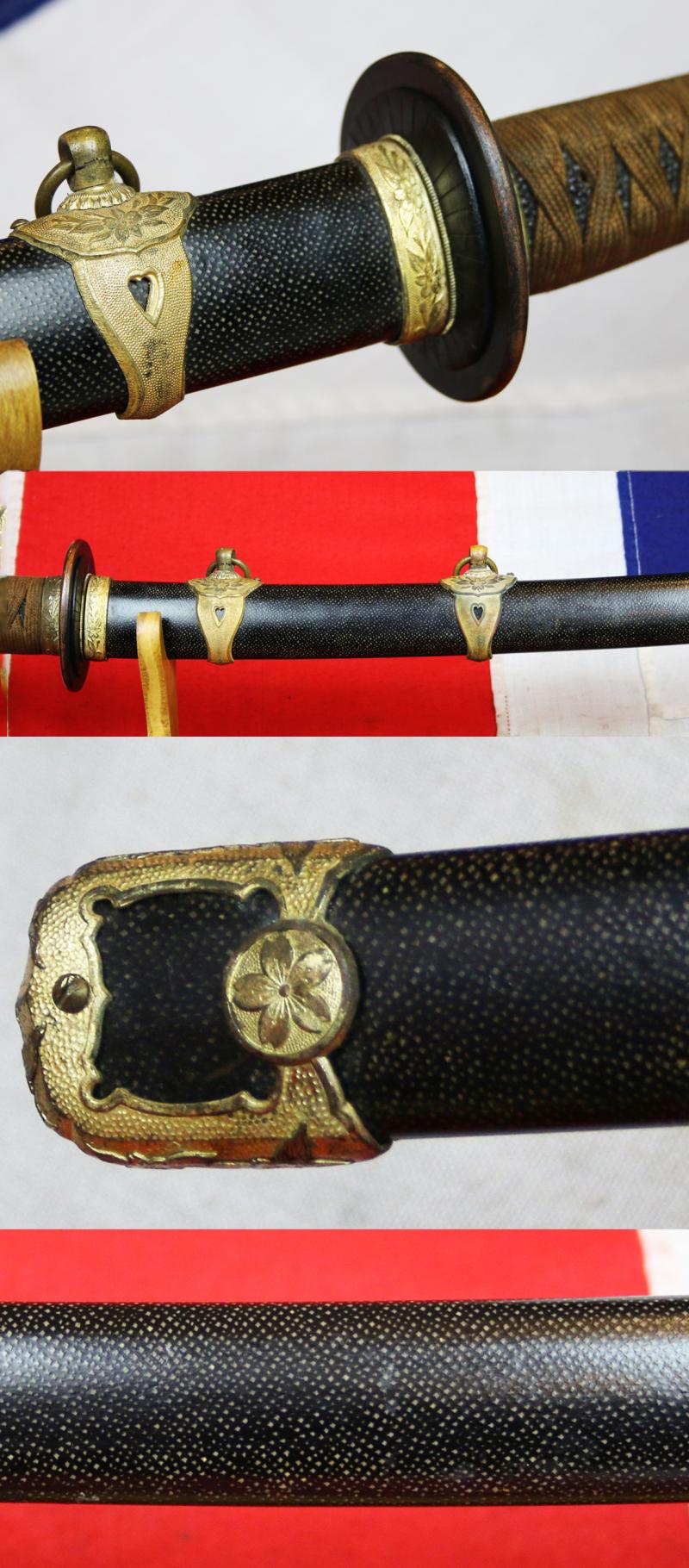
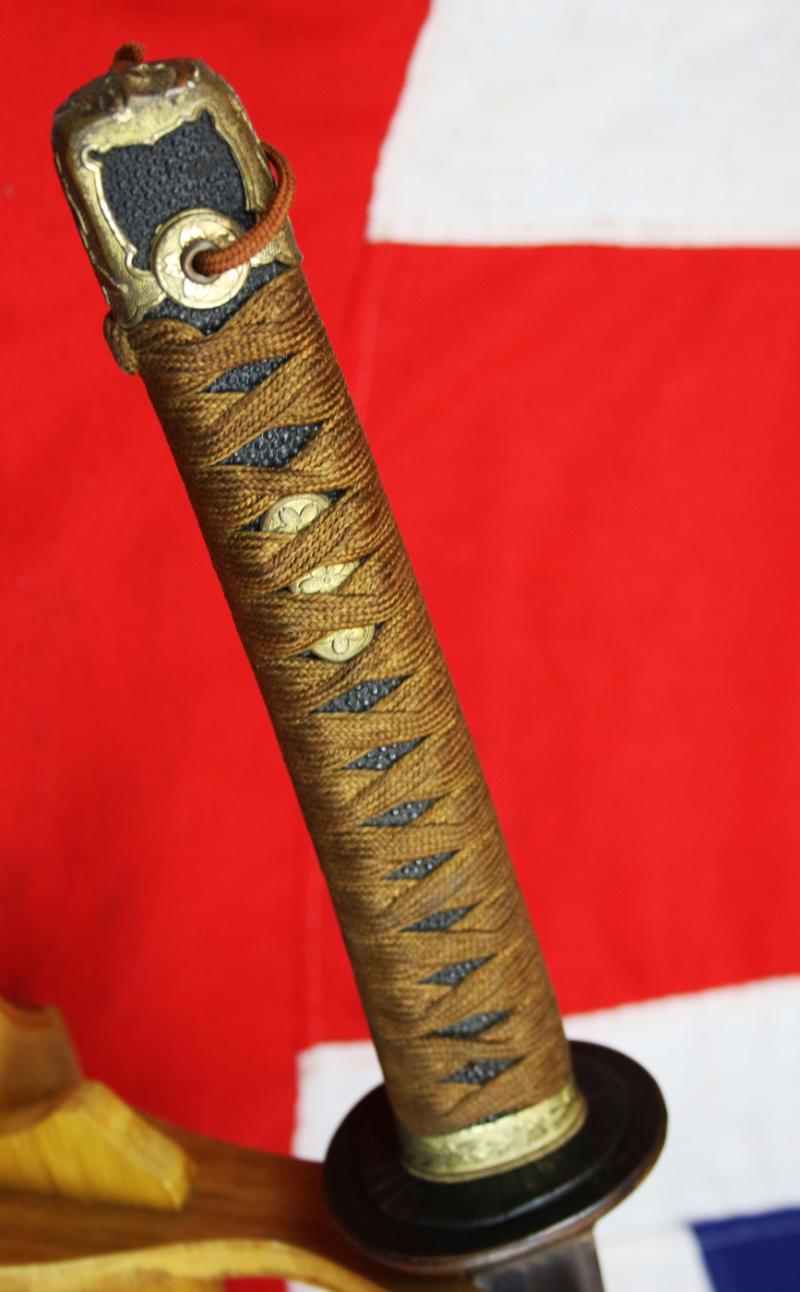
It has a typical {numbered, mounts and traditional three part naval oval tsuba {with two sunburst seppa dai}, the tsuka (handle) has two menuki (grip decorations), and kabuto-gane (pommel end cap), with the wooden securing peg still present. Good tsuka-Ito {hilt binding} over coarse, black, samegawa, with traditional Showa cherry-blossom decorative collar.
The condition of the blade, is in superb order, with just a few small marks left to show its age. Now it has been finished and returned from the workshop, the whole sword now looks just how it once was in 1939 before the scabbard was stitched into its foul weather sea cover. Overall it is now entirely in excellent order throughout.
Fortunately, these beautifully crafted swords were used on board ship, so the army version was far more likely to bear considerable wear, through considerable marching and combat through jungle warfare etc
Cherry blossom motifs appear on many of the koshirae {mounts}.
The scabbard is covered in deluxe naval service samegawa, and has gilt brass fittings, now with good gilding and all of the fittings are crisp and very good
The two original scabbard hanging mounts are present, and the condition is excellent plus.
Really it is once more a super example of an original, Imperial Japanese Navy Officer’s Kai-Gunto, now in pristine condition with clear signature.
It has been over one thousand years ago that the art of making swords appeared in Japan. The swordsmiths of the time may not have known it but they were creating a legendary sword. The Samurai sword has seen combat in many battlefields. From the early days of the Samurai warrior to the fierce battles in the South Pacific during WWII.
From the earliest days hand-made traditional the Samurai sword was unique because it was forged using the finest skills known to man. A tremendous amount of work was dedicated to creating these pieces. They were an instrument of war as much as a beautiful artifact to adorn any decor.
The Samurai sword has grown to be one of the most highly desired military antiques of all time.
The 1937 Pattern Japanese Naval Sword, known as the Kai-Guntō (海軍刀, Sea Military Sword), was formally enacted in October 1937 as the official sidearm for Imperial Japanese Navy officers. These mounts were designed to be more practical for combat than previous, more delicate dress swords, yet they retained traditional elements and were often fitted with high-quality stainless steel blades.
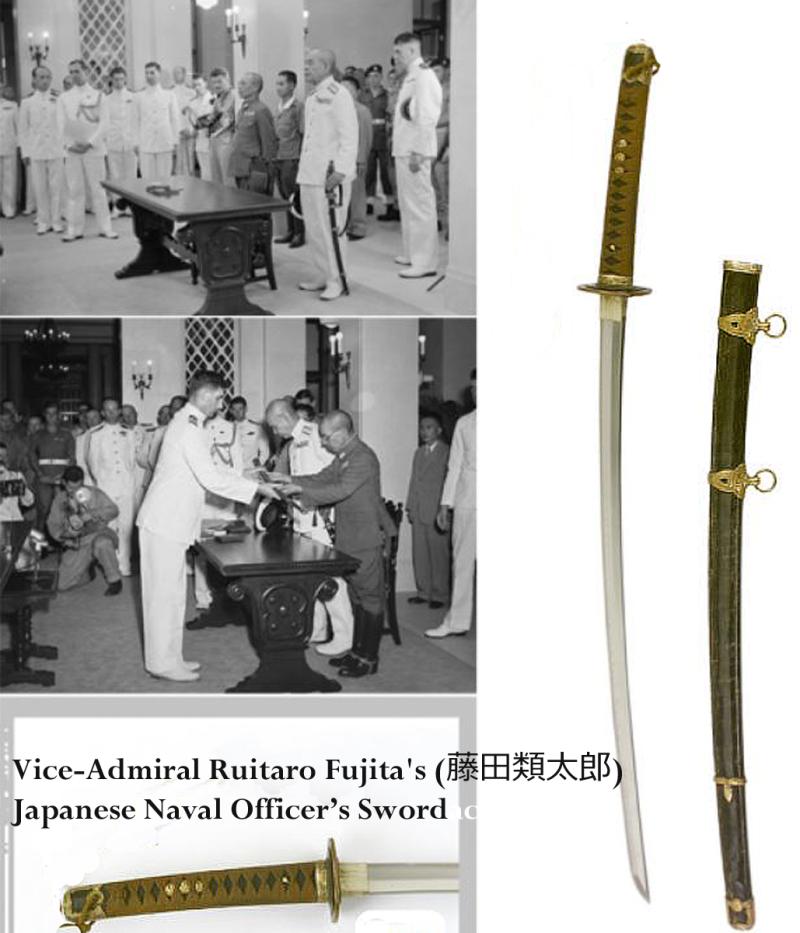
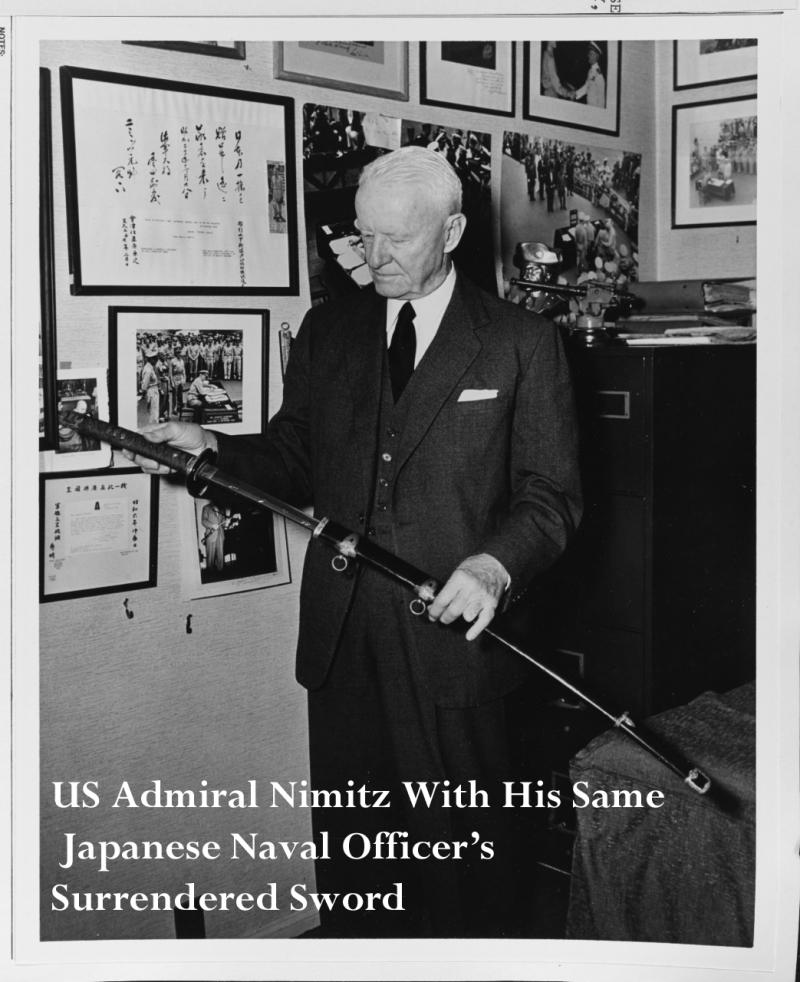
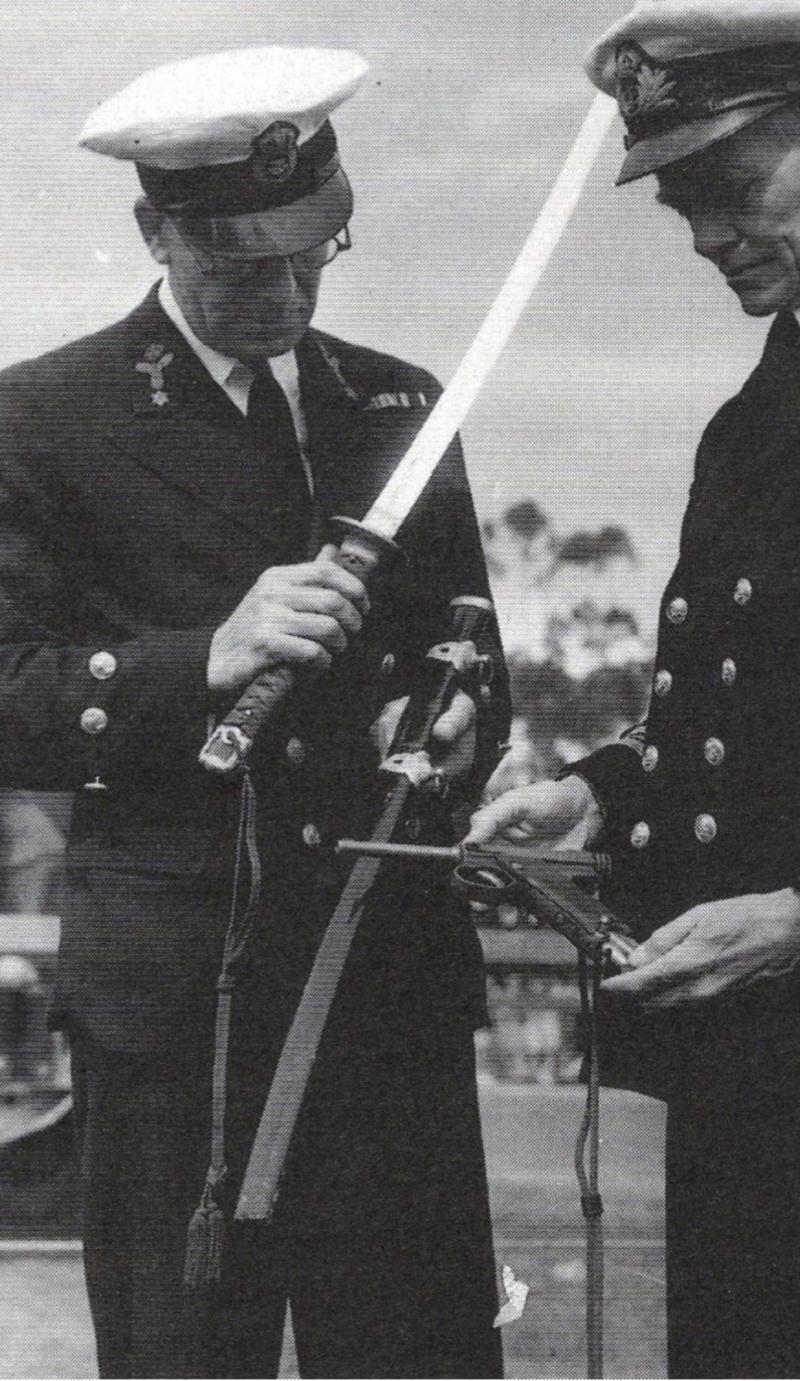
Photo of a Japanese Naval Officer’s sword type examined by commonwealth naval officers after capture. Plus another showing Admiral Nimitz admiring his identical sword, and Admiral
*Museum grade conservation, is a premise where extra care made in every way possible, so as not to create an 'as new' finish, it is important to keep and maintain all natural aging and patina.
The British Pacific Fleet (BPF) was a Royal Navy formation that saw action against Japan during the Second World War. It was formed from aircraft carriers, other surface warships, submarines and supply vessels of the RN and British Commonwealth navies in November 1944.
After formation in Ceylon, the BPF began with operations against Japanese resources in Sumatra before moving to Australia where it made its headquarters at Sydney with a forward base at Manus Island off Papua New Guinea. The fleet supported the invasion of Okinawa in March 1945 by neutralising the Sakishima Islands. Though subjected to heavy attacks by Japanese aircraft, their well-armoured carriers and modern fighter aircraft gave effective protection. Submarines attached to the fleet sank Japanese shipping, and in July 1945 the fleet joined in the bombardment of the Japanese home islands. By the time Japan surrendered in August 1945, the fleet included four battleships, six fleet carriers, fifteen smaller carriers and over 750 aircraft.
Now priced after the 60 hour conservation has been assessed
Code: 26140
2650.00 GBP