
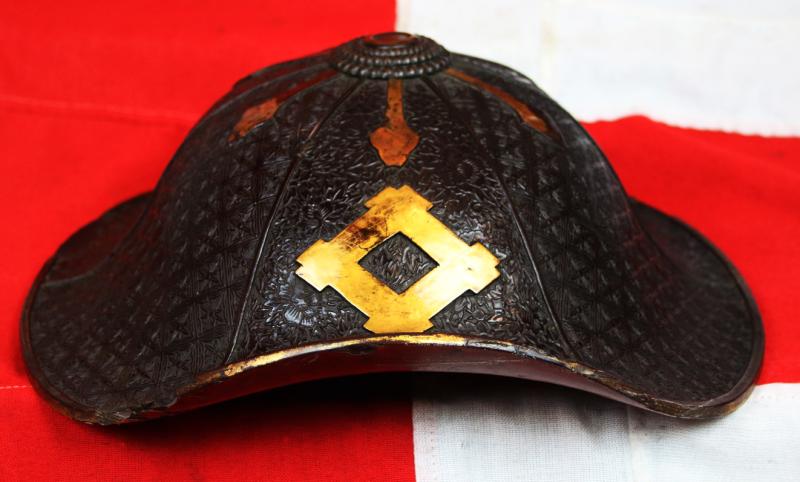
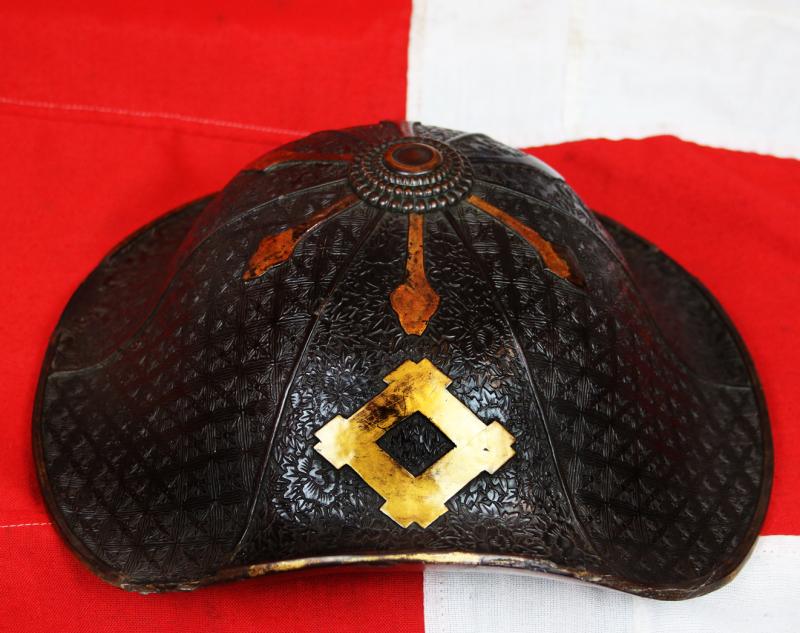
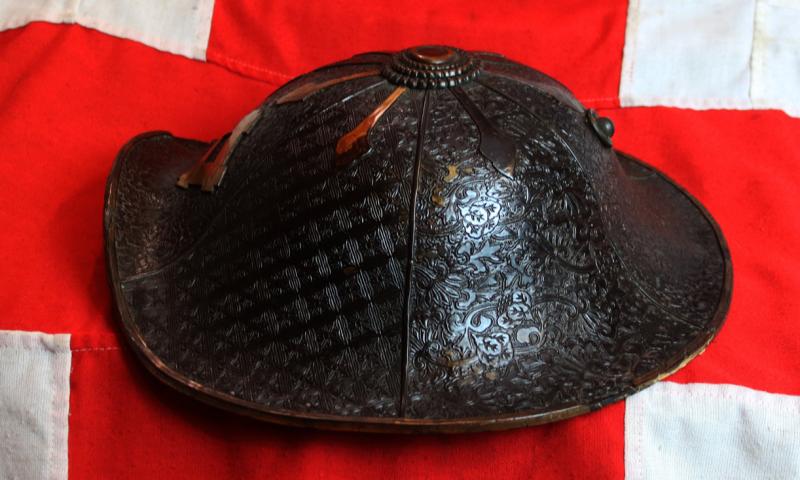
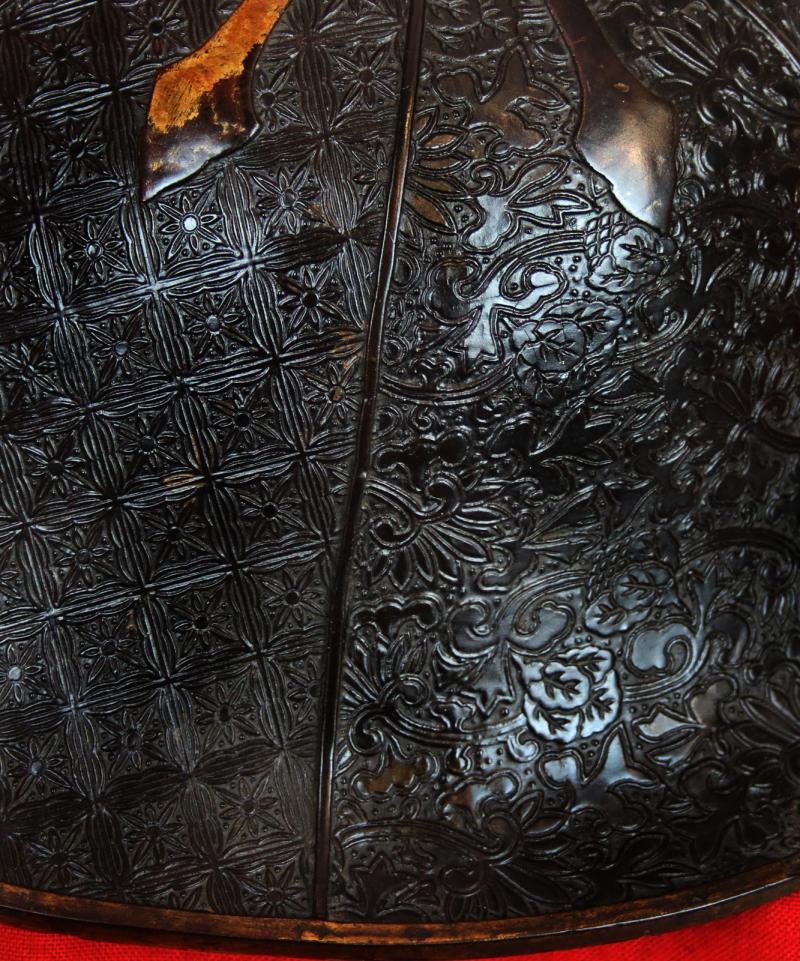
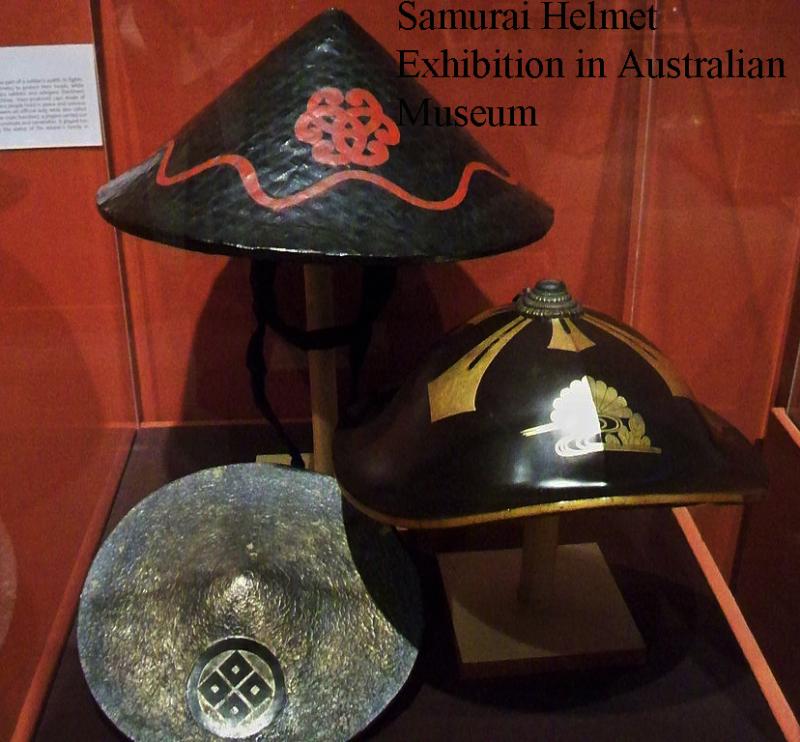
A Beautiful Edo Period Bato Jingasa Samurai Horserider's War Hat With Beautiful Four Flower Panels and Two Geometric Takebori Relief Decor In Six Distinct Panels Within the Urushi Lacquer With Clan Mon
Brown urushi lacquer with superb well-head mon, with six ken and red lacquer interior
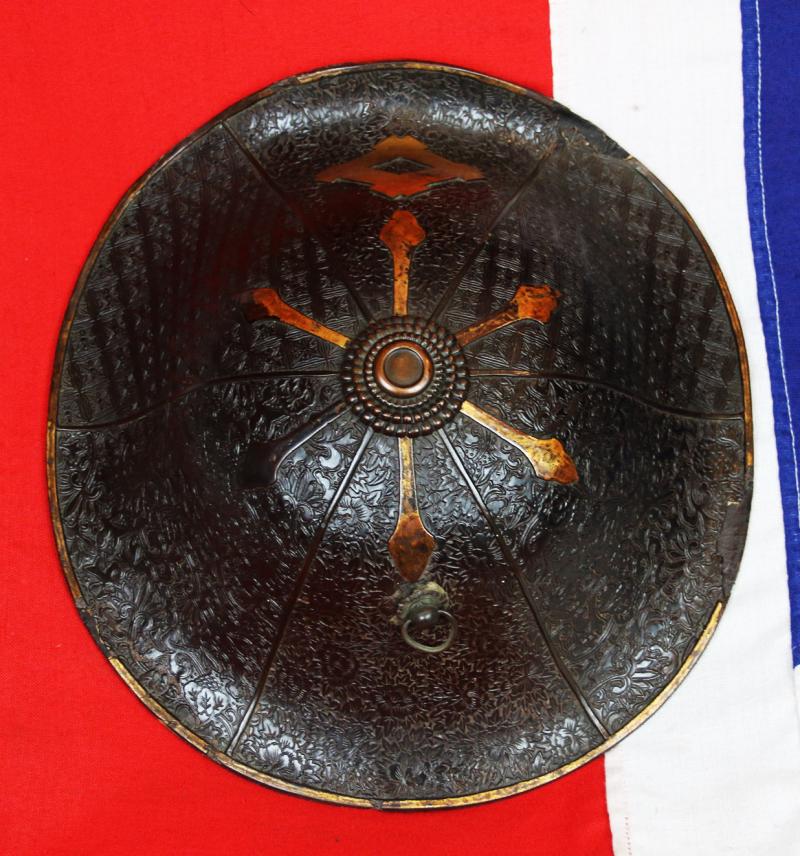
Four ring symbolic tahen top mount. The samurai believed that through the tehen the spirit of Hachiman, the god of war, could pass into them. For this reason this hole on the kabuto is sometime sometimes called hachiman-za, literally "the seat of Hachiman". In this jingasa the tahen aperture is covered with a removable cap.
From The Collection of Likely The World's Greatest Authority and Author On Japanese Polearms & Their Use
In the armour of the Edo period, the tehen was richly adorned with multi-layered decorations, sometimes made of various metals. There are some schools of armorers where the tehen was so well finished and precise that it was covered only with a small iron rim, and sometimes not even with that. In the latter case it is possible to appreciate the value of the kabuto and admire the mastery of those who made it. At the rear a ring is fixed at the back of the helmet, designed to carry a small identification flag (Kasa jirushi no kan).
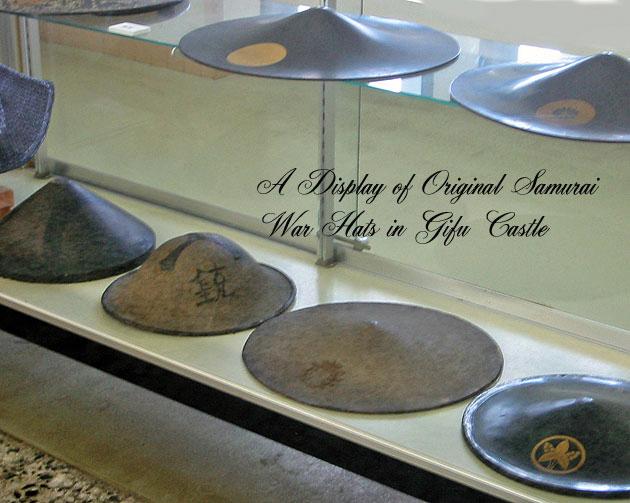
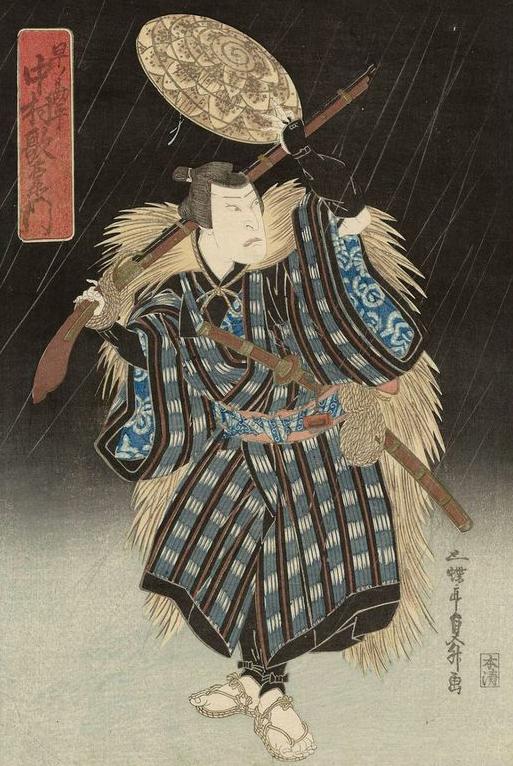
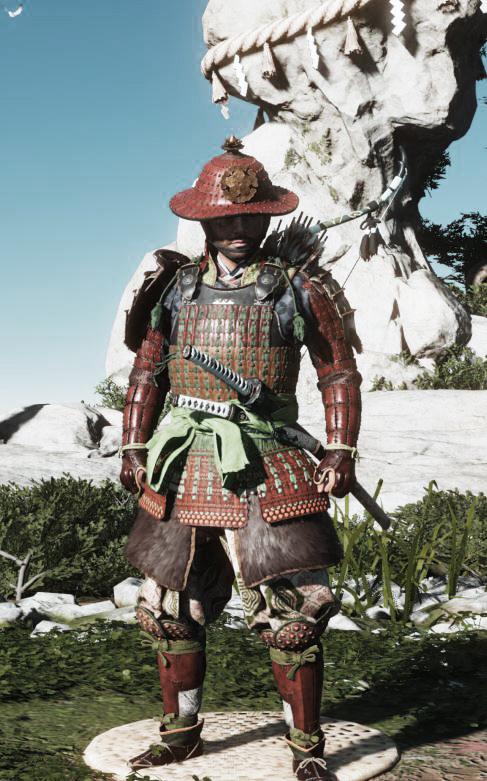
Apart from protection (the main function), a jingasa carried out the functions essential to caps: sunshade and rainshelter. It played too the role of a marker indicating the status of the wearer’s family in society. They were used as a container or weapon too. Jingasa developed both in shape and decoration during the Edo era (1603-1867) and were a symbol of samurai culture. Some Jingasa was a conical helmet most commonly worn with Ashigaru Armour, others were dished and round and a few had an upturned brim like this example so the firing of arrows in combat would be unhindered by a wide brim at the front.
It was typically made of hardened lacquered leather, or wood or a pressed composition somewhat like papier mache but also sometimes with iron. The jingasa could also commonly be marked with the mon of the lord or clan to help identify the warrior's side on a battlefield.
Cherished for its infinite versatility, urushi lacquer is a distinctive art form that has spread across all facets of Japanese culture from the tea ceremony to the saya scabbards of samurai swords
Japanese artists created their own style and perfected the art of decorated lacquerware during the 8th century. Japanese lacquer skills reached its peak as early as the twelfth century, at the end of the Heian period (794-1185). This skill was passed on from father to son and from master to apprentice.
The varnish used in Japanese lacquer is made from the sap of the urushi tree, also known as the lacquer tree or the Japanese varnish tree (Rhus vernacifera), which mainly grows in Japan and China, as well as Southeast Asia. Japanese lacquer, 漆 urushi, is made from the sap of the lacquer tree. The tree must be tapped carefully, as in its raw form the liquid is poisonous to the touch, and even breathing in the fumes can be dangerous. But people in Japan have been working with this material for many millennia, so there has been time to refine the technique!
Overall in very nice condition for age with small lacquer wear marks.
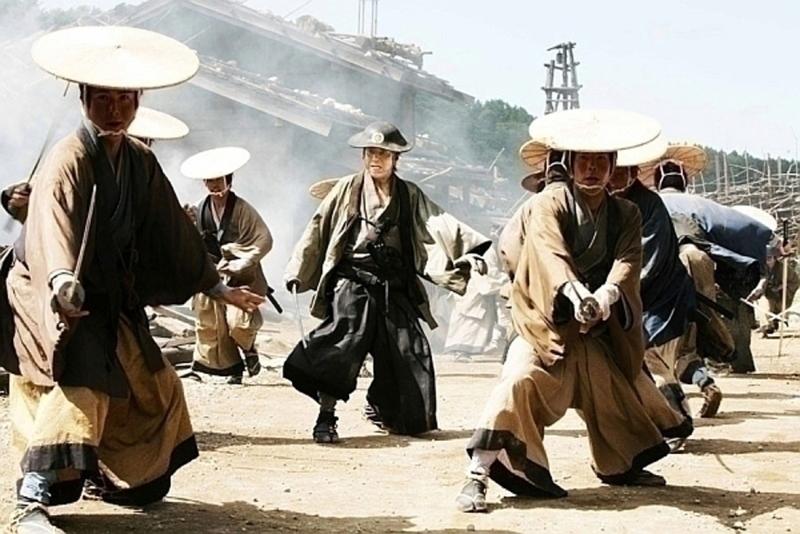
Photo in the gallery from renowned Japanese director Takashi Miike 's classic, 13 Assassins (Jûsan-nin no shikaku). Where a samurai lord, surrounded by his bodyguard of samurai under attack, wears his same jingasa.
Code: 26208