
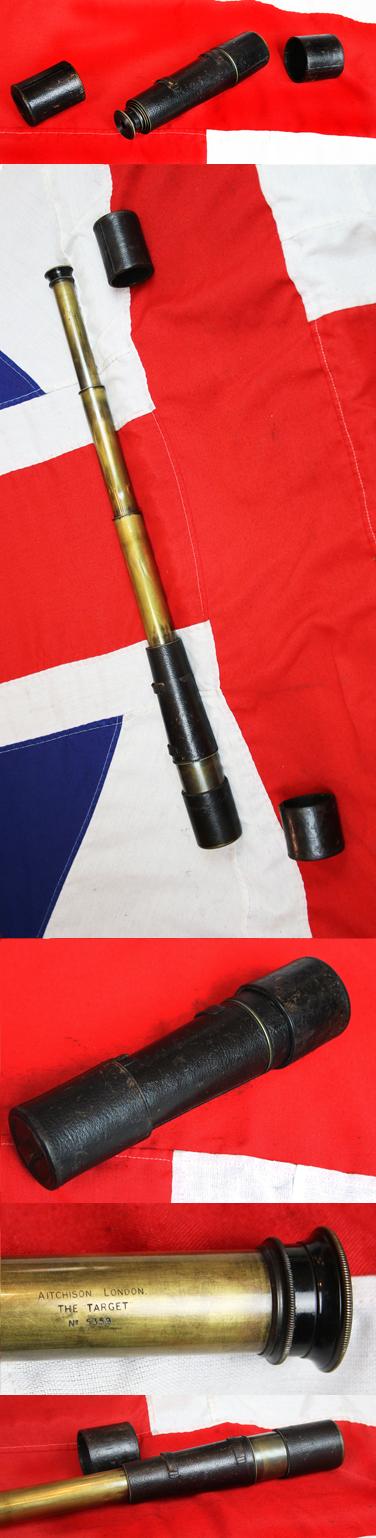
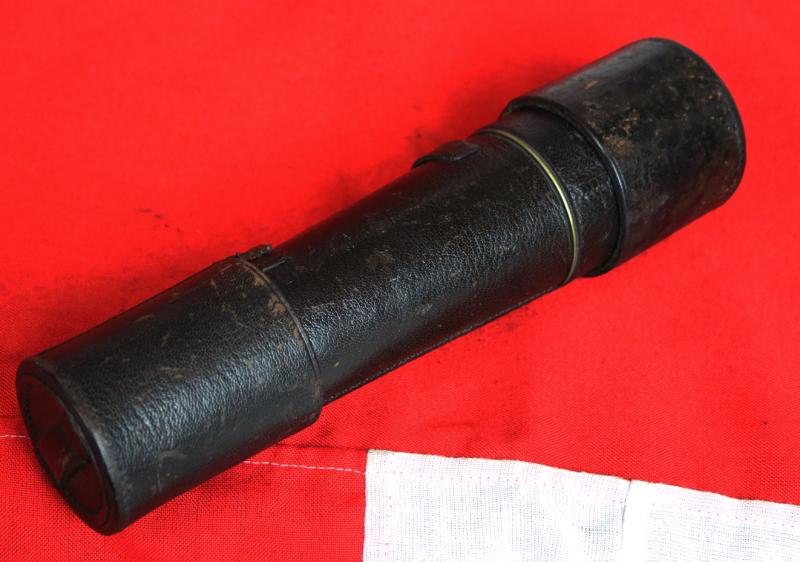
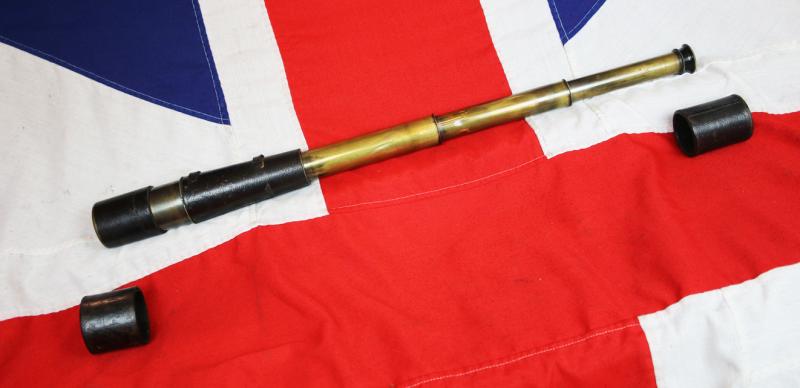
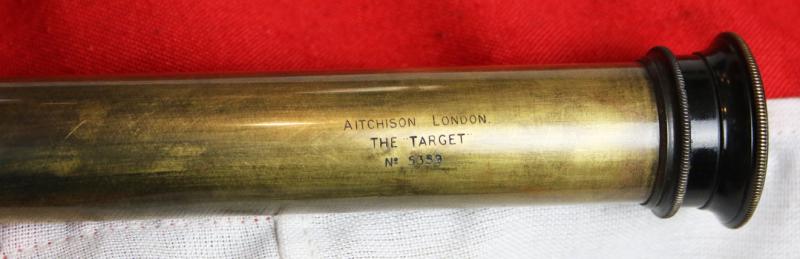
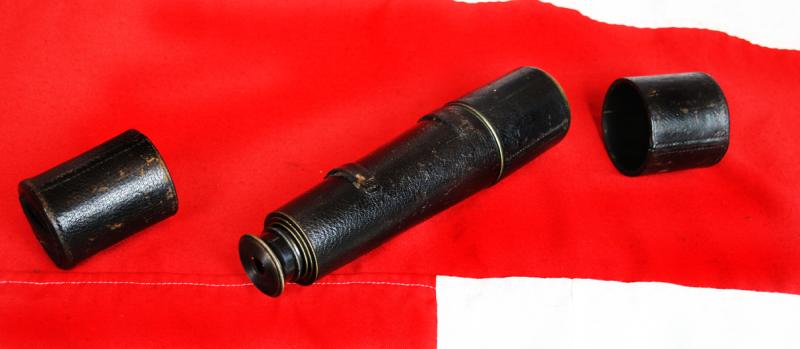
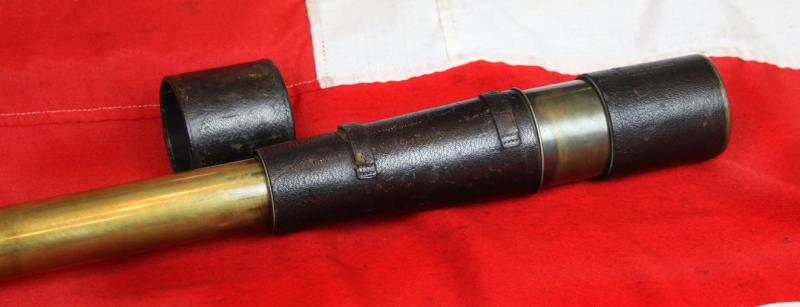
Aitchison of London, Late Antique 'Three Draw' Military Sniper Spotter's Telescope. In Great Untouched Condition & Superb Optics. With Boer War Pattern, Regulation, Rifle Brigade Black Leather Protection Covering, With Fore & Aft Covers
An Aitchison military or marine officers telescope, an antique, vintage brass telescope manufactured by the British optical firm Aitchison & Co.
A beautifully crafted instrument hand made with the highest skill and quality, from the days when British instruments were the acme standard by which all others were judged. In fact it is safe to say just about everything marked ‘Made in Britain’ was considered the world over as the apex of quality and manufacturing, from railways to motor cars, from shotguns to gentleman’s suits. If a bridge between two mountains was made of Sheffield Steel, everyone was confident that the mountains would collapse long before the bridge did.
The draw actions are beautifully tight and snug, with absolutely no wear and element of looseness, which can often be the case.
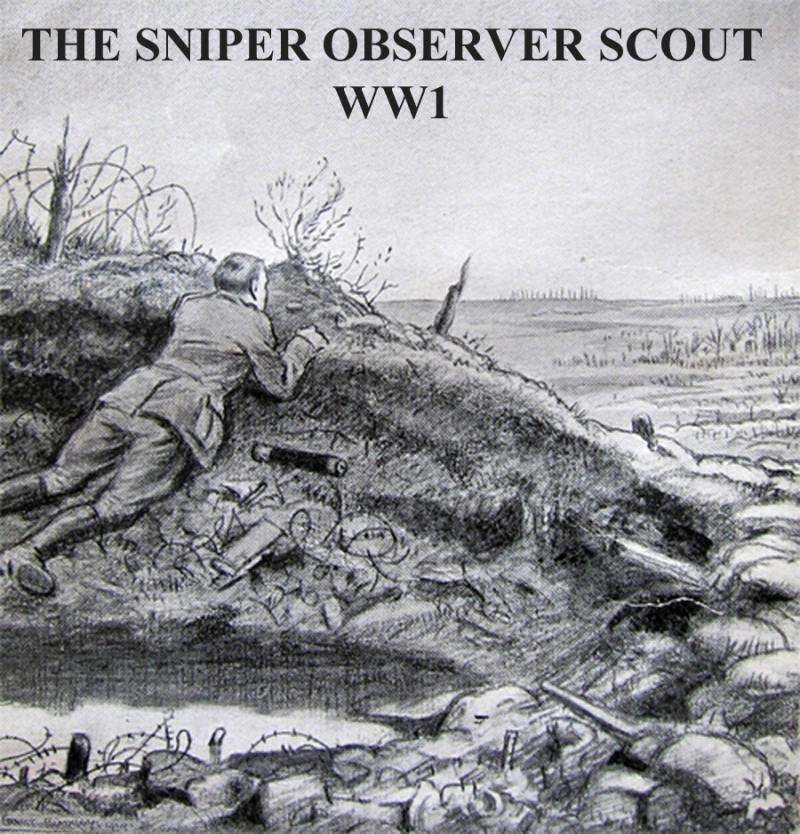
Excellent vision with incredible clarity and magnificent magnification. Also perfect for service at sea, to spot an impending submarine waiting to pounce upon a British warship, or as was this beauty, upon the plains of South Africa such as at the Defence of Ladysmith, as this was used, and later in the trenches of Western Europe, such as at Ypres or The Somme, by a British sniper’s ‘spotter’.
The earliest true British snipers originated during the Second Boer War (1899–1902) with the Lovat Scouts, a specialized Scottish Highland regiment. Recognizing the Boers' deadly marksmanship, the British formed this unit of expert deerstalkers. They were the first military unit to utilize the ghillie suit for camouflage.
While individual sharpshooters existed in the British Army as early as the Napoleonic Wars (such as Rifleman Thomas Plunket in 1809), organized sniping as a formal military doctrine was developed much later.The First Scouts (1900): Formed by Simon Fraser, 14th Lord Lovat, the Lovat Scouts utilized their civilian stalking skills, high-powered telescopes, such as this one, and advanced fieldcraft to neutralize enemy positions.
The Lovat Scouts formally became the British Army’s first official sniper detachments.The School of Sniping (1916): British Expeditionary Force (BEF) trenches initially lacked proper counters to German snipers. Major Hesketh Hesketh-Prichard revolutionized British tactics by founding the Scouting, Observation, and Sniping (SOS) schools in France and Belgium. He trained soldiers in counter-sniping and the use of telescopic sights
Today, it would be perfect to espy a magnificent eagle in the Highlands of Scotland. Whatever one’s need’s this may be just perfect, in fact ‘spot-on’, just as it has been for well over 100 years.
Founded in London in 1889, the company merged with Dollond in 1927 to form Dollond & Aitchison.
An extract from
The Sniper-observer Scout
Sniping in France by Major H. Hesketh-Prichard
., K.C.M.G., etc.
"In the early days of 1915, in command of the 2nd Division, I well remember the ever-increasing activity of the German sniper and the annoyance of our officers and men in the trenches. I can recall the acquisition by the Guards' Brigade, then in the Brickfields of Cuinchy with Lord Cavan as Brigadier, of two rifles fitted with telescopic sights and the good use made of them. It was the experience of 1915 that impressed upon us the necessity of fighting for superiority in all branches of trench warfare, amongst .which sniping held an important position. It was therefore a great satisfaction to me upon my arrival from the battlefields of the Somme in the autumn of 1916 to find Major Hesketh-Prichard's School firmly established in the First Army area, thanks in a great measure to the support and encouragement of Lieut.-General Sir Richard Haking, the Commander of the Eleventh Corps.
I may be permitted to add my testimony that in each phase of the war, not only in the trenches, but in the field, we found the value of the trained sniper, observer and scout.
It is simply an account of some memories of sniping, observation and scouting in France and Flanders, and its purpose is to preserve, as far as may be, in some form the work and training of a class of officers and men whose duties became ever more important as the war progressed. It is in the hope that the true value of sniping and scouting will continue to be recognized in the future training of our armies, as it certainly was recognized in the later years of the war, that this book is written.
The idea of organized sniping was not a new one to me when I went out to France in May, 1915. I had been there before, in the previous March, and had seen the immense advantages which had accrued to the Germans through their superiority in trench warfare sniping.
It is difficult now to give the exact figures of our losses. Suffice it to say that in early 1915 we lost eighteen men in a single battalion in a single day to enemy snipers. Now if each battalion in the line killed by sniping a single German in the day, the numbers would mount up. If any one cares to do a mathematical sum, and to work out the number of battalions we had in the line, they will be surprised at the figures, and when they multiply these figures by thirty and look at the month's losses, they will find that in a war of attrition the sniper on this count alone justifies his existence and wipes out large numbers of the enemy.
But it is not only by the casualties that one can judge the value of sniping. If your trench is dominated by enemy snipers, life in it is really a very hard thing, and moral must inevitably suffer. In many parts of the line all through France and Belgium the enemy, who were organized at a much earlier period than we, certainly did dominate us. Each regiment and most soldiers who have been to France will remember some particular spot where they will say the German sniping was more deadly than elsewhere, but the truth of the matter is that in the middle of 1915 we were undergoing almost everywhere a severe gruelling, to say the least of it.
When I went out in May, 1915, I took with me several telescopic-sighted rifles, which were either my own property or borrowed from friends. I was at the time attached to the Intelligence Department as an officer in charge of war-correspondents, and my work gave me ample opportunity to visit all parts of the line. Whenever I went to the line I took with me, if it was possible, a telescopic-sighted rifle, and I found that both brigades and battalions were soon applying to me to lend these rifles. In this way opportunities arose of visiting the line and studying the sniping problem on the spot."
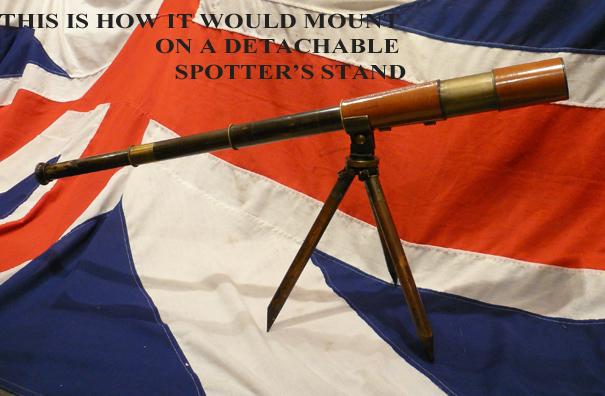
Photo 8 in the gallery is of how it could and would be mounted in the trenches etc. upon a separate, detachable, spotters tripod stand. {Photo not of this scope, but another similar from WW1}
Code: 26228