
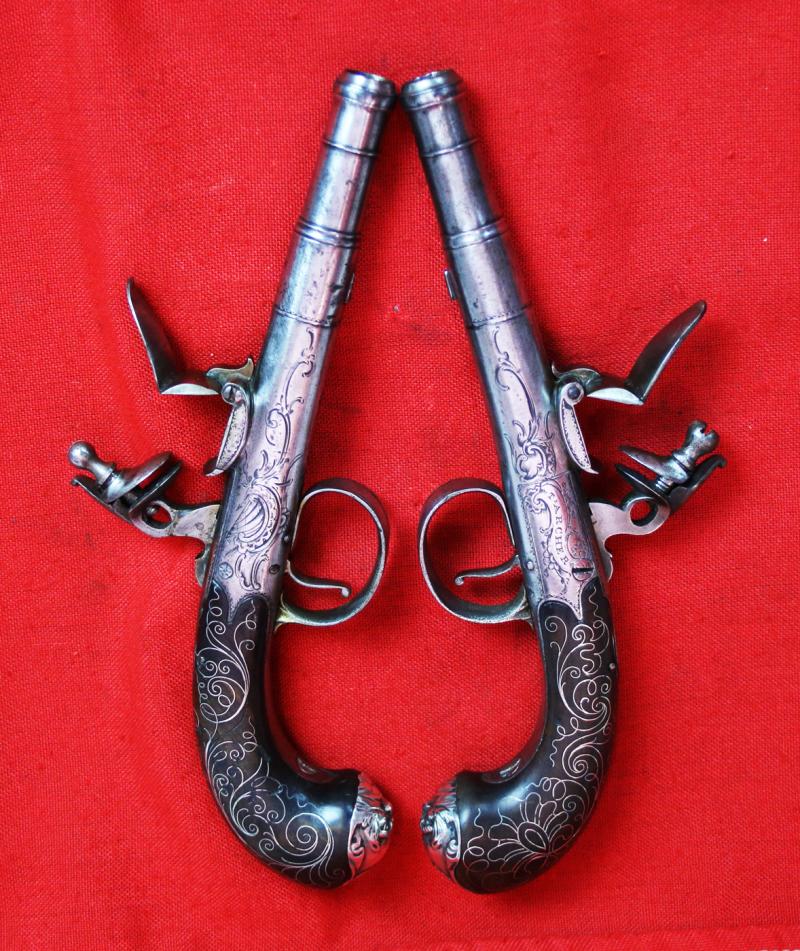
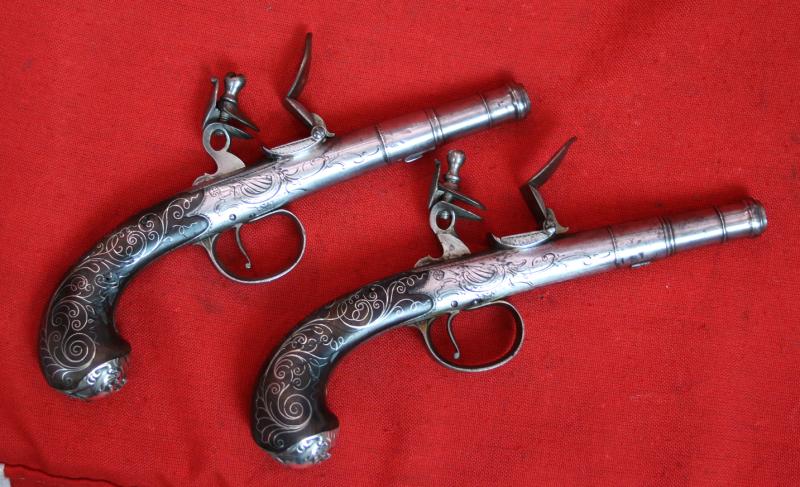
Absolutely Beautiful & Captivating Pair Of American Revolution Period 18th Century 'Queen Anne' Cannon Barrel Pistols with Silver Inlays & Solid Silver Grotesque Mask Butt Caps. Near Identical To Another Recovered From a Shipwreck off The Florida Coast
A wondrous pair of breech loading pistols of exquisite quality and extravagance, around 250 years old. In fabulous condition for age.
A single pistol, near identical, also with likely Charles Freeth silver mounts and inlays, is in the Metropolitan Museum in New York, Object Number: 37.189.4.
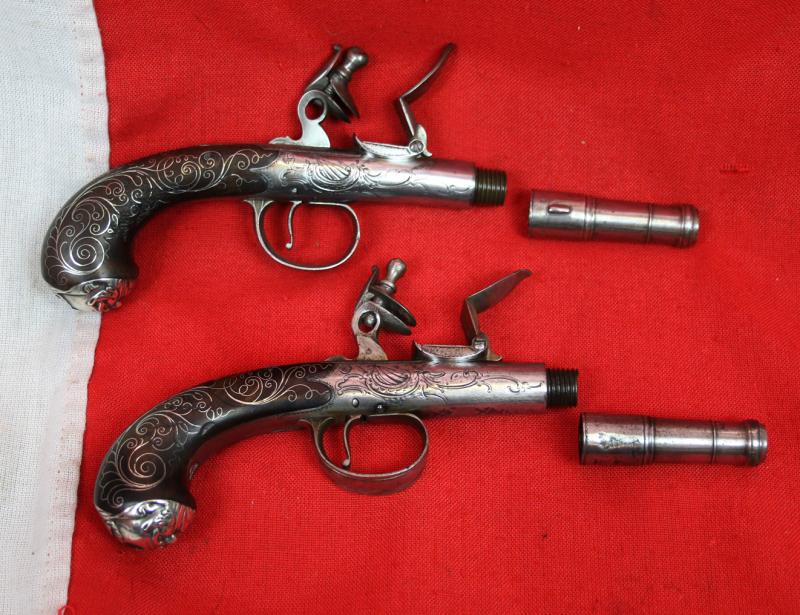
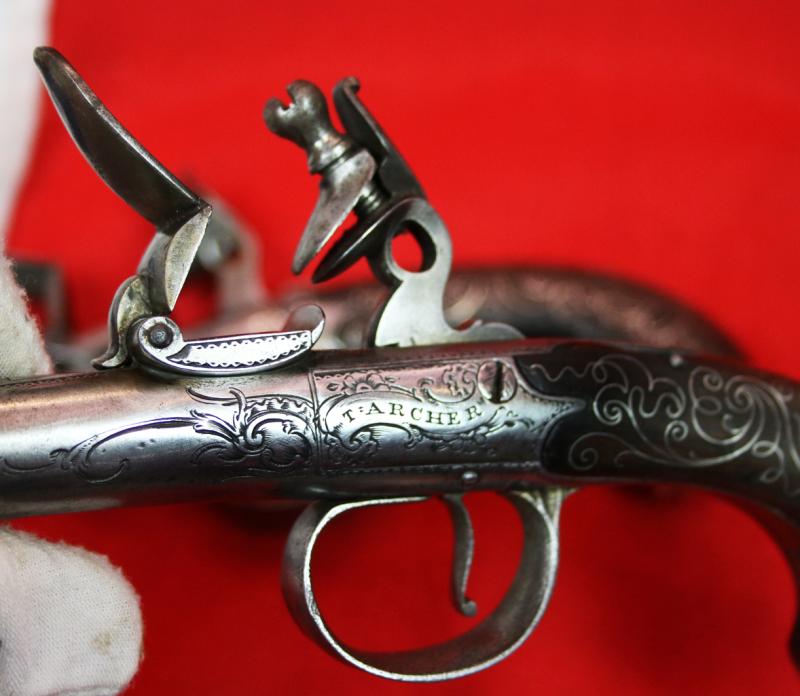
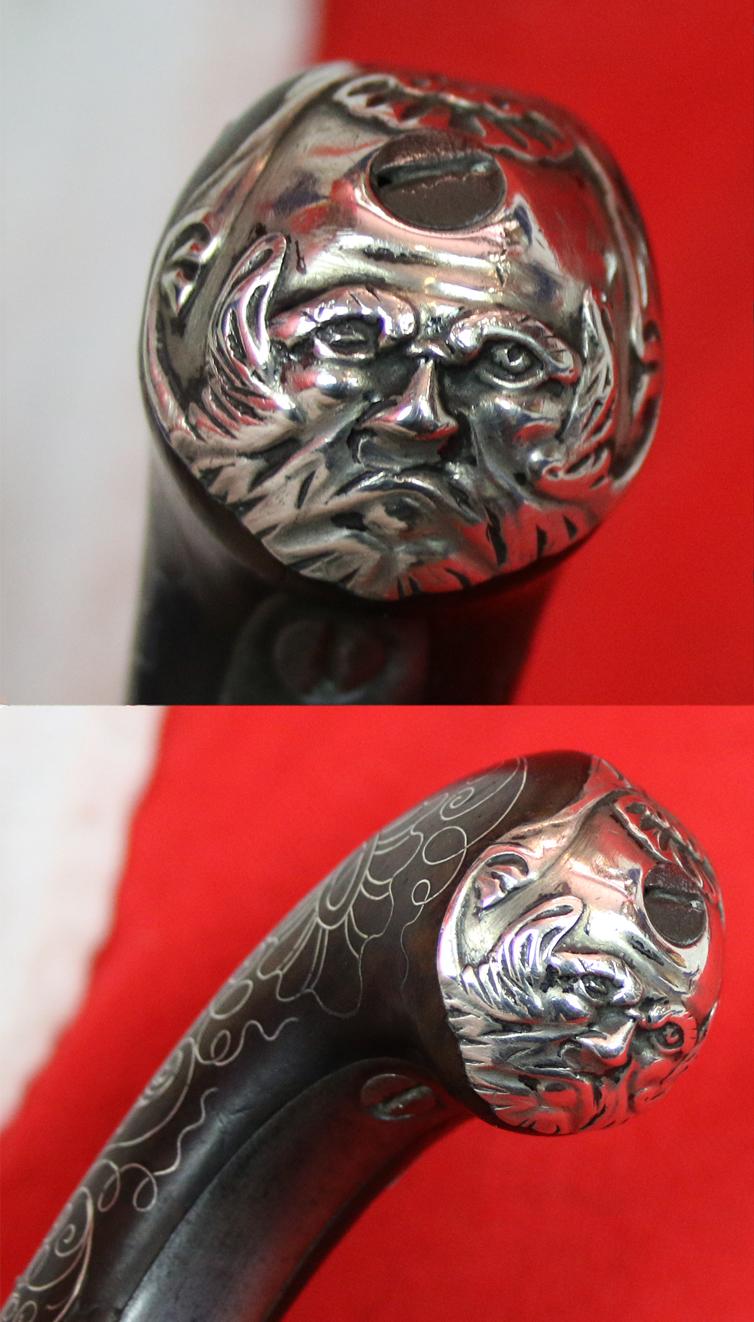
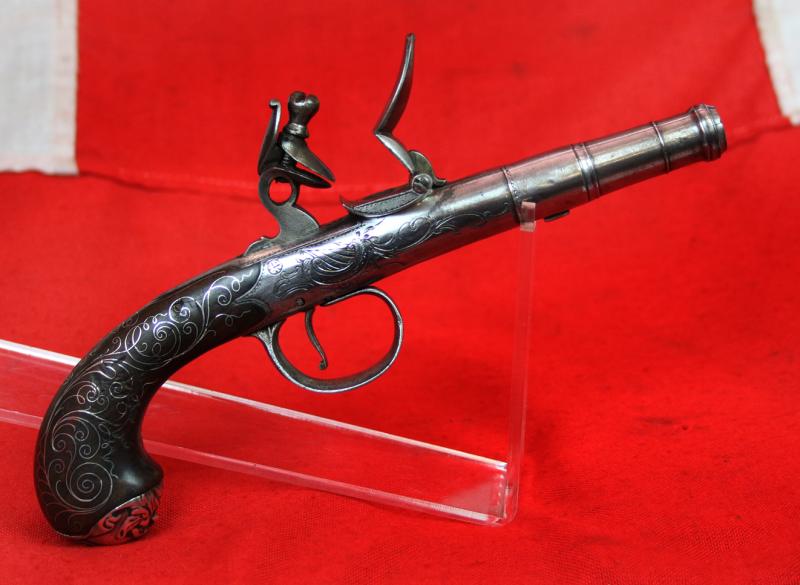
Superb silver grotesque mask butt caps and elaborate fine line silver inlays, possibly by Charles Freeth, {his signature grotesque face form butt-caps are featured stunningly depicting scrolls and shells. With steel cannon barrels, boxlock actions, sides, finely engraved with elaborate rococco scrolls, with a safety mechanisms enabled by sliding the trigger guards forward once the pistol is cocked. Excellent tight and crisp actions.
Maker marked by master gunsmith Mr Thomas Archer of Birmingham, circa 1776. Known as a 'Queen Anne' flintlocks these are both stunning examples in wonderful condition. Very unusual form of demon face grotesque butt masks in silver. Examples of his pistols are in the British Museum.
The ‘Queen Anne’ style pistol is distinctive in that it doesn't require a ramrod, as they are the earliest form of breech loading pistols. The barrel of the pistol unscrews and allows it to be loaded from the rear, and near the touch hole, at the breech of the barrel. These pistols were originally made in flintlock.
The Queen Annestyle pistols were very popular for the elite and highest status of society, and were made in a variety of calibres, usually about 38 to 50 bore. Boot pistols, Holster pistols, pocket pistols and Sea Service pistols may be made in the 'Queen Anne' style. This type is known as a Queen Anne pistol because it was during her reign that it became popular {although produced for some decades after the reign of Queen Anne}.
The finest examples were made with silver fittings and or inlays such as this.
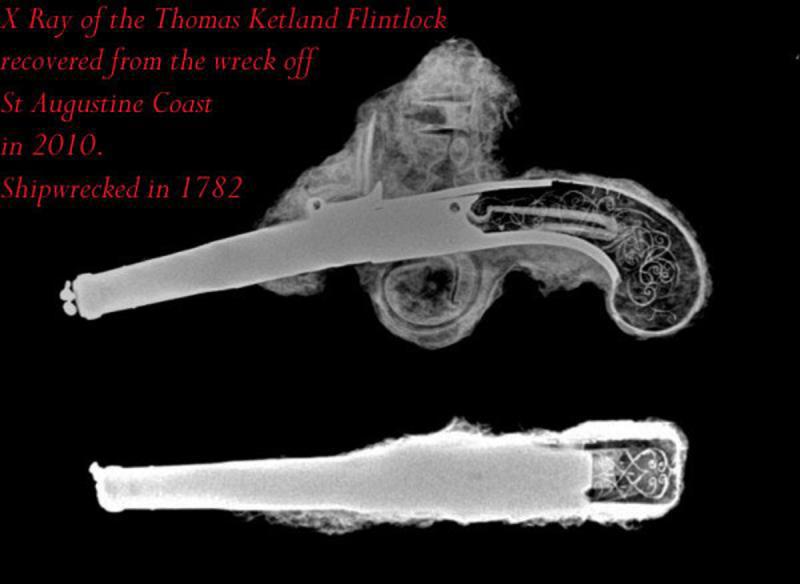
These pistols are extremely similar, if not identical to a single pistol found in 2010, within a shipwreck off St Augustine USA.
Our pistols must have been made at the same time as the flintlock found in the Revolutionary War ship wreck. A ship that was lost in a storm on New Year's Eve 1782 off the coast of St Augustine, Florida. That extremely similar pistol was by T.Ketland, and now resides on display in the St Augustine Lighthouse and Maritime Museum.
The story of an American Revolutionary War shipwreck, excavated by Museum archaeologists and students from 2009-2014, and the recovered artefacts from the 1782 British Loyalist wreck found just off St. Augustine’s coast. It was determined that the wreck carried loyalists or Tories evacuating Charles Town, South Carolina and fleeing to British, East Florida which was still loyal to the crown. As many as 16 ships from Charleston (the name of Charles Town today) wrecked on the St. Augustine sandbar on New Year's Eve, December 1782.
As British loyalists ran in fear of the victorious Americans, many lost everything they had to the sea.
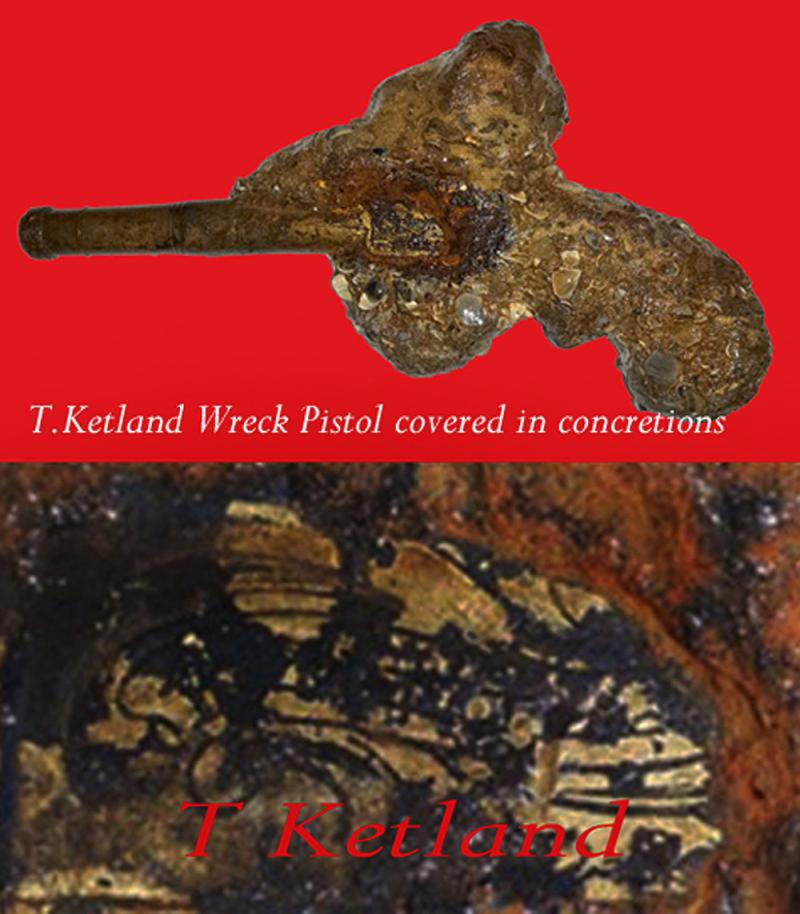
Among the rare artefacts discovered, covered in concretions, was an identical to our silver scroll inlaid gentleman's pistol, made by Thomas Ketland in London, England.
In addition, an archaeologist found the ship's bell, which was devoid of any markings. The lack of the Royal Navy motifs, such as the broad arrow, provides a clue that this ship may have been privately owned. Also, archaeologists recovered a very early carronade ( small, deck-mounted cannon) made in 1780 in the Carron Ironworks in Scotland.
We include in the gallery photos of the recovered identical pistol, covered in concretions, and another picture of an X Ray, clearly showing that the recovered pistol is so much the same as ours, even down to the silver scroll engraving that was revealed in the x ray on the pistols
Each pistol is approx 8.5 inches long
The commander in chief of British forces General Gage's Impact on the War efforts to clamp down on the colonists' ability to arm themselves were a primary catalyst for the conflict. The effort to confiscate weapons caches at Concord escalated into the famous Battles of Lexington and Concord in April 1775, formally igniting the American Revolution.
General Gage, a great friend of George Washington from the previous Anglo-French-Indian War, was supposedly also a possessor of a pair of the same form of ‘Queen Anne’ pistols. His ancestral home and estate, Firle Place, is local neighbour of the Lanes Armoury’s partners farm near Lewes {several of our family’s dogs were bred and raised on the Gage estate}. He was a fine, brave and noble commander in the Anglo French War. Gage commanded the vanguard on Braddock’s expedition against the French in the Ohio Valley. On July 9, 1755, the force blindly marched into a forest ambush at Fort Duquesne, was nearly annihilated, and Braddock was killed. True to form, Gage conducted himself with courage in combat. Wounded himself, he improvised a rear guard that allowed the escape of George Washington,.
However he was not a general of great success in the build up to the Revolutionary War, and at Bunker Hill, in 1775, it was his ultimate pyrrhic victory. And, he was of even less success, due to political circumstances, as a governor of Massachusetts, it was noted at the time, even by his enemies, he was a good and wise man surrounded by his difficulties, thus he was ultimately replaced by General Howe. If he had stayed, and been rewarded by his pleading for adequate re enforcements and support for his more conciliatory ideas from England, things may have turned out very differently in the Americas, for he was known for his tact and reasonableness in negotiations, but he was replaced by men of a more military mindset.
Two other famous ‘Queen Anne’ pairs of pistols of the same form are currently in US Museums;
The incredibly famous ‘Ward & Steele’ Pistols: A historical pair of Queen Anne-style flintlocks carried during the American Revolution. Once looted from the Valley Forge Historical Society Museum.
‘William Lytle's’ Pistols: Stunning Queen Anne pistols carried in the American Revolution.
The near matching pistol in the Met {link}
https://www.metmuseum.org/art/collection/search/29609
The "Ward and Steele" pistols refer to a historic pair of 18th-century Queen Anne-style flintlock pistols. These rare firearms were part of a collection of artifacts stolen from the Valley Forge Historical Society in the early 1970s. After a decades-long cold case, the pistols were recovered by the FBI and repatriated to the Museum of the American Revolution in late 2021
As with all our antique guns, no license is required as they are all unrestricted antique collectables
Code: 26248