
WW1 / WW2 / 20th Century

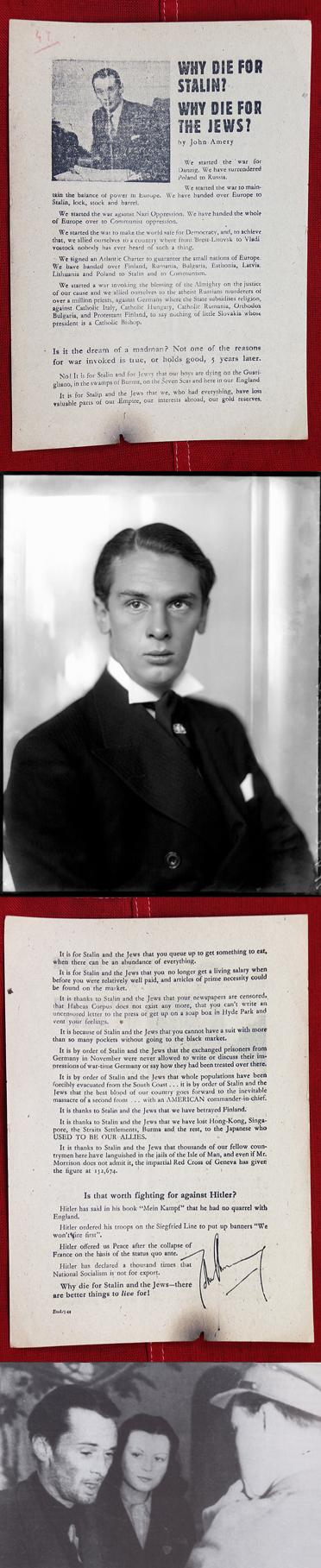
A Most Interesting & Historical Nazi Propaganda Leaflet Written by Notorious British Nazi and Traitor, John Amery, Who Was Executed At the Wars End
From a small former intelligence officer's collection of original surviving WW2 psychological warfare propaganda leaflets we were delighted to acquire.
An anti-Semitic propaganda leaflet printed in English, by infamous traitor John Amery, the Amery family's black sheep fascist, and the son of Churchill's Secretary of state for India. It was intended for distribution to British soldiers and civilians, a double-sided propaganda leaflet, entitled "Why Die for Stalin? Why die for the Jews?" and authored by British fascist and propagandist JOHN AMERY (1912-1945), who was tried and executed for treason postwar. The leaflet features the usual conspiratorial pabulum explaining that British soldiers are dying fruitlessly for Jewish and communist interests in Italy, Burma and on the Atlantic, while attempting to explain the fruitlessness of hostilities between England and Germany.
Leaflets for propaganda, could be dropped by balloons and planes over enemy territory, or, distributed by hand when in occupied or allied territory. They was used heavily in both world wars by all sides. In World War II, special bombs were developed to disperse airborne leaflets. Used as a form of psychological warfare, these leaflets were dropped in enemy-controlled territory to incite fear, coerce surrender, or turn the populace against their leadership. This tactic proved to be largely ineffective, except when morale among troops was extremely low. Leaflet bombs are still used today in military warfare, as well as by radical political and ideological groups.
Toward the end of World War II, Germany dropped millions of propaganda leaflets on enemy lines to encourage troops to surrender. Some of these leaflets were tailored to African American soldiers and suggested they would be treated better as German prisoners of war than as citizens in their own country.
Nazi Germany was not known for its fair treatment of people of African descent, or any persons who weren’t Aryan. People of colour were frequently vilified and deemed uncivilised in Nazi propaganda. Yet, Germany was willing to use any tactics necessary to avoid defeat, including highlighting American racism, to exploit existing tensions within the U.S. military. And by the wars end they even encouraged foreign Muslims to join the dedicated Muslim waffen SS regiments, which in the 1930's would be unthinkable.
Although these pamphlets were made in their tens of thousands almost all were destroyed, either immediately on landing or at the wars cessation, so very few indeed survive and mostly survive today in national archives or museums.
On 22 June, the Second Armistice at Compiègne was signed between France and Germany. Amery resided in the territory belonging to the collaborationist Vichy government led by Marshal Philippe Pétain. However, his personality soon antagonised the Vichy Regime so he made several attempts to leave but was not allowed. The head of the German Armistice Commission offered Amery a chance to live in Germany to work in the political arena but he was unable to get Amery out of occupied France.
In September 1942, Hauptmann Werner Plack gained Amery the French travel permit he needed, and in October Plack and Amery travelled to Berlin to speak to the German English Committee. It was at this time that Amery suggested that the Germans consider forming a British anti-Bolshevik legion. Adolf Hitler was impressed by Amery and allowed him to remain in Germany as a guest. During this period, Amery made a series of pro-German propaganda radio broadcasts, attempting to appeal to the British people to join the war on communism.
British Free Corps
The idea of a British force to fight the communists languished until Amery encountered Jacques Doriot during a visit to France in January 1943. Doriot was part of the LVF (Légion des Volontaires Français), a French volunteer force fighting alongside the Germans on the eastern front.
Amery rekindled his idea of a British unit and aimed to recruit 50 to 100 men for propaganda purposes and to establish a core of men with which to attract additional members from British prisoners of war. He also suggested that such a unit could provide more recruits for the other military units made up of foreign nationals.
Amery's first recruiting drive for what was initially to be called the British Legion of St George took him to the Saint-Denis POW camp outside Paris. Amery addressed between 40 and 50 inmates from British Commonwealth countries and handed out recruiting material. This first effort at recruitment was a complete failure, but he persisted.
Amery's drive for recruits found two men, of whom only one, Kenneth Berry, joined what was later called the BFC. Amery's link to the unit ended in October 1943, when the Waffen SS decided his services were no longer needed, and it was officially renamed the British Free Corps.
Arrest
Amery continued to broadcast and write propaganda in Berlin until late 1944 when he travelled to Northern Italy to lend support to Italian dictator Benito Mussolini's Salò Republic. On 25 April 1945, Amery was captured along with his French mistress Michelle Thomas by Italian partisans from the Garibaldi Brigade near Como. Amery and Thomas were initially to be executed, but both of them were eventually sent to Milan, where they were handed over to Allied authorities. Amery was wearing the uniform of the "Muti Legion", a fascist paramilitary organisation. The British army officer who took him into custody was Captain Alan Whicker, later known as a broadcaster.
Trial and execution
Amery was tried for treason in London. In a preliminary hearing, he argued that he had never attacked Britain and was an anti-Communist, not a Nazi. At the same time, his brother Julian attempted to show that John had become a Spanish citizen, and therefore would legally be incapable of committing treason against the United Kingdom.
His counsel, Gerald Osborne Slade KC, meanwhile, tried to show that the accused was mentally ill. Amery's sanity was questioned by his own father, Leo, but all efforts to have the court consider his mental state were unsuccessful. Further attempts at a defence were suddenly abandoned on the first day of his trial, 28 November 1945, when to general astonishment, Amery pleaded guilty to eight charges of treason, and was sentenced to death. The trial lasted just eight minutes.
Before accepting Amery's guilty plea, the judge, Mr Justice Humphreys, made certain that Amery realised the only permissible penalty would be death by hanging. After satisfying himself that Amery fully understood the consequences of pleading guilty, the judge announced this verdict:
John Amery ... I am satisfied that you knew what you did and that you did it intentionally and deliberately after you had received warning from ... your fellow countrymen that the course you were pursuing amounted to high treason. They called you a traitor and you heard them; but in spite of that you continued in that course. You now stand a self-confessed traitor to your King and country, and you have forfeited your right to live.
Amery was hanged in Wandsworth Prison on 19 December 1945 by executioner Albert Pierrepoint, who in his autobiography described Amery as "the bravest person I'd ever hanged", and buried in the prison cemetery. Amery actually quipped as he was led to the scaffold, "I've always wanted to meet you, Mr Pierrepoint, though not of course under these circumstances!" In 1996, Julian Amery had his brother's remains exhumed and cremated, scattering his ashes in France.
5 1/2" x 8" read more
185.00 GBP
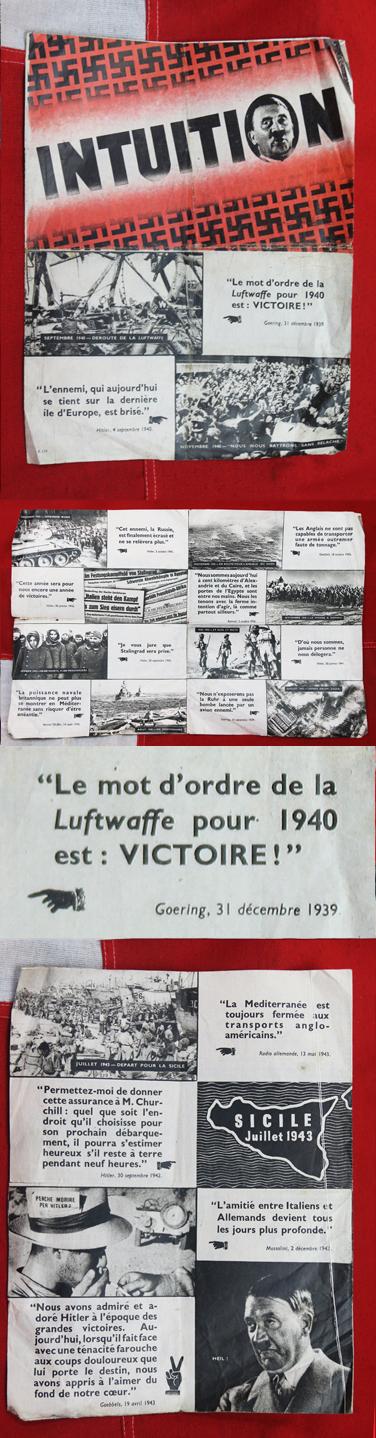
A Superb Condition and Very Rare WW2 1943 Published Nazi & Vichy-French Propaganda Leaflet, Titled INTUITION With Swastikas and Portrait Photo of Adolf Hitler. Four Pages, Folded
From a small former intelligence officer's collection of original surviving WW2 psychological warfare propaganda leaflets we were delighted to acquire.
With photographs and propaganda quotes from such as Hitler, Goering, and Mussolini, showing the fallacy of their statements
For example; "Le mot dordre de la luftwaffe pour 1940 est; victoire"
translation "The Luftwaffe watchword for 1940 is; victory"
Goering 31st December 1939
"l'amitie entre italiens et allemands deviant tous les jours profinde"
translation "the friendship between Italians and Germans becoming deep every day"
Mussolini 2 December 1942
Leaflets for propaganda, could be dropped by balloons and planes over enemy territory, or, distributed by hand when in occupied or allied territory. They was used heavily in both world wars by all sides. In World War II, special bombs were developed to disperse airborne leaflets. Used as a form of psychological warfare, these leaflets were dropped in enemy-controlled territory to incite fear, coerce surrender, or turn the populace against their leadership. This tactic proved to be largely ineffective, except when morale among troops was extremely low. Leaflet bombs are still used today in military warfare, as well as by radical political and ideological groups.
Toward the end of World War II, Germany dropped millions of propaganda leaflets on enemy lines to encourage troops to surrender. Some of these leaflets were tailored to African American soldiers and suggested they would be treated better as German prisoners of war than as citizens in their own country.
Nazi Germany was not known for its fair treatment of people of African descent, or any persons who weren’t Aryan. Black people were frequently vilified and deemed uncivilised in Nazi propaganda. Yet, Germany was willing to use any tactics necessary to avoid defeat, including highlighting American racism, to exploit existing tensions within the U.S. military..
Although these pamphlets were made in their tens of thousands almost all were destroyed either immediately or at the wars cessation, so very few survive and mostly survive today in national archives or museums.
This one is particularly rare, in fact we haven't seen a surviving example before, certainly not in the past 50 years.
This is also a large size some could be only a few inches in size.
16.25 inches x 10.5 inches un-folded open.
read more
295.00 GBP
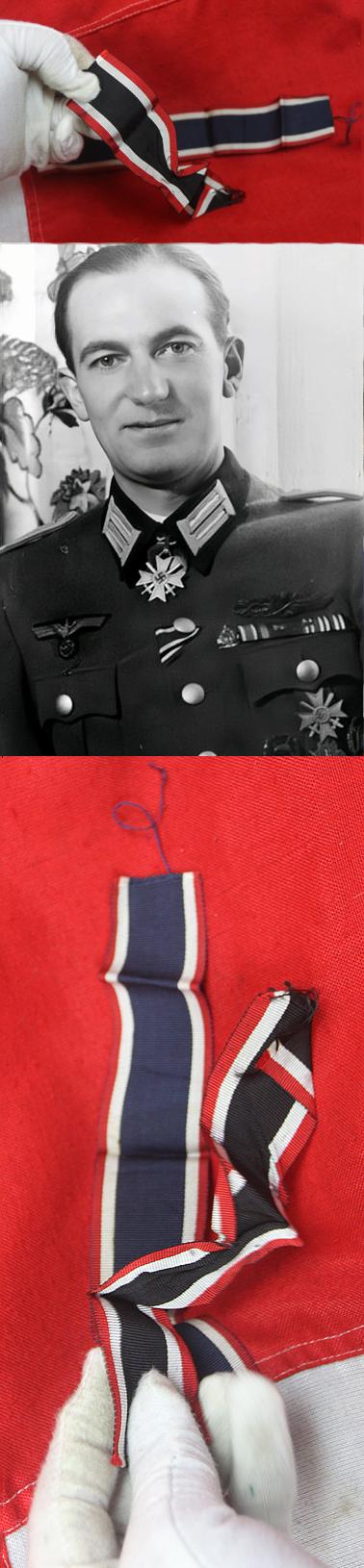
A Very Desirable Early Neck Ribbon for a German WW2 Knight's Cross of the War Merit Cross
In two pieces. An extremely useful ribbon if one had a Knights Cross of the war Merit Cross lacking its ribbon. New replacement reproduction ribbon is available and relatively inexpensive, but old, early ribbon is another matter entirely.
The Knights Cross of the War Merit Cross was considered to be ranked higher than the German Cross in silver, but below the Knights Cross of the Iron Cross. A medal now valued between £4,000 to £10,000. A total of 118 awards of the Knights Cross of the War Merit Cross with swords, and 137 awards without swords were awarded. Considering the relative rarity of the award compared with the grades of the Knights Cross of the Iron Cross, it took on "extra meaning" it did not necessarily deserve, as it ranked below the Knights Cross of the Iron Cross. For example, Reichsmarschall Hermann Göring made a concerted effort to get Hitler to award him this order, much to Hitler's annoyance. In response, Hitler outlined a series of criteria governing the awarding of this decoration and the philosophy of such awards, and directed that "prominent party comrades" were not to be awarded with the Knights Cross of the War Merit Cross (or similar decorations), and withdrew the proposed awards of this order to Gauleiter Erich Koch and Herbert Backe. Directing his comments at Göring personally, Hitler ordered that such attempts to gain this award be stopped. Also, six persons received two Knights Crosses of the War Merit Cross (each one with and without Swords): Walter Brugmann, Julius Dorpmüller, Karl-Otto Saur, Albin Sawatzki, Walter Schreiber, and Walter Rohlandt. read more
240.00 GBP
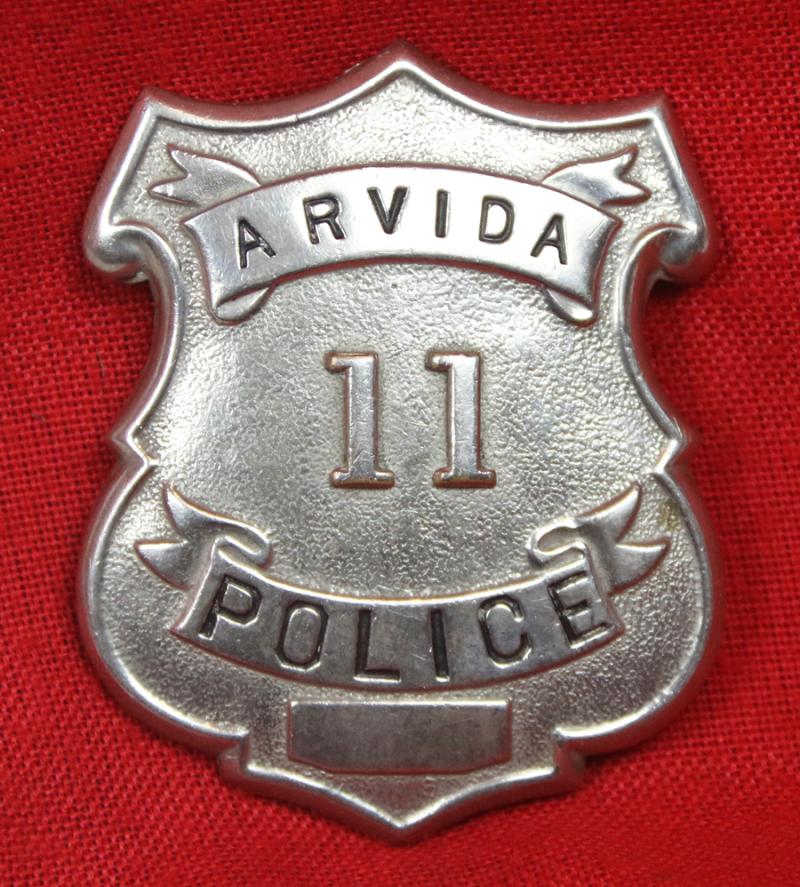
A Most Interesting & Scarce Vintage Patrolman's Police Shield Arvida Police. Numbered II
A now defunct force. In very good condition overall , with a panel at the base front. Bears the central affixed number, II. With central north-south affixing pin with rotating safety fixing. read more
85.00 GBP
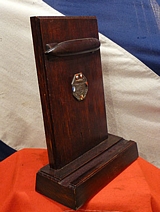
An Unusual Piece of Original, Airship Aeronautica, 1929 Zeppelin Display Stand, In Oak With Zeppelin Badge And Carved Airship
Ferdinand von Zeppelin served as an official observer with the Union Army during the American Civil War. During the Peninsular Campaign, he visited the balloon camp of Thaddeus S. C. Lowe. Lowe sent the curious von Zeppelin to another balloon camp where the German-born aeronaut John Steiner could be of more help to the young man. His first ascent in a balloon, made at Saint Paul, Minnesota during this visit, is said to have been the inspiration of his later interest in aeronautics.
Zeppelin's ideas for large dirigibles was first expressed in a diary entry dated 25 March 1874. Inspired by a recent lecture given by Heinrich von Stephan on the subject of "World Postal Services and Air Travel", he outlined the basic principle of his later craft: a large rigidly-framed outer envelope continuing a number of separate gasbags. In 1887 the success of Charles Renard and Arthur Krebs' airship La France prompted him to send a letter to the King of W?rttemberg about the military necessity for dirigibles and the lack of German development in this field. He went on to start the Zeppelin Airship Co. and his name lived on in German legend as the great airship pioneer of international travel and airship warfare. 11 inches x 9 inches x 3.5 inches read more
225.00 GBP
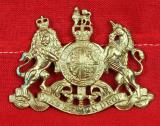
British Royal Crest General Service Helmet Plate in Gilt Brass
The Royal Coat of Arms for the British monarchy. The coat features both the motto of English monarchs, Dieu et mon droit (God and my right), and the motto of the Order of the Garter, Honi soit qui mal y pense (shame upon him who thinks evil of it) on a representation of the Garter behind the shield. It measures 83mm x 64mm read more
95.00 GBP
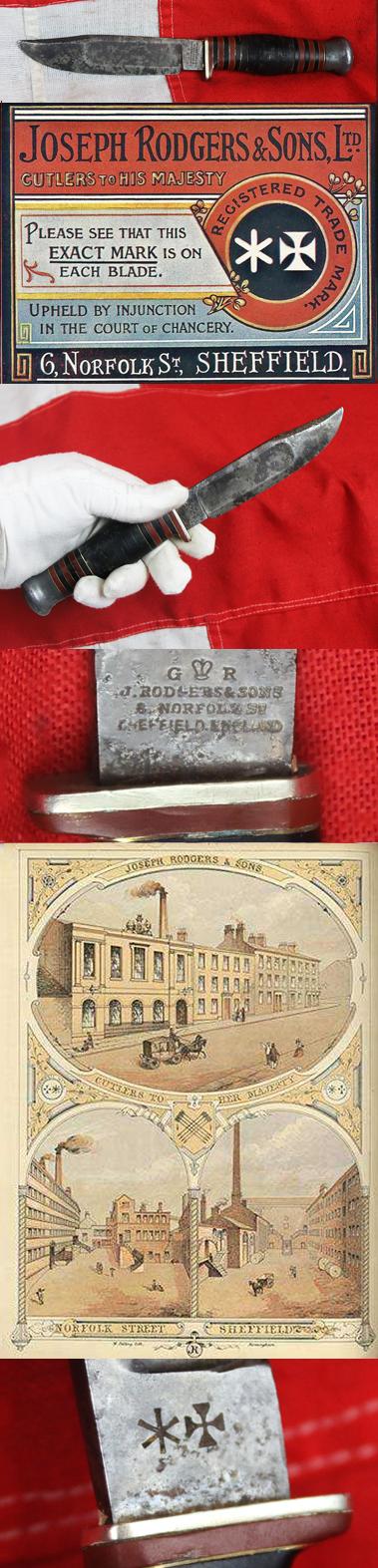
A Joseph Rodgers & Sons 6 Norfolk St. Sheffield Ltd Bowie Knife
A famous firm of cutlers and silversmiths founded in Sheffield in 1682. It was converted under the style of Joseph Rodgers & Sons Ltd in 1871.
The factory was at 6 Norfolk Street, Sheffield and a showroom at 60 Holborn Viaduct, London.
With Joseph Rodgers GR Crown stamp with the 1891 England mark. on the reverse ricasso is the star and Maltese cross stamp
The star and Malta cross marks was originally that of Benjamin Rich. Rogers registered the same mark in 1764.
Overall used but a very nice example of these famed Bowies from one of the great early Sheffield Bowie makers. Private purchase knives such as this were very popular by British [and American] special forces in WW2 before the FS knife was produced in good numbers in 1941.
No scabbard read more
285.00 GBP
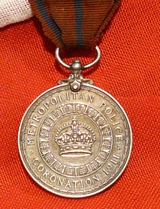
Solid Silver Metropolitan Police Coronation Medal, George Vth 1911
Named to PC Bramble. Very good condition. Original ribbon with silver Spink and Son mount.
The Police Coronation Medal was sanctioned in 1911 as an award to policemen, members of ambulance units, firemen and Royal Parks' staff on duty during the official celebrations of the coronation of King George V that took place during 1911.
The medal is silver and is 1.4 inches (36 mm) in diameter. It was designed by the Australian sculptor Bertram Mackennal.
Obverse: A crowned left-facing bust of King George V with the inscription GEORGIVS V REX ET IND: IMP:.
Reverse: The Imperial Crown with an ornate surround, with the inscription CORONATION 1911 below and the name of the service the recipient was serving with above.
Ribbon: 1.25 inches (32 mm) wide. Red with a narrow central blue stripe, with a similar stripe towards each edge.
The recipient's rank and name were engraved on the edge of the medal read more
60.00 GBP
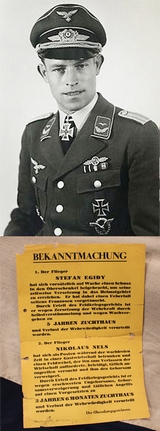
Fascinating German WW2 Public Notice Poster Regarding Two Luftwaffe Flyers. Public Crucifixion of Former Luftwaffe Fighting Aces. Blamed For The Loss of The Battleship Tirpitz
Der flieger [flyer] Stefan Egidy hat sich vorsatzlich auf wache einen schuss in den oberschenkel beigebracht, um seine zeitweise versetzung in das helmatgeblet zu erreichen .er hat dabel einen ueberfall seitens franzosen vorgetauscht durch urtell des feldkriegsgerichts ist er wegen zerstzung der wehrkraft durch selbstverstummelung und wegen wachvergehen zu 5 jahren zucthaus und verlust der wehrwurdigkeit verurteilt worden. Roughly it translates that Flyer Stefan Egidy was court martialled for a self inflicted wounding and sentence to 5 years and loss of privileges. Also Flieger [flyer] Niklaus Nels was similar court-martialled and sentenced to 3 years 6 months. German pilots were occasionally court-martialled for all manner of reasons, another one at the time was Born in Oberbalbach, Heinrich Ehrler, he grew up in the Weimar Republic and Third Reich as one of 12 children. He joined the military service in the Wehrmacht in 1935, initially service with the artillery and anti-aircraft artillery. He participated in the Spanish Civil War and following the outbreak of World War II transferred to the Jagdwaffe (fighter force). Following flight training, he was posted to the 4. Staffel of Jagdgeschwader 77 (JG 77?77th Fighter Wing), which was later redesignated to 4. Staffel of Jagdgeschwader 5 (JG 5?5th Fighter Wing).
Scapegoated for the loss of the German battleship Tirpitz, Ehrler - who had been nominated for the Knight's Cross of the Iron Cross with Oak Leaves and Swords prior to the disaster - was court-martialled, stripped of his command and sentenced to three years and two months Festungshaft (honorable imprisonment). Ehrler's sentence was later commuted and his loss of rank rescinded, and in February 1945 he was transferred to Jagdgeschwader 7. According to his fellow pilots, Ehrler thereafter flew in the increasingly desperate air battles without the purpose and dedication that had made him one of the Luftwaffe's most successful aces. On 4 April 1945, he shot down two Allied bombers for his final two victories, before destroying a third by ramming with his damaged aircraft after having run out of ammunition. His last recorded statement was "Theo, I have run out of ammunition. I'm going to ram this one. Good bye. We'll see each other in Valhalla." - Heinrich Ehrler's last transmission over the Squadron Radio Network before he rammed the B-24 bomber "Trouble in Mind," piloted by Captain John Ray, destroying both aircraft and killing himself. Central tear through middle can't be seen in photo
Intriguing ephemera from the 3rd Reich would look very fine if framed, obviously not in good condition but as direct examples of WW2 aeronautical history absolutely fascinating. Remarkable to survive and probably unique examples. read more
135.00 GBP
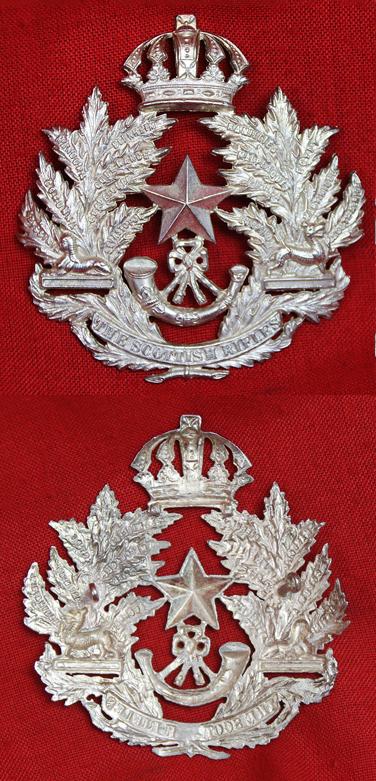
The Scottish Rifles, Helmet Plate, With Battle Honours, Silvered
In jolly nice condition, die cast, two lugs 10cm x 9.5cm.
The Cameronians (Scottish Rifles) was a rifle regiment of the British Army, the only regiment of rifles amongst the Scottish regiments of infantry. It was formed in 1881 under the Childers Reforms by the amalgamation of the 26th Cameronian Regiment and the 90th Perthshire Light Infantry. In 1968, when reductions were required, the regiment chose to be disbanded rather than amalgamated with another regiment, one of only two infantry regiments in the British Army to do so, with the other being the York and Lancaster Regiment. It can trace its roots to that of the Cameronians, later the 26th of Foot, who were raised in 1689. The 1881 amalgamation coincided with the Cameronian's selection to become the new Scottish Rifles.
The regiment's battle honours included:
Early wars: Blenheim, Ramillies, Oudenarde, Malplaquet, South Africa 1846-72, South Africa 1877-8-92, Relief of Ladysmith, South Africa 1899-1902
The Great War: Mons, Le Cateau, Retreat from Mons, Marne 1914 '18, Aisne 1914, La Bassée 1914, Messines 1914, Armentières 1914, Neuve Chapelle, Aubers, Loos, Somme 1916 '18, Albert 1916, Bazentin, Pozières, Flers-Courcelette, Le Transloy, Ancre Heights, Arras 1917 '18, Scarpe 1917 '18, Arleux, Ypres 1917 '18, Pilckem, Langemarck 1917, Menin Road, Polygon Wood, Passchendaele, St Quentin, Rosières, Avre, Lys, Hazebrouck, Bailleul, Kemmel, Scherpenberg, Soissonnais-Ourcq, Drocourt-Quéant, Hindenberg Line, Épéhy, Canal du Nord, St Quentin Canal, Cambrai 1918, Courtrai, Selle, Sambre, France and Flanders 1914-18, Doiran 1917 '18, Macedonia 1915-18, Gallipoli 1915-16, Rumani, Egypt 1916-17, Gaza, El Mughar, Nebi Samwil, Jaffa, Palestine 1917-18
Second World War: Ypres-Comines Canal, Odon, Cheux, Caen, Mont Pincon, Estry, Nederrijn, Best, Scheldt, South Beveland, Walcheren Causeway, Asten, Roer, Rhineland, Reichswald, Moyland, Rhine, Dreierwalde, Bremen, Artlenberg, North-West Europe 1940, '44-45, Landing in Sicily, Simeto Bridgehead, Sicily 1943, Garigliano Crossing, Anzio, Advance to Tiber, Italy 1943-44, Pegu 1942, Paungde, Yenagyaung 1942, Chindits 1944, Burma 1942 '44.
Silver coloured metal, not hallmarked read more
95.00 GBP