
WW1 / WW2 / 20th Century


A Most Incredible and Intriguing European Art Deco Bronze Table Lamp, Decorated With the Subject of a Prisoner in an Ancient Chinese 'Cangue' Torture Device Beneath a Lamp
A seated figure with the torture block of a Chinese 'cangue' . Likely designed from small portable carved wooden figures purchased and brought back to Europe by travellers to the Treaty Port of Ningbo in China, sometime in the early 20th century. The European fascination with all things oriental, from the exotic east, has influenced western art considerably for centuries, and it is frequently known as Chinoiserie Art, although the depiction of Chinese torture implements was somewhat niche, but they were especially popular, and depicted in decorative art, paintings, prints and sculpture. But this is the first time we have seen an old rendition of one in the form of a beautiful bronze table lamp. This very nice quality and fascinating piece of object d'art in bronze and enamel painted glass, is one of those incredible creations. This kind of tortuous affair using the cangue was usually unique to the far east from the ancient period up to relatively modern times. In fact the legendary Genghis Khan himself was imprisoned in such a terrible device when he was captured by another mongol leader as a youth before he grew into becoming the world greatest conqueror.
the bronze is signed at the reverse base, the front lamp base bears Chinese script, as does the cangue panel around the prisoners neck, which often details the prisoner's crimes, and the French bronze founder's label is on the underneath.
Although there are many different forms, a typical cangue would consist of a large, heavy flat board with a hole in the centre large enough for a person's neck. The board consisted of two pieces. These pieces were closed around a prisoner's neck, and then fastened shut along the edges by locks or hinges. The opening in the centre was large enough for the prisoner to breathe and eat, but not large enough for a head to slip through. The prisoner was confined in the cangue for a period of time as a punishment. The size and especially weight were varied as a measure of severity of the punishment. The Great Ming Legal Code (大明律) published in 1397 specified that a cangue should be made from seasoned wood and weigh 25, 20 or 15 jīn (roughly 20–33 lb or 9–15 kg) depending on the nature of the crime involved. Often the cangue was large enough that the prisoner required assistance to eat or drink, as his hands could not reach his own mouth, or even lie down. The word "cangue" is French, from the Portuguese "canga," which means yoke, the carrying tool has also been used to the same effect, with the hands tied to each arm of the yoke. Frequently translated as pillory, it was similar to that European punishment except that the movement of the prisoner's hands was not as rigorously restricted and that the board of the cangue was not fixed to a base and had to be carried around by the prisoner. the condition overall is very good, the lamp has four hand painted enamel glass panels but the interior somewhat concealed one has been long past repaired in the mid section 13.5 inches high x 7 inches deep, x 3.2 inches wide. If one wishes to use it for illumination once more It will need safely rewiring to approved standards, what remains of any past wiring should not be used under any circumstances. read more
545.00 GBP
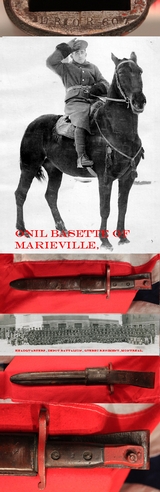
A Most Desirable & Rare Canadian WW1 Historical Regimental Ross Bayonet of The 1st Depot Battalion, 1st Quebec Regt. One Of The Great Heroic Regiments Of Canada From The Close of the Great War.
A veritable museum grade collectors piece. With superb regimental markings from the small number of conscripts and heroes of the ill fated, 1st Depot Batt. The Quebec Regt. Who suffered a terrible percentage of casualties at the Western Front.
A fairly uncommon bayonet to find, even unmarked of regimental details these days, but, very rare indeed to find with good regimental markings, especially by such a small detachment of conscripts from a regiment of such noble history. A draft of Military Service Act, 1917 conscripts from the 1st Depot Battalion, Quebec Regiment, Montreal sailed on the S.S. Scandinavian March 25, 1918 arriving in England April 3, 1918. The total size of this draft at present is unknown probably about 500 soldiers. What is known is that 140 of this draft were channelled through the 23rd Reserve Battalion into the 14th (Royal Montreal) Battalion. Of this draft of 140 soldiers,100 were casualties with 22 deaths all within the last 100 days of the war! Photo in the gallery of Headquarters, Depot Battalion, Quebec Regiment, Montreal, March 27, 1918, Lt.-Col. L.J. Daly-Gingras, D.S.O., O.C. A photo in the gallery of a mounted soldier, Onil Basette of Marieville, 1st Depot Battalion, 1st Quebec Regiment, taken in 1918. The bayonet metal is unusually painted red . Details of their noble and heroic service in just those 100 days are including in the following engagements; The Advance in Picardy (8 August 3 September, 1918) Amiens 8-11 August 1918
The Breaking of the Hindenburg Line (26 August ? 12 October, 1918) Arras, 1918 26 August 3 September 1918
Scarpe, 1918 26-30 August 1918
Drocourt-Queant Line 2-3 September 1918
Hindenburg Line, Battles of the 12 September 9 October 1918
Canal du Nord 27 September 2 October 1918
Picardy (17 October 11 November) Pursuit to Mons 11 November 1918 read more
365.00 GBP
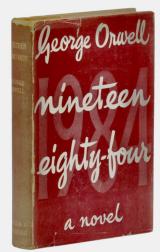
George Orwell 1984 1st Edition, Ist Printing In Red RESERVED.. Now SOLD
"Nineteen Eighty-Four is a book that goes through the reader like an east wind, cracking the skin, opening the sores... I do not think I have ever read a novel more frightening and depressing; and yet, such are the originality, the suspense, the speed of writing and withering indignation that it is impossible to put the book down." VS Pritchett
"Already we know almost literally nothing about the Revolution and the years before the Revolution. Every record has been destroyed or falsified, every book has been rewritten, every picture has been repainted, every statue and street and building has been renamed, every date has been altered. And that process is continuing day by day and minute by minute. History has stopped. Nothing exists except an endless present in which the Party is always right." George Orwell 1984 published in 1949 by Secker and Warburg and, of course, is one of the most important novels of the 20th century. Orwell died in January 1950. Printed in both red and green in 1949 and it is still not known which colour came first.
Stock photo read more
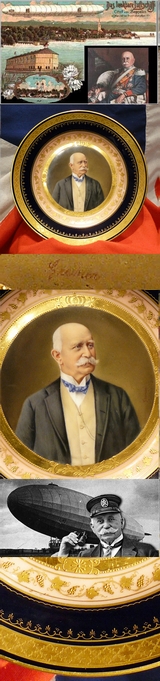
A Beautiful Antique Royal Vienna Porcelain Cabinet Plate By Griener Hand Painted by One of the Finest Artists of Royal Vienna, and Signed Griener.
A portrait bust of Count Graf von Zeppelin. With gold reflief border. Pre WW1 early 20th Century. Royal Vienna mark in underglazed blue. Gilding of the finest quality 99% good or better condition. The great inventor of the amazing Zeppelin Airships that eventually spanned the globe. DELAG German: Deutsche Luftschiffahrts-Aktiengesellschaft was founded on 16 November 1909 as a subsidiary of the Luftschiffbau Zeppelin Corporation to commercialize airship travel. It became the world's first passenger airline in revenue service with the launch of LZ 7 Deutschland in 1910. While DELAG's initial flights were primarily sightseeing tours, by 1919 it was operating a regular schedule between Berlin and Friedrichshafen with a stop at Munich. Between 1910 and the outbreak of World War I DELAG transported over 34,028 passengers on 1,588 commercial flights.
The first DZR (1935?1940)
The creation of the DZR as successor to DELAG occurred for both political and business reasons. Luftschiffbau Zeppelin (LZ) chairman Hugo Eckener, who had intended to run against Hitler in the 1932 presidential election, was already disliked by the Nazis. When Eckener later resisted the new Nazi government's efforts to use zeppelins for propaganda purposes, Reich Minister of Aviation Hermann G?ring insisted that a new agency be created to extend Party control over LZ Group. A personal rivalry between G?ring and Propaganda Minister Joseph Goebbels also played a role. To complicate matters further, the Luftschiffbau was a loss-making concern and needed cash investment, in particular to complete construction of the Hindenburg.
Deutsche Zeppelin-Reederei was therefore incorporated on 22 March 1935 as a joint venture between Zeppelin Luftschiffbau, the Ministry of Aviation, and Deutsche Luft Hansa. The LZ Group's capital contribution came primarily from its two airships LZ 127 Graf Zeppelin and LZ 129 Hindenburg, the latter of which was not yet complete on the date of incorporation. Nearly all of the rest was an infusion of cash by the Air Ministry and DLH. In exchange for this, the DZR agreed to ownership apportioned as follows: read more
985.00 GBP

Set of Three German Mutterkreuz, Early Ist Pattern in Silver, Two 2nd Patterns in Gold & Silver
The first is a very rare example of the first pattern Mutterkreuz Mother's Cross in silver in good condition. all awarded to the same lady, but she was supposed to return the first pattern as it was an error in the Third Reich distribution, which is why it is so rare. 85% of the value of the three medals is for the very rare Ist pattern medal
The Cross is more or less identical to the more common later pattern, except that on the back is stamped "Das Kindadelt dir Mutter' and the early style signature of Adolf Hitler. Later models have '16 Dezember 1938' and the later version of his signature. From 1933 to 1945 Hitler's signature changed a few times.
The 2nd is the gold cross 2nd pattern and the third a silver 2nd pattern.
The first pattern only existed for a very short time thus,. as a result, it is one of the rarest non military awards.
It was Adolf Hitler’s joint experiences of witnessing the manpower losses on the Western Front in WWI and deaths in his immediate family that were the behind a desire to encourage German mothers to have large families.
Three of Adolf’s siblings died as children and even his mother, who he doted on, died when he was just 18. By the time the National Socialists gained power Hitler had already formulated plans for expansion in the east with Lebensraum, or living space. The army, as well, would need those large families to provide a stream of new recruits. The honouring of motherhood was also another way of encouraging traditional German values to counter what Hitler, and many saw as the decadence of the more liberal, roaring ‘20s and early 1930s.
The result was a civil award that recognised the contribution of German mothers to the nation. The Ehrenkreuz der Deutschen Mutter, translated as the Cross of Honour of the German Mother, or as it more informally known, the Mother’s Cross, was instituted by statutory order on 16 December, 1938 by Adolf Hitler. The Cross was originally to be awarded on the second Sunday in May, or Mother’s Day, but as some three million German women were already eligible this was extended to include other important national occasions. It did mean that the first awards weren’t given until May 1939. The Mother’s Cross came in three grades, as follows:
Gold Cross – for mothers with eight or more children
Silver Cross – for mothers with six or seven children
Bronze Cross – for mothers with four or five children
Size: 36 x 46mm
Acquired from the estate of a late collector, acquired by him from his collecting period that commenced in the 1950's. Please note 85% of the value of this small collection is the the most rare ‘1st pattern’ silver example, these single and highly rare medals can easily achieve over £1000 today, 10 times the value of the 2nd patterns as we show here.
Photo 5 in the gallery shows the rear view of this 1st pattern mutterkreuz medal that was used to illustrate the versions in Militaria History published in 2018 read more
1095.00 GBP

A Very Rare WW1 German Airship Bataillon 'Luftschiffer' Regt. Nr.1 Officer’s Sword, of the Elite Imperial German Kaiser's Zeppelin and Airship Guarde Infantry, Only The Second We Have Seen in 30 Years
Probably one of the rarest German swords available, from the iconic German Zeppelin force of WW1. A duluxe quality blade bearing the Luftschiffer Battalion no 1, a Luftschiffer observation balloon and the Imperial German Kaiser's Garter Star symbol, plus a troop of horses pulling the balloon limber. Airship Battalion officer's swords are so rare as to be virtually unavailable, we have only seen one other in the past 40 years or so. We have not even heard or seen of another example in over 30 years. The German Airship Battalions were a small yet vital part of the Kaiser's Imperial German war machine. It was a mix of old and new technology that created the amazing new air services which in turn resulted in the iconic and hugely successful psychological warfare, of the highly feared and indomitable, so called, Hun in the Sky. The very beginning of true aerial warfare as we know it today. Some of the most famous stories of the war were based around the German Airships Zeppelins and the like and their continued use by Hitler's Third Reich right up to the late 1930's as can be seen, impressively and incredibly depicted, in the third of the Indiana Jones movies shows just how important they were considered. Any souvenirs or militaria from those early services are incredibly sought after, and very scarce indeed. All the weaponry connected with those services are particularly rare and very highly prized. At the start of World War I the Imperial German Army had five Luftschiffer (airship) battalions and one airship company. They were used as frontline observation posts and the larger ships as long range bombers. Fatalities of the crews were very high indeed due to their vulnerability. This sword is the best you could possibly hope for, as, not only does it have a deluxe etched blade, with two blued panels regimentally marked for the Luftschiffer Battalion No1, It also bears the Imperial Garter Star to represent this battalion was part of the Guard Infantry. The most elite part of the Imperial German armed forces, based in Berlin and assigned to the front lines in France and Belgium. The Luftschiffer became the backbone of German aerial warfare in the first years of the War, conducting reconnaissance flights as well as the first bombings of cities, including Paris and London.
Upon the outbreak of World War I, the Luftschifftruppe numbered around 20–25 zeppelins in service. The Luftschifftruppe began aerial surveillance early on in Belgium and France, but often came under fire by anti-aircraft guns. Because of their slow speed, they were very vulnerable. After three Zeppelins were shot down in the first month alone, the Luftschiffer were switched to naval surveillance, observing British ship movements, in which capacity they played a decisive role in the Battle of Jutland. Tests were done of dropping bombs from Zeppelins in order to increase their potential. Zeppelins had a typical carrying capacity of almost 9 metric tons, making them useful enough for this operation. Following the Christmas truce, Kaiser Wilhelm II approved of the Luftschifftruppe's bombing of England. On January 19, 1915, the first bombs fell over Britain, when two Zeppelins dropped 50 kg explosives on villages outside Great Yarmouth. Five people died in the first raid; 18 more raids that year would end in almost 900 casualties. Following the terror, the British government began taking measures to stop the bombings. Anti-aircraft guns were set up all over south-eastern England, as well as spotlights for night time.
The bombings in 1916 were more intense than in 1915. After an accidental bomb-dropping on London, the Kaiser approved of raids directly against the city's urban center. Twenty-three raids on London resulted in around 1,800 casualties. Despite safety precautions, civilians were still unprepared for the raids and zeppelins were still able to avoid defenses. By 1917 and 1918 the threat the Luftschifftruppe posed to London was diminished. Large-scale introduction of fighter planes caused nearly half of the planned bombings to end in failure. Only eleven successful raids occurred in the last year of the war. Nearly 80 zeppelins had been built for the Luftschifftruppe during the war; around 60 of them were shot down, including Peter Strasser's own zeppelin, with himself on board. The hilt is plated steel with wire bound fishskin grip. A blackened steel scabbard with slight denting. read more
5450.00 GBP

Original 1930’s Third Reich Portrait of Rudolf Jordan Hitler's Personally Appointed Gauleiter of Halle-Merseburg & Magdeburg-Anhalt and Former General of the SA, Gruppenfuhrer der SA. Likely Commissioned & Paid For By Adolf Hitler Personally
Most rare surviving example of the official portrait of one of Hitler’s personally appointed district political leaders known as a Gauleiter, as almost all of around 450 original, 1930’s German portraits of Hitler’s inner circle and high command are now in the U.S. Army Center of Military History in Washington. Each portrait could have cost up to 12,000 Reichmarks each, a most considerable sum in 1939 around 60,000 dollars
Hitler usually bought and paid for them all personally, and the small Zinc bust of Rudolf Jordan by Albert Gottlieb he bought and paid 2000 Reich Marks for it in 1941 {about $10,000 US at the time} it's in the Deutsches Historisches Museum.
Approximately 114 men held the highly esteemed position of Gauleiter. Many shared a common background. Most of them, particularly during the early years, were drawn from the cadre of "old fighters" that had helped Hitler forge the Party during the Kampfzeit (Time of Struggle). The rank and power of these men was shared equally and was only four below Hitler himself. Their power was thus highly significant within the echelons of the Third Reich.
Many of these portraits were either commissioned, or acquired by Hitler personally, and they are all part of the record of Hitler and his elite commanders rise to power, in order to satisfy his determination to conquer the world and subjugate and destroy all who resisted.
No dictator can effectively govern a nation on his own. This was certainly the case with Adolf Hitler who had little time for or interest in the day-to-day regional administration of the Nazi Party.
For that purpose, he appointed his most loyal, charismatic and brutal subordinates: the ‘Little Hitlers’, officially known as Gauleiters.
Firstly, after the NSDAP gained power over Germany the Nazi Party adopted a new framework, which divided Germany into regions called Gaue. Each Gaue had its own leader, a Gauleiter. Each Gaue was then divided into subsections, called Kreise. Each Kreise then had its own leader, called a Kreisleiter. Each Kreise was then divided into even smaller sections, each with its own leader, and so on. Each of these sections were responsible to the section above them, with Hitler at the very top of the party with ultimate authority.
As almost all these oil portraits of Germany’s ‘Little Hitler’s’ were removed from Germany in 1945/6 and transported to America, it is estimated that just a very few, perhaps as few as between five or ten remained in Europe and in private hands. This is one of those tiny few. An incredibly rare example of the original, historical, visual record of the power structure organised by Hitler himself. Which makes this an incredibly rare original artifact that is an historically important representation of likely the most important and radical political events of the past thousand years. From those three decades of the 20th century that has changed the very structure of the world for all time.
The US high command in 1945/6 realised just how important it was to keep and save as many such portraits of his gauleiters as possible, as a permanent record and reminder for the future, of the monumental fight and sacrifices in order to subdue the axis powers from their schemes of world domination, during the two most significant decades of the past 300 years..
This is original portrait, in oil on canvas, of Gauleiter Rudolf Jordan (21 June 1902 - 27 October 1988). He was a Nazi Gauleiter in Halle-Merseburg and Magdeburg-Anhalt during Hitler’s socialist Third Reich. One of the notorious and prominent high command of Hitler’s Third Reich. An original Nazi oil portrait from the 1930's. Most similar in the new Aryan style of the Nazi portrait painter Fritz Erler, and his painting of 'Minister and Gauleiter Adolf Wagner', 1936. It was exhibited in the GDK, the Great German Art Exhibition, in 1939, in room 23. It was bought there by Hitler for 12.000 RM. In fact he bought two paintings by Fritz Erler: Portrait des Staatsministers und Gauleiters Adolf Wagner and Portrait des Reichsministers Fricke.
They are now in the possession of the US Army Military Center of History. Possibly this portrait was also in that exhibition with the two other Gauleiter Wagner and Frick. Erlers similar style portrait of Hitler, also painted in his SA uniform, in 1931, is currently valued for sale at 725,000 Euros. Around 450 portraits depicting Hitler and other Nazi-officials and symbols are currently stored in the U.S. Army Center of Military History in Washington
From 19 January 1931, Jordan was appointed Nazi Gauleiter of Halle-Merseburg, and then began rising within the Party ranks, acting as member of the Prussian Landtag between April 1932 and October 1933 and being appointed to the Prussian State Council and made an SA Gruppenfuhrer. In the same year began the publication of the Mitteldeutsche Tageszeitung newspaper, led by Jordan. In March 1933 came his appointment as Plenipotentiary for the Province of Saxony in the Reichsrat and in November 1933 his election as a member of the Reichstag. On 20 April 1937, Adolf Hitler personally appointed him Reichsstatthalter (Reich Governor) in Braunschweig and Anhalt and NSDAP Gauleiter of Magdeburg-Anhalt. Jordan was succeeded as Gauleiter of Halle-Merseburg by Joachim Albrecht Eggeling.
In the same year came Jordan's promotion to SA-Obergruppenfuhrer. In 1939, Jordan became Chief of the Anhalt Provincial Government and Reichsverteidigungskommissar (Reich Defence Commissar, or RVK) in Defence District XI. On 18 April 1944 came Jordan's last leap up the career ladder when he was appointed High President (Oberpresident) of the Province of MagdeburgIn the war's dying days, Jordan managed to go underground with his family under a false name. He was nonetheless arrested by the British on 30 May 1945, and in July of the next year, the Western Allies handed him over to the Soviets. Late in 1950 after four years in custody in the Soviet occupation zone Jordan was sentenced to 25 years in a labour camp in the Soviet Union. Only Federal Chancellor Konrad Adenauer's visit to Moscow managed to persuade the Soviets to reconsider Jordan's sentence, and then he was released on 13 October 1955. In the years to come, Jordan earned a living as a sales representative, and worked as an administrator for an aircraft manufacturing firm. He died in Munich. The Gardelegen massacre was the cold-blooded murder of inmates that had been evacuated from the Dora-Mittelbau concentration camp and some of its sub-camps on April 3rd, 4th and 5th. Around 4,000 prisoners had been bound for the Bergen-Belsen, Sachsenhausen or Neuengamme concentration camps, but when the railroad tracks were bombed by American planes, they had been re-routed to Gardelegen, which was the site of a Cavalry Training School and a Parachutist Training School. The trains were forced to stop before reaching the town of Gardelegen and some of the escaped prisoners had terrorized the nearby villages, raping, looting and killing civilians.
The man who is considered to be the main instigator of the Gardelegen massacre is 34-year-old Gerhard Thiele , who was the Nazi party district leader of Gardelegen. On April 6, 1945, Thiele called a meeting of his staff and other officials at which he issued an order, which had been given to him a few days before by Gauleiter Rudolf Jordan , that any prisoners who were caught looting or who tried to escape should be shot on the spot. In 1932, Nazi Gauleiter Rudolf Jordan claimed that SS Security Chief Reinhard Heydrich was not a pure "Aryan". Within the Nazi organisation such innuendo could be damning, even for the head of the Reich's counterintelligence service. Gregor Strasser passed the allegations on to Achim Gercke who investigated Heydrich's genealogy. Gercke reported that Heydrich was "... of German origin and free from any coloured and Jewish blood". He insisted that the rumours were baseless. Even with this report, Heydrich privately engaged SD member Ernst Hoffman to further investigate and deny the rumours. The last two pictures in the gallery of Jordan with Hitler and his Gaulieters at his 50th birthday examining his convertible Volkwagen Beetle, and the Erler painting of Gauleiter Wagner, bought by Hitler. 2 foot x 3 foot unframed. Water stain at the rear of the canvas. Surviving original portraits of Third Reich leaders are now very rare for at the end of the war thousands of paintings, portraits of Nazi-leaders, paintings containing a swastika or depicting military/war sceneries were destroyed. With knives, fires and hammers, they smashed countless sculptures and burned thousands of paintings. However around 8,722 artworks were shipped to military deposits in the U.S. From 1933 to 1949 Germany experienced two massive art purges. Both the National Socialist government and OMGUS (the U.S. Military Government in Germany) were highly concerned with controlling what people saw and how they saw it. The Nazis eliminated what they called Degenerate art, erasing the pictorial traces of turmoil and heterogeneity that they associated with modern art. The Western Allies in turn eradicated Nazi art. Whatever one considers about the actions of all of the entire third reich, art is art, and every piece is a representation of a portion of history, good or bad. One thing we learned very well from the tragic 1930s and 1940s is that classifying art as non-art and forbidding books or art for political reasons is a dead-end street. No matter how much one dislikes or despises the infamous despots and dictators of history, such as Hitler, Caligula, Pol Pot & Stalin, and no matter how much their depictions were used as propaganda, a painting or sculpture of them cannot be re-classified as 'non art'. This painting depicts a member of Hitler’s notorious inner circle, that for a brief period of world history very nearly placed the entire world in subjugation to the will of Germany and it’s ally Japan. It is the embodiment of why the preservation of such art can remind the thousands of its observers, for generations to come, that those people such as Rudolf Jordan, who were just ordinary looking nondescript individuals, that if left unchecked would have condemned the entire world to a nightmarish dystopia, of slavery, starvation and misery. And thanks to great leaders such as Winston Churchill, who had the talent and skill to embolden a solitary nation, racked by trepidation, facing the free world’s greatest foe alone, they were utterly routed and deposed by the near defeated and subdued great democracies. Part of the theory of Hannah Ahrend Johanna "Hannah" Arendt, 14 October 1906 - 4 December 1975 was a German-born Jewish American political theorist. Though often described as a philosopher, she rejected that label on the grounds that philosophy is concerned with "man in the singular" and instead described herself as a political theorist because her work centres on the fact that "men, not Man, live on the earth and inhabit the world." This portrait would nicely improve with some cosmetic restoration and cleaning. read more
4950.00 GBP

1907 King Edward VIIth Wilkinson Sword Enfield Hook Quillon Bayonet For the Early SMLE Rifle in Original Scabbard & Canvas Frog. issued To The 2nd Bt. Lancashire Fusiliers
Just returned from 12 hours of hand polishing and conservation to reveal at last its completely original, near as new, condition, with original leather and steel mounted scabbard and its early canvas frog, with regimental stamps for the 2nd Bt, Lancashire Fusiliers. Numerous ordnance inspection stamps at the ricasso from 1909, 1910,1911,1913 & 1914 alongside the service pattern 1907 date Wilkinson maker stamp and ER Crown
2nd Battalion, Lancashire Fusiliers were in Dover with 12th Brigade, 4th Division when war was declared in August 1914. 4th Division was held back from the original British Expeditionary Force by a last minute decision to defend England against a possible German landing. The fate of the BEF in France and the lack of any move by the Enemy to cross the channel, reversed this decision and they proceeded to France landing at Boulogne on the 20th of August 1914, arriving in time to provide infantry reinforcements at the Battle of Le Cateau, the Divisional Artillery, Engineers, Field Ambulances and mounted troops being still en-route at this time. They were in action at the The Battle of the Marne, The Battle of the Aisne and at Messines in 1914. In 1915 they fought in The Second Battle of Ypres. On the 4th of November 1915 the 2nd Lancashires moved with 12th Brigade to 36th (Ulster) Division to provide training over the winter months and returned to 4th Division on the 3rd of February 1916.
In 1916 moved south and were in action during the Battles of the Somme. In 1917 they were at Arras, in action during the The First and Third Battles of the Scarpe, before heading north for the Third Battle of Ypres, where they fought in The Battle of Polygon Wood, The Battle of Broodseinde, The Battle of Poelcapelle and The First Battle of Passchendaele. In 1918 they were in action on The Somme, then returned to Flanders fighting in the Defence of Hinges Ridge during The Battle of Hazebrouck and in The Battle of Bethune, The Advance in Flanders The Second Battles of Arras, the Battles of the Hindenburg Line and the Final Advance in Picardy. The 4th Division was demobilised in Belgium in early 1919.
On Wednesday 4th July 2007 four soldiers from the First World War were laid to rest in Belgium. One was clearly identified as Private Richard Lancaster of the 2nd Battalion of the Lancashire Fusiliers who died on the 10th November 1914. He was found with two other bodies who may have been LFs but there was not enough evidence to prove it. The other body was that of a soldier, possibly and officer from the TA Fusilier Brigade in the 66th East Lancashire Division. He was killed on the 10th October 1917 during the battle for Passchendaele read more
940.00 GBP
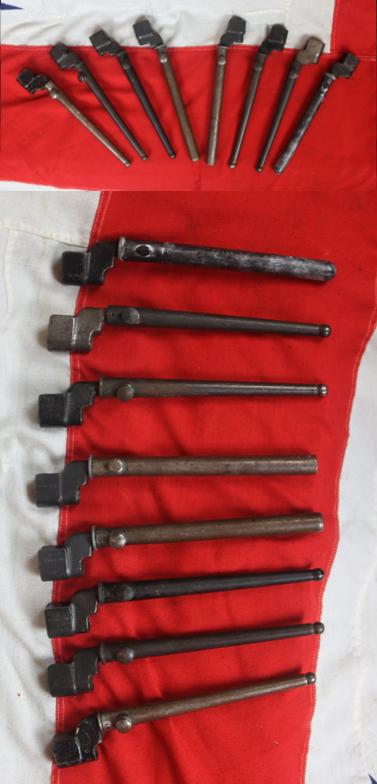
A Good Collection Of Original British WW2 Enfield No4 Rifle Spike Bayonets MKII’s In MKI Scabbard.{ Plus 200 Other Mixed Antique & WW1 Bayonets Yet To Be Added }
In very nice condition, all from one collector, kept in storage since the 1950’s, including the rarest of all a MKI in MKI scabbard {sold separately}. All were originally in full storage grease and slightly different forms and makers of the eponimous WW2 British armed forces Enfield No.4 bayonets, MKII’s, used in WW2.
We also acquired, just two days ago, within the collection over 200 early and mid Victorian British bayonets, including early 20th century mixed world bayonets, and these MKII Enfield No4 bayonets, all from within the entire single collection, that he {the late collector} acquired in the 1950’s and 1960’s, all of which will be sorted and catalogued, when we have time, over the next six months. The antique and WW1 bayonets will likely vary in price from £120 to £395.
Here, and now, we show under stock code 24589, these eight WW2 issue Enfield No.4 Bayonets MKII’s. Act fast the collection was made available yesterday and four have been sold already so far, yesterday morning in the shop and last night online. Only 4 MKII’s with regular MKI scabbards are still available.
They are now priced each, at £45.
British troops pulled off a number of bayonet charges in the brief campaign to drive Argentine forces from the Falkland Islands in 1982. Grunts from the Scots Guards and the Gurkhas chased 500 enemy troops off the summit of Mount Tumbledown in the pre-dawn darkness of June 14. The British suffered 63 casualties in the battle; 160 Argentine soldiers were either killed, wounded or captured. Two weeks earlier a 2 Para private by the name of Graham Carter led his comrades in a bayonet charge against a force of enemy troops across Goose Green.
In the last 20 years, British troops have resorted to the bayonet to break impasses in combat both in Iraq and Afghanistan. In May, 2004, a detachment from the Argyll and Sutherland Highlanders surprised a force of 100 insurgents near Al Amara, Iraq with a bayonet charge. British casualties were light, but nearly 28 guerrillas were killed. And as recently as October of 2011, a British Army lance corporal named Sean Jones led a squad of soldiers from the Prince of Wales Royal Regiment in a bayonet charge against Taliban fighters in Helmand Province, Afghanistan. After being ambushed and pinned down by militants, the 25-year-old ordered his squad to advance into a hail of machine gun fire. “We had to react quickly,” Jones remarked. “I shouted ‘follow me’ and we went for it.” He was awarded the Military Cross for his actions. Even in an age of GPS-guided bombs, unmanned drones and network-centric warfare, 300-year-old technology — like the simple bayonet — can still carry the day.
A couple of years or so ago Burundi was preparing to send a peace keeping contingent to the Congo and Somalia yet they knew that their army was not up to it and begged for a UN training team to come and train it. On being asked who they would like, they decided to look at the Americans, French, Canadians, Germans and Swedes but it was the British that they chose to train their army because they said they wanted to be trained by the best.
The last photo in the gallery of lance corporal Sean Jones recieving his Military Cross for gallantry from the former Prince of Wales, now H.M.King Charles IIIrd, for his famous heroic command of the bayonet charge in Helmand read more
45.00 GBP
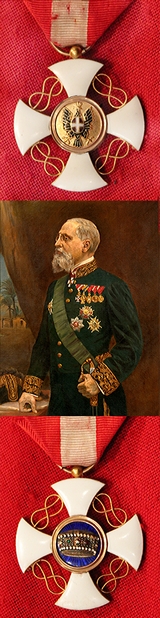
A Stunning Italian 'Order of the Crown of Italy' in Gold; Knight's Cross Medal. With Polychrome Transluscent Enamel Of The Crown Of Savoy
In Gold and enamels, 37 x 39mm, enamels superbly intact without chipping, original ribbon, extremely fine condition. Gold-edged white enamel cross pattee alisee with gold knots between the arms, on laterally-pierced ball suspension; the face with a circular central deep blue translucent enamel medallion bearing the gilt crown of Savoy with red, with white and green jewels, encircled by a gold ring; the reverse with a gold circular central medallion bearing a crowned black enamel eagle, an oval red enamel shield with a white enamel cross on its breast; The Order of the Crown of Italy was founded as a national order in 1868 by King Vittorio Emanuel II, to commemorate the unification of Italy in 1861. It was awarded in five degrees for civilian and military merit.
Compared with the older Order of Saints Maurice and Lazarus (1572), the Order of the Crown of Italy was awarded more liberally and could be conferred on non-Catholics as well; eventually, it became a requirement for a person to have already received the Order of the Crown of Italy in at least the same degree before receiving the Order of Saints Maurice and Lazarus.
The order has been suppressed by law since the foundation of the Republic in 1946. However, Umberto II did not abdicate his position as fons honorum and it remained under his Grand Mastership as a dynastic order. While the continued use of those decorations conferred prior to 1951 is permitted in Italy, the crowns on the ribbons issued before 1946 must be substituted for as many five pointed stars on military uniforms. Following the demise of the last reigning monarch in 1983, the order, founded by the first, is no longer bestowed. Notable recipients of the order were; Major General Robert A. McClure, father of U.S. Army Special Operations, Director of Information and Media Control at Supreme Headquarters Allied Expeditionary Force (SHAEF) during World War II
Brigadier General Billy Mitchell, United States Army air power advocate.
Charles Poletti, Governor of New York, and Colonel in the United States Army; served in Italy during World War II. Painting in the gallery by Karel Zadnik (1847-1929), painted in Bilowitz in 1912 of Count Hugo II Logothetti who is wearing his Italian Order of the Crown of Italy around his neck. Silk ribbon with small old staining. read more
225.00 GBP