
Japanese


A Superb Nobukuni 信国 Signed Mount Fuji Shinto Samurai Katana, Circa 1670, Signed on The Nakago Nobukuni Saku, With Mount Fuji Hamon Fuji-mi Saigyo and The Wave Fuchi Kashira.
This fabulous and unique 360 year old sword, by a high rated master swordsmith. A most substantial and incredibly impressive sword in super condition, with likely the most desirable and rarest form of hamon pattern.
It has a most rare, superb hamon that shows an horizon combined with Mount Fuji hamon, called the Fuji-mi Saigyo, with the incredibly desirable hamon temper line that depicts separate various views of the horizon with the snow topped Mount Fuji. The original Edo period Fuchigashira hilt mounts are carved iron, Higo style engraved with the representation of the crashing wave pattern that traditionally accompanies Mount Fuji, as can be seen the the world famous painting by Hokusai, 'The Wave' with Mount Fuji in the background.
The pierced early Edo iron tsuba is further complimentary with pierced clouds. Fully restored blue silk tsukaito binding, and the whole of the swords mounts have been cleaned and conserved to as good as new, with gilt dragon menuki beneath the silk ito.
In the most ancient swords, all hamon were of the straight-edge variety. Irregular patterns started to emerge around the 1300s, with famous smiths such as Kunimitsu, Muramasa, and Masamune, among many others. By the 1600--1700s, hamons with various shapes in them became very desirable, such as trees, flowers, clovers, pillboxes, and many others. Common themes included juka choji (multiple, overlapping clovers), kikusui (chrysanthemums floating on a stream), Yoshino (cherry blossoms on the Yoshino River), or Tatsuta (maple leaves on the Tatsuta River), and one of the most desirable of all, just as this sword has, was the design Fujimi Saigyo (Priest Saigyo viewing Mount Fuji)
Mount Fuji is a composite volcano, capped with snow, growing larger as layer upon layer of lava and ash built up on its slopes. Like its geologic history, Mount Fuji’s sacred history has also developed over time as different religions, beliefs and myths have added new layers. Since ancient times, the mountains of Japan have been revered as sacred places, giving rise to a tradition of beliefs and rituals that scholars call sangaku shinko, meaning “mountain creed.” When Shinto, the native religion of Japan, emerged sometime before the sixth century A.D., it wove this mountain creed into a wider veneration of nature. According to Shinto belief, natural features such as trees, lakes, streams, rocks and mountains are the dwelling places of spirits called kami, which hold influence over human affairs and respond to human prayer and ritual. Kami are believed to be concentrated in mountain areas, and shrines have been erected to mark sacred spots. The introduction of Buddhism from China in the sixth century further developed the practice of mountain worship as Buddhists, who viewed mountain climbing as a metaphor for the spiritual ascent to enlightenment, adopted Shinto sacred mountains as pilgrimage destinations. In the ninth century, a religious sect called Shugendo arose that based its doctrine and practice on mountain climbing itself, believing that practitioners could commune with deities on mountain summits and thereby obtain supernatural powers.
The name “Fuji” most likely came from an indigenous Ainu word meaning “deity of fire”—not surprising for a volcano that erupted often. In about 800 A.D., a shrine was built near the base of the mountain with the hope of placating the god that caused the volcano’s eruptions. Fuji later became regarded as the dwelling of the Shinto goddess Konohana Sakuya Hime, “the Goddess of the Flowering Trees.” Today, she is still the principal deity of the sacred mountain, revered in Shinto shrines at Fuji’s base and summit, including the one originally built for the older fire god, and honored in a fire ceremony at the end of each year’s climbing season. Buddhists found in Fuji an inspiring symbol of meditation and called its summit zenjo, a Buddhist term describing a perfect meditative state. Buddhists also came to regard Fuji as the abode of the Buddha of All-Illuminating Wisdom. In the 14th century, Shugendo practitioners established the first climbing route to lead pilgrims to Fuji’s summit.
As once told to us by an esteemed regular visitor to us here in our gallery, and the same words that are repeated in his book;
“In these textures lies an extraordinary and unique feature of the sword - the steel itself possesses an intrinsic beauty. The Japanese sword has been appreciated as an art object since its perfection some time during the tenth century AD. Fine swords have been more highly prized than lands or riches, those of superior quality being handed down from generation to generation. In fact, many well-documented swords, whose blades are signed by their makers, survive from nearly a thousand years ago. Recognizable features of the blades of hundreds of schools of sword-making have been punctiliously recorded, and the study of the sword is a guide to the flow of Japanese history.”
Victor Harris
Curator, Assistant Keeper and then Keeper (1998-2003) of the Department of Japanese Antiquities at the British Museum. He studied from 1968-71 under Sato Kenzan, Tokyo National Museum and Society for the Preservation of Japanese Swords
A most substantial blade, in nice condition for its age {of around 360 years} 28.25 inches long, from tsuba to tip overall 41 inches long including saya. read more
8550.00 GBP

A Beautiful, Edo, Higo School of Armour. A 17th Century Samurai's Tetsu Abumi Stirrup, Clan Mon of Bird & Sakura Equestrian Armour of ‘Mono no Aware’, 物の哀れ, Protective Armour & Weapon To Kick Out At Foot Samurai While Galloping In Battle
This Japanese higo school armour stirrup, with a clan crest (mon) of a bird in a cherry blossom treee (sakura) ‘mono no aware’ 物の哀れ in sinchu , is made in the traditional dove's breast (hato mune) shape with an open platform lined with red lacquer, slightly curved forward so that the foot fits in without sliding backwards. In the front extremity the stirrup has a rectangular buckle with several horizontal slots which also serve as a handle.
Not only a fine example of early original samurai equestrian combat armour, for protecting the foot of a mounted combat samurai in battle, it is also a weapon and a beautiful work of art. It also represents a most inexpensive collector's item of original samurai armour, combined as a weapon of combat and war, and around 400 years old.
The whole surface is in ancient russetted iron in the distinctive Higo school style, with a large onlaid most decorative sinchu clan mon crest mount of a bird with sakura tree, the ‘Mono no Aware’
Cultural context for this samurai crest. In Japan, this image represents the concept of mono no aware (the pathos of things). 物の哀れ —a poignant awareness of the impermanence of life, as both the cherry blossoms and the birds’ activity are intense but fleeting.
It is to be noted as we previously detailed, that these stirrups, due to their weight, were also used as weapons against the enemy infantry samurai and ashigaru. A kick from this by the mounted samurai when riding past a standing samurai at full gallop would smash through even the strongest iron helmet kabuto, resulting in likely instant death. The same effect as hitting any object with a 12 pound steel club hammer at full swing
Abumi, Japanese stirrups, were used in Japan as early as the 5th century, and were a necessary component along with the Japanese saddle (kura) for the use of horses in warfare. Abumi became the type of stirrup used by the samurai class of feudal Japan Early abumi were flat-bottomed rings of metal-covered wood, similar to European stirrups. The earliest known examples were excavated from tombs. Cup-shaped stirrups (tsubo abumi) that enclosed the front half of the rider's foot eventually replaced the earlier design.
During the Nara period, the base of the stirrup which supported the rider's sole was elongated past the toe cup. This half-tongued style of stirrup (hanshita abumi) remained in use until the late Heian period (794 to 1185) when a new stirrup was developed. The fukuro abumi or musashi abumi had a base that extended the full length of the rider's foot and the right and left sides of the toe cup were removed. The open sides were designed to prevent the rider from catching a foot in the stirrup and being dragged.
The military version of this open-sided stirrup, called the shitanaga abumi, was in use by the middle Heian period. It was thinner, had a deeper toe pocket and an even longer and flatter foot shelf. It is not known why the Japanese developed this unique style of stirrup, but this stirrup stayed in use until European style-stirrups were introduced in the late 19th century. The abumi has a distinctive swan-like shape, curved up and backward at the front so as to bring the loop for the leather strap over the instep and achieve a correct balance. Most of the surviving specimens from this period are made entirely of iron, inlaid with designs of silver or other materials, and covered with lacquer. In some cases, there is an iron rod from the loop to the footplate near the heel to prevent the foot from slipping out. The footplates are occasionally perforated to let out water when crossing rivers, and these types are called suiba abumi. There are also abumi with holes in the front forming sockets for a lance or banner. Seieibushi (Elite Samurai)
Traditionally the highest rank among the samurai, these are highly skilled fully-fledged samurai. Most samurai at the level of Seieibushi take on apprentices or Aonisaibushi-samurai as their disciples.
Kodenbushi (Legendary Samurai)
A highly coveted rank, and often seen as the highest attainable position, with the sole exception of the rank of Shogun. These are samurai of tremendous capability, and are regarded as being of Shogun-level. Kodenbushi are hired to accomplish some of the most dangerous international missions. Samurai of Kodenbushi rank are extremely rare, and there are no more than four in any given country.
Daimyo (Lords)
This title translates to 'Big Name' and is given to the heads of the clan.
Shogun (Military Dictator)
The apex of the samurai, the Shogun is the most prestigious rank possible for a samurai. Shoguns are the leaders of their given district, or country, and are regarded as the most powerful samurai.
Picture in the gallery of Samurai Wagakawa Kiyohide riding his black horse into battle wearing his identical black and brass mounted abumi horse armour stirrup. read more
1450.00 GBP
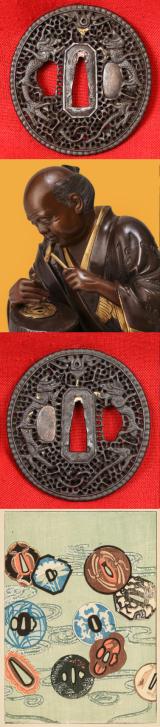
Openwork Iron Nanban Tsuba With A Pair of Dragons and Golden Nunome-Zogan Decor. A Most Fine Japanese 17th Century Sword Guard
Japanese sword hilt (tsuba) in cut iron and damascened with gold (nunome-zogan). The metal is finely carved with dragons chasing the sacred pearl in the Nanban style. The pearl is pierced and contains a small mobile ball which today comes out of its housing (see photos). Japanese work from the 17th century Edo period.
Nanban tsuba (Southern Barbarian sword guards) are 16th to 19th-century Japanese sword fittings characterized by foreign, non-traditional designs, primarily featuring intricate iron openwork (sukashi), beaded rims, and Chinese or European motifs. Originating from trade with foreign ships, these often-lavish guards were produced in China or by the Dutch East India Company and adapted for Japanese swords.
"Nanban" means "Southern Barbarian," a term used during the Edo period to describe foreigners—specifically Portuguese, Spanish, and Dutch traders—who arrived by sea.
While the name implies Western influence, most designs actually show strong Chinese influence.
They are usually made of iron, featuring complex openwork (carved in relief or pierced), undercutting, and often feature "small balls" trapped in small compartments that can move. Common motifs include dragons chasing flaming pearls, foreign letters (like "VOC" for the Dutch East India Company), and arabesque designs.
Initial pieces were likely imported from China or Southeast Asia through Nagasaki from the late 16th century onwards.
Japanese craftsmen began copying these styles. They often added specific features for Japanese swords, such as the hitsu-ana (holes for the utility knife/hairpin) and modifying the nakago-ana (tang hole).
The Yagami School: Based in Nagasaki, this school specialized in this style during the 18th century, famous for intricate ironwork featuring Chinese-style dragons and, notably, "1000 monkey" designs.
Although foreign-influenced, they were popular among samurai as fashionable, often heavily gilded or inlaid with gold/silver. They were sometimes used to subtly showcase hidden religious preferences (e.g., small crosses) during the prohibition of Christianity
Nanban-style carvers in Yamashiro (modern-day Kyoto) refers to 18th-century Japanese metalworkers, specifically tsuba (sword guard) makers, who adopted foreign design elements—primarily Chinese, but also Portuguese and Dutch influences—into their craft.
These artisans are known for producing Nanban Tsuba (Southern Barbarian sword guards), which often feature intricate, openwork (sukashi) designs, such as dragons, vines, and lion-like figures, usually on an iron ground.
They utilized gold or silver nunome-zōgan (inlay) to highlight designs, frequently carving on a cross-hatched background to create a textured, luxurious, or exotic look.
While Nanban-style items were often associated with Nagasaki, Kyoto-based makers (Yamashiro) were known for producing higher-quality, more sophisticated, and detailed versions, often with better-finished carvings.
Connection to Heianjo School: Some of these designs are categorized alongside Heianjo-style Tsuba, which were established in Yamashiro and known for combining iron with brass inlays.
These carvers operated during the Edo period (1603–1868), with peak production of these refined, domestically made Nanban pieces occurring around the 18th century.
Size 72x5mm Good condition. read more
495.00 GBP
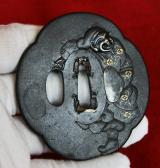
An Amazing Edo Period Tsuba Of Charm and Quality
An iron plate of mokko form with a takebori figure of an 'immortal' type figure. Finely inlaid with gold and silver upon his garb.
Tsuba were made by whole dynasties of craftsmen whose only craft was making tsuba. They were usually lavishly decorated. In addition to being collectors items, they were often used as heirlooms, passed from one generation to the next. Japanese families with samurai roots sometimes have their family crest (mon) crafted onto a tsuba. Tsuba can be found in a variety of metals and alloys, including iron, steel, brass, copper and shakudo. In a duel, two participants may lock their katana together at the point of the tsuba and push, trying to gain a better position from which to strike the other down. This is known as tsubazeriai pushing tsuba against each other. read more
675.00 GBP

A Beautiful Ancient Samurai Long Sword, A Koto Period Katana Around 500 Years Old Sengoku Period With All Original Edo Period Mounts & Fittings
A most impressive and beautiful sword, a fine statement piece of any collection of oriental art. A sword mounted in wonderful original Edo period koshirae, all decorated on the theme of bamboo.
A superb pair of shakudo fuchigashira carved with bamboo leaves, shakudo is a billon of gold and copper (typically 4-10% gold, 96-90% copper) which can be treated to form an indigo/black patina resembling lacquer. Unpatinated shakudo Visually resembles bronze; the dark colour is induced by applying and heating rokusho, a special patination formula. Shakudo was historically used in Japan to construct or decorate katana fittings such as tsuba, menuki, and kozuka; as well as other small ornaments. When it was introduced to the West in the mid-19th century, it was thought to be previously unknown outside Asia, but recent studies have suggested close similarities to certain decorative alloys used in ancient Egypt, Greece, and Rome.
Large iron plate tsuba with bamboo and birds, and bamboo form menuki under the green/blue silk wrap over giant rayskin. The original Edo saya is subtly decorated with incredible skill and detail with wonderful, dark, scrolling and crushed Abilene shell. Long powerful blade, with beautiful polish. The activity of the grain in the hada {blade mid section} is now visible since renovation, and it looks absolutely beautiful, especially bearing in mind it is around 500 years old.
For centuries, if not millennia, bamboo has permeated everyday Japanese life, figured in some of the country’s best-known literature and become a staple of its art, as both motif and material. Its propensity to bend yet endure makes it a cultural symbol. In both Japan and China, an ink painting of a tiger in a grove of bamboo signifies social harmony and, it would seem, political savvy, as this wily animal is among the few able to navigate the dense bamboo forest. Bamboo contains multitudes. Perhaps nowhere more than in Japan, home to over 600 species of this amazing plant, officially a subfamily of grasses but blessed with a woody stem and the ability to lift well above its weight. Japan’s ubiquitous bamboo is unsurprisingly storied. Woven artifacts evidence from the later Jomon Period (10,000-200 B.C.). The ancient nation- and culture-building texts, the “Kojiki” (Records of Ancient Matters) and “Nihon Shoki” (“The Chronicles of Japan”), record bamboo knives and combs with magical powers. The oldest surviving baskets are 8th-century offering trays kept in the Shosoin treasure house in Nara. Bamboo was obviously crucial to the 10th-century prose narrative “Taketori Monogatari” (“Tale of the Bamboo Cutter”). Tea masters of the 15th century revered seemingly artless utensils in their burgeoning spiritual practice. Emperors were gifted the choicest of bamboo wares. The Sengoku period Sengoku Jidai, "Warring States period") is a period in Japanese history of near-constant civil war, social upheaval, and intrigue from 1467 to 1615.
The Sengoku period was initiated by the Ōnin War in 1467 which collapsed the feudal system of Japan under the Ashikaga Shogunate. Various samurai warlords and clans fought for control over Japan in the power vacuum, while the Ikkō-ikki emerged to fight against samurai rule. The arrival of Europeans in 1543 introduced the arquebus into Japanese warfare, and Japan ended its status as a tributary state of China in 1549. Oda Nobunaga dissolved the Ashikaga Shogunate in 1573 and launched a war of political unification by force, including the Ishiyama Hongan-ji War, until his death in the Honnō-ji Incident in 1582. Nobunaga's successor Toyotomi Hideyoshi completed his campaign to unify Japan and consolidated his rule with numerous influential reforms. Hideyoshi launched the Japanese invasions of Korea in 1592, but their eventual failure damaged his prestige before his death in 1598. Tokugawa Ieyasu displaced Hideyoshi's young son and successor Toyotomi Hideyori at the Battle of Sekigahara in 1600 and re-established the feudal system under the Tokugawa Shogunate. The Sengoku period ended when Toyotomi loyalists were defeated at the siege of Osaka in 1615.
It has been over one thousand years ago that the art of making swords appeared in Japan. The swordsmiths of the time may not have known it but they were creating a legendary sword. The Samurai sword has seen combat in many battlefields. From the early days of the Samurai warrior to the fierce battles in the South Pacific during WWII.
From the earliest days hand-made traditional the Samurai sword was unique because it was forged using the finest skills known to man. A tremendous amount of work was dedicated to creating these pieces. They were an instrument of war as much as a beautiful artifact to adorn any decor.
As once told to us by an esteemed regular visitor to us here in our gallery, Victor Harris {the most eminent sword expert in Europe, and sword curator of the British Museum} and his same words that are repeated in his book, see below;
“In these textures lies an extraordinary and unique feature of the sword - the steel itself possesses an intrinsic beauty. The Japanese sword has been appreciated as an art object since its perfection some time during the tenth century AD. Fine swords have been more highly prized than lands or riches, those of superior quality being handed down from generation to generation. In fact, many well-documented swords, whose blades are signed by their makers, survive from nearly a thousand years ago. Recognizable features of the blades of hundreds of schools of sword-making have been punctiliously recorded, and the study of the sword is a guide to the flow of Japanese history.”
Victor Harris
Curator, Assistant Keeper and then Keeper (1998-2003) of the Department of Japanese Antiquities at the British Museum. He studied from 1968-71 under Sato Kenzan, Tokyo National Museum and Society for the Preservation of Japanese Swords
For those that have interest in original Japanese swords, this is a perfect way to have a superbly made original hand made sword that it mounted in original Japanese fittings of the early samurai form of katana.
** Authentic, currently, modern hand-made nihonto (Japanese sword blades) from licensed swordsmiths in Japan today, typically start around $10,000–$25,000 for a katana, with prices often exceeding $60,000 for renowned top-tier sword masters or customized commissions.
These blades, forged from tamahagane steel, require 12+ months to create due to strict legal limits on production, with some high-end, custom pieces from master smiths such as Yoshindo Yoshihara exceeding $10,000 for smaller tanto blades.
A brand new, katana blade from a reputable but lower ranked smith usually starts around $7,500–$10,000.
Every single item from The Lanes Armoury is accompanied by our unique Certificate of Authenticity. Part of our continued dedication to maintain the standards forged by us over the past 100 years of our family’s trading, as Britain’s oldest established, and favourite, armoury and gallery
.
Overall in super condition, just tiny denting to the small kashira {as is often the case}, overall length in saya 37.5 inches long, when the sword is withdrawn from saya it is 35.25 inches long overall read more
7450.00 GBP

A Very Fine Yasutsugu School Katana, circa 1675-1684 Likely the 4th Generation, Signed, with Aoi Mon, Namban Tetsu Oite Bushu Edo Echizen Yasutsugu
With a stunning bi coloured, black ribbed and cinnabar red lacquer saya, hand decorated with a wonderful light feathering and a scrolling silver saya jiri bottom mount. The mounts fuchi kashira and menuki are gold and shakudo decorated of the chrysanthemum. The story of the Yasutsugu lineage starts with the birth of the first generation, Ichizaemon, who is believed to have been born around the middle of the sixteenth century. His place of birth was in Shimosaka of Shiga-gun in the province of Omi. Omi is next to Mino and contains Lake Biwa. Yasutsugu was born into a sword making family headed by his father, Hironaga, reputed to be the last descendent of Yamato no Kuni Senjuin. Though his father was from Omi, he was trained in the Mino tradition. Around the 11th or 12th year of this same period of Keicho (1606-1607), Yasutsugu’s fame reached the point that he was called to Edo (Tokyo) to share his forging skills with Tokugawa Ieyasu. About this time Yasutsugu was given the privilege of using the character “Yasu” (康) from Tokugawa Ieyasu’s (徳川家康) name. Thus, from that point on, he changed his name to Yasutsugu. About the same time (some feel it was a few years later) he was given the additional privilege of carving the Hollyhock crest (Aoi mon) on his blades. These privileges were given in perpetuity to Yasutsugu and his descendants. Thus the Yasutsugu swordsmiths became the kaji of the Tokugawa Family.
Yasutsugu worked in Echizen and Edo as was the custom with the Tokugawa family in those days. It was much like the practice of Sankin Kodai (alternate year attendance) that was required of the Daimyo of the country. He died in seventh year of Genna (1621) probably in his 70’s.
Upon the death of the first generation Yasutsugu , the family mantle was taken up by his son, Ichinojô.
Nidai Yasutsugu made swords in the same style as the first generation. Some say that his ability was nearly the equal of his father’s. While all do not agree, there seems to be a consensus that he was without a doubt a close second
The two branches of the Yasutsugu school continued for many generations. The Edo school continued through eleven generations. It is generally agreed that the only two smiths of the last eight generations that were of note are the fourth our sword and the eleventh generations. The fourth generation had the advantage of being trained by the third generation, a quality smith. In addition, the fourth generation left several works in which he collaborated with the well-known smith, Izumi (no) Kami Kaneshige. The fourth generation’s working period was from 1675, the third year of Enpo to 1684, the first year of Teikyo era.
Interestingly, the steel used to produce this sword was in part sourced from Europe, likely from
Dutch traders. This steel was known as “Namban tetsu”, (lit. Southern Barbarian steel). It would
have been expensive and unique to produce swords with steel from faraway lands in the late
1600s. Thus the nakago (tang) is chiselled with the words Namban tetsu.
it is mounted with An Antique Edo Period Iron Large Tsuba Inlaid with Silver Aoi Leaves
The Tsuba can be solid, semi pierced of fully pierced, with an overall perforated design, but it always a central opening which narrows at its peak for the blade to fit within. It often can have openings for the kozuka and kogai to pass through, and these openings can also often be filled with metal to seal them closed. For the Samurai, it also functioned as an article of distinction, as his sole personal ornament. The tsukaito is beautifully traditionally rebound as is the black ribbing lacquer, on its original Edo lacquer saya.
As can be seen it is likely in its last original Edo polish in stunning condition which is beautiful, with just the tiniest natural aged surface mark. The kashira is carved buffalo horn with an applied gold lacquer partially complete aoi mon
Overall length in saya 38 3/4, blade tsuba to tip 27 3/4 inches long
It has been over one thousand years ago that the art of making swords appeared in Japan. The swordsmiths of the time may not have known it but they were creating a legendary sword. The Samurai sword has seen combat in many battlefields. From the early days of the Samurai warrior to the fierce battles in the South Pacific during WWII.
From the earliest days hand-made traditional the Samurai sword was unique because it was forged using the finest skills known to man. A tremendous amount of work was dedicated to creating these pieces. They were an instrument of war as much as a beautiful artifact to adorn any decor.
As once told to us by an esteemed regular visitor to us here in our gallery, Victor Harris {the most eminent sword expert in Europe, and sword curator of the British Museum} and his same words that are repeated in his book, see below;
“In these textures lies an extraordinary and unique feature of the sword - the steel itself possesses an intrinsic beauty. The Japanese sword has been appreciated as an art object since its perfection some time during the tenth century AD. Fine swords have been more highly prized than lands or riches, those of superior quality being handed down from generation to generation. In fact, many well-documented swords, whose blades are signed by their makers, survive from nearly a thousand years ago. Recognizable features of the blades of hundreds of schools of sword-making have been punctiliously recorded, and the study of the sword is a guide to the flow of Japanese history.”
Victor Harris
Curator, Assistant Keeper and then Keeper (1998-2003) of the Department of Japanese Antiquities at the British Museum. He studied from 1968-71 under Sato Kenzan, Tokyo National Museum and Society for the Preservation of Japanese Swords
For those that have interest in original Japanese swords, this is a perfect way to have a superbly made original hand made sword that it mounted in original Japanese fittings of the early samurai form of katana.
** Authentic, currently, modern hand-made nihonto (Japanese sword blades) from licensed swordsmiths in Japan today, typically start around $10,000–$25,000 for a katana, with prices often exceeding $60,000 for renowned top-tier sword masters or customized commissions.
These blades, forged from tamahagane steel, require 12+ months to create due to strict legal limits on production, with some high-end, custom pieces from master smiths such as Yoshindo Yoshihara exceeding $10,000 for smaller tanto blades.
A brand new, katana blade from a reputable but lower ranked smith usually starts around $7,500–$10,000.
Every single item from The Lanes Armoury is accompanied by our unique Certificate of Authenticity. Part of our continued dedication to maintain the standards forged by us over the past 100 years of our family’s trading, as Britain’s oldest established, and favourite, armoury and gallery read more
12950.00 GBP
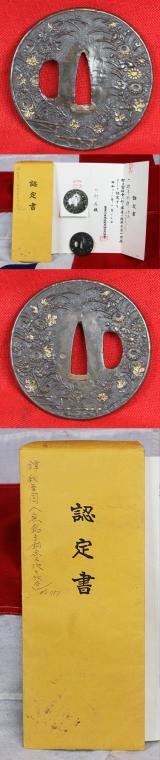
A Beautiful Late Edo Bakumatsu Copper Katana Tsuba With NBTHK Papers.
Bakumatsu copper tsuba, NBTHK Kicho Kodugu papers from 2020. With a translation, the "ninteisho" is introducing the document as recognition written in calligraphy. The tsuba is decorated with Aki kusa, Autumn grass [flowers], unsigned. The Nihon Bijutsu Tōken Hozon Kyōkai is a public interest incorporated foundation established in February 1948 to preserve and promote Japanese swords that have artistic value. Tsuba are usually finely decorated, and are highly desirable collectors' items in their own right. Tsuba were made by whole dynasties of craftsmen whose only craft was making tsuba. They were usually lavishly decorated. In addition to being collectors items, they were often used as heirlooms, passed from one generation to the next. Japanese families with samurai roots sometimes have their family crest (mon) crafted onto a tsuba. Tsuba can be found in a variety of metals and alloys, including iron, steel, brass, copper and shakudo. In a duel, two participants may lock their katana together at the point of the tsuba and push, trying to gain a better position from which to strike the other down. This is known as tsubazeriai pushing tsuba against each other. The tsuba has north and south kuchi-beni.
Literally "lipstick", but refers to the copper plugs of the nakago-ana. Their function is to secure the tsuba firmly when mounted on a blade. These plugs are sometimes called sekigane. read more
695.00 GBP

A Simply Stunning A Fabulous Original Antique Shinto Early Edo Period Chisa Katana. Wondrous Pure Gold and Shakudo Mounts Of The Tale of Momotarō, the Demon and The Monkey. Superbly Beautiful Blade Hamon and Hada Grain
An absolute beauty of an original samurai sword katana.
The blade is in amazing condition with a breathtaking hamon and hada, it is truly amazing! with a beautiful iron mokko plate tsuba with a silver faced figure fishing from a stream flowning down from a mountail range. The saya is decorated in ishime stone finish lacquer.
The koshirae {mounts and fittings} are equally wonderful, the kashira is carved buffalo horn and the fushi in gold and shakudo on a nanako ground, of the monkey, in three different images of it running, and the menuki are also very fine, of pure gold and shakudo depicting the monkey and the evil Oni {demon}. They represent the Japanese folklore story featuring an oni (demon/ogre) and a monkey is Momotarō (Peach Boy). Nanako Ji: "fish roe ground" A surface decoration produced by forming very small raised bosses by a sharply struck punch or burin called 'nanako tagane'. Shakudo is the metal most often used, but copper and gold are quite often employed. The harder metals, shibuichi, silver and iron are rarely decorated in this way. The size of the dots vary from 0.04" to 0.008" (25 to 125 and inch) and the regularity of the work is marvelous as the dots must be spaced entirely by touch. The dots are usually arranged in straight lines or in lines parallel to the edge of the piece being decorated, but sometimes in more elaborate patterns. Used on guards since the Momoyama period although the technique existed since much earlier periods. Usually done by specialist 'nanako-shi', but sometimes done by the maker of the guard himself.
Shakudo is a billon of gold and copper (typically 4-10% gold, 96-90% copper) which can be treated to form an indigo/black patina resembling lacquer. Unpatinated shakudo Visually resembles bronze; the dark color is induced by applying and heating rokusho, a special patination formula.
Shakudo Was historically used in Japan to construct or decorate katana fittings such as tsuba, menuki, and kozuka; as well as other small ornaments. When it was introduced to the West in the mid-19th century, it was thought to be previously unknown outside Asia, but recent studies have suggested close similarities to certain decorative alloys used in ancient Egypt, Greece, and Rome. The lacquer surface of the saya has some age bruising etc. due to its vintage
In the tale, depicted within the mounts of the sword, a monkey is one of three animal companions who aid the hero in defeating malevolent oni on Onigashima (Demon Island).
The Tale of Momotarō (Peach Boy)
An elderly couple finds a giant peach floating down a river. Inside is a baby boy, who they name Momotarō ("Peach Boy").
The Journey: Momotarō grows up with incredible strength and decides to go to Onigashima to stop the oni, who are kidnapping people and stealing treasure.
On his journey, Momotarō meets a talking dog, a monkey, and a pheasant. He shares his special millet dumplings (kibi dango) with them, gaining their loyalty and friendship.
The Battle: Upon reaching the island, the monkey uses his agility to infiltrate the demon fortress. Together, Momotarō and his companions overpower the demon chief and his followers.
Victory: The defeated oni promise never to bother the villagers again, and Momotarō returns home with the captured demon chief and stolen treasure.
The Monkey: In the story, the monkey is agile and clever, acting as a key strategist and fighter.
Oni: The oni represent evil and the obstacles that need to be overcome.
The Teamwork: The story is a famous example of team-based success in Japanese culture, emphasizing how different strengths (the dog's loyalty, the monkey's agility, and the pheasant's vision) can overcome a strong adversary.
This tale is deeply rooted in Japanese culture, particularly in Okayama Prefecture, where it is believed the legend originated.
The Chisa Katana samurai sword;
The most common blade cutting edge lengths for Chisa katana was approximately eighteen to twenty-four inches. They were most commonly made in the Buke-Zukuri mounting (which is generally what is seen on katana and wakizashi). The chisa katana was able to be used with one or two hands like a katana (with a small gap in between the hands) and especially made for double sword combat a sword in each hand.
It was the weapon of preference worn by the personal Samurai guard of a Daimyo Samurai war lord clan chief, as very often the Daimyo would be more likely within his castle than without. The chisa katana sword was far more effective a defence against any threat to the Daimyo's life by assassins or the so-called Ninja when hand to hand sword combat was within the Castle structure, due to the restrictions of their uniform low ceiling height. The hilt was usually around ten to eleven inches in length, but could be from eight inches or up to twelve inches depending on the Samurai's It has been over one thousand years ago that the art of making swords appeared in Japan. The swordsmiths of the time may not have known it but they were creating a legendary sword. The Samurai sword has seen combat in many battlefields. From the early days of the Samurai warrior to the fierce battles in the South Pacific during WWII.
From the earliest days hand-made traditional the Samurai sword was unique because it was forged using the finest skills known to man. A tremendous amount of work was dedicated to creating these pieces. They were an instrument of war as much as a beautiful artifact to adorn any decor.
As once told to us by an esteemed regular visitor to us here in our gallery, Victor Harris {the most eminent sword expert in Europe, and sword curator of the British Museum} and his same words that are repeated in his book, see below;
“In these textures lies an extraordinary and unique feature of the sword - the steel itself possesses an intrinsic beauty. The Japanese sword has been appreciated as an art object since its perfection some time during the tenth century AD. Fine swords have been more highly prized than lands or riches, those of superior quality being handed down from generation to generation. In fact, many well-documented swords, whose blades are signed by their makers, survive from nearly a thousand years ago. Recognizable features of the blades of hundreds of schools of sword-making have been punctiliously recorded, and the study of the sword is a guide to the flow of Japanese history.”
Victor Harris
Curator, Assistant Keeper and then Keeper (1998-2003) of the Department of Japanese Antiquities at the British Museum. He studied from 1968-71 under Sato Kenzan, Tokyo National Museum and Society for the Preservation of Japanese Swords
For those that have interest in original Japanese swords, this is a perfect way to have a superbly made original hand made sword that it mounted in original Japanese fittings of the early samurai form of katana.
** Authentic, currently, modern hand-made nihonto (Japanese sword blades) from licensed swordsmiths in Japan today, typically start around $10,000–$25,000 for a katana, with prices often exceeding $60,000 for renowned top-tier sword masters or customized commissions.
These blades, forged from tamahagane steel, require 12+ months to create due to strict legal limits on production, with some high-end, custom pieces from master smiths such as Yoshindo Yoshihara exceeding $10,000 for smaller tanto blades.
A brand new, katana blade from a reputable but lower ranked smith usually starts around $7,500–$10,000.
Every single item from The Lanes Armoury is accompanied by our unique Certificate of Authenticity. Part of our continued dedication to maintain the standards forged by us over the past 100 years of our family’s trading, as Britain’s oldest established, and favourite, armoury and gallery
The blade is 22 inches long from tsuba to tip read more
4750.00 GBP

A Delightful & Beautiful Early to Mid Edo Period 1598-1863 Samurai War Arrow. A Long Bladed Armour Piercing Tagari-Ya, With Yadake Bamboo haft, & Sea Eagle Feather Flights and a Traditional Tamahagane Tempered Steel Head In Stunning Polish with Hamon
Yanagi-Ha (willow leaf) Form. With original traditional eagle feathers, probably the large edge-wing feathers of a Japanese sea eagle.
The armour pierceing arrow tip, of yanagi-ha form, that is swollen at the tip to have the extra piercing power to penetrate armour and helmets {kabuto}, is a brightly polished, traditional tamagahane steel hand made, by a sword smith, long arrow head, originally hand made with folding and tempering exactly as would be a samurai sword blade, possibly signed on the tang under the binding but we would never remove it to see. The Edo period early eagle feathers are now slightly worn.
It is entirely indicative of the Japanese principle that as much time skill and effort be used to create a single 'fire and forget' arrow, as would be used to make a tanto or katana. A British or European blacksmith might once have made ten or twenty arrows a day, a Japanese craftsman might take a week to make a single arrow, that has a useable combat life of maybe two minutes, the same as a simplest British long bow arrow.
The Togari-Ya or pointed arrowheads look like a miniature version of a long Yari (spear) and were used only for war and are armour piercing arrows . Despite being somewhat of a weapon that was 'fire and forget' it was created regardless of cost and time, like no other arrow ever was outside of Japan. For example, to create the arrow head alone, in the very same traditional way today, using tamahagane steel, folding and forging, water quench tempering, then followed by polishing, it would likely cost way in excess of a thousand pounds, that is if you could find a Japanese master sword smith today who would make one for you. Then would would need hafting, binding, and feathering, by a completely separate artisan, and finally, using eagle feathers as flights, would be very likely impossible. This is a simple example of how incredible value finest samurai weaponry can be, items that can be acquired from us that would cost many times the price of our original antiques in order to recreate today. Kyu Jutsu is the art of Japanese archery.The beginning of archery in Japan is pre-historical. The first images picturing the distinct Japanese asymmetrical longbow are from the Yayoi period (c. 500 BC – 300 AD).
The changing of society and the military class (samurai) taking power at the end of the first millennium created a requirement for education in archery. This led to the birth of the first kyujutsu ryūha (style), the Henmi-ryū, founded by Henmi Kiyomitsu in the 12th century. The Takeda-ryū and the mounted archery school Ogasawara-ryū were later founded by his descendants. The need for archers grew dramatically during the Genpei War (1180–1185) and as a result the founder of the Ogasawara-ryū (Ogasawara Nagakiyo), began teaching yabusame (mounted archery) In the twelfth and thirteenth century a bow was the primary weapon of a warrior on the battlefield. Bow on the battlefield stopped dominating only after the appearance of firearm.The beginning of archery in Japan is pre-historical. The first images picturing the distinct Japanese asymmetrical longbow are from the Yayoi period (c. 500 BC – 300 AD).
The changing of society and the military class (samurai) taking power at the end of the first millennium created a requirement for education in archery. This led to the birth of the first kyujutsu ryūha (style), the Henmi-ryū, founded by Henmi Kiyomitsu in the 12th century. The Takeda-ryū and the mounted archery school Ogasawara-ryū were later founded by his descendants. The need for archers grew dramatically during the Genpei War (1180–1185) and as a result the founder of the Ogasawara-ryū (Ogasawara Nagakiyo), began teaching yabusame (mounted archery) Warriors practiced several types of archery, according to changes in weaponry and the role of the military in different periods. Mounted archery, also known as military archery, was the most prized of warrior skills and was practiced consistently by professional soldiers from the outset in Japan. Different procedures were followed that distinguished archery intended as warrior training from contests or religious practices in which form and formality were of primary importance. Civil archery entailed shooting from a standing position, and emphasis was placed upon form rather than meeting a target accurately. By far the most common type of archery in Japan, civil or civilian archery contests did not provide sufficient preparation for battle, and remained largely ceremonial. By contrast, military training entailed mounted maneuvers in which infantry troops with bow and arrow supported equestrian archers.
Mock battles were staged, sometimes as a show of force to dissuade enemy forces from attacking. While early medieval warfare often began with a formalized archery contest between commanders, deployment of firearms and the constant warfare of the 15th and 16th centuries ultimately led to the decline of archery in battle. In the Edo period archery was considered an art, and members of the warrior classes participated in archery contests that venerated this technique as the most favoured weapon of the samurai. In the gallery is from an edo exhibition of archery that shows a tagari ya arrow pierced completely through, back and front, an armoured steel multi plate kabuto helmet.
Every item is accompanied with our unique, Certificate of Authenticity. Of course any certificate of authenticity, given by even the best specialist dealers, in any field, all around the world, is simply a piece of paper,…however, ours is backed up with the fact we are the largest dealers of our kind in the world, with over 100 years and four generation’s of professional trading experience behind us read more
645.00 GBP

A Beautiful Koto-Shinto Period Signed Yasuhiro, in KiiKuni. Antique Samurai Daisho With Rokakku Clan Mon. Traditional Daisho, the Two Swords Of The Samurai, Comprise a Fine Daito Long Sword & Signed Shoto Short Sword. With With Pierced Rokakko Mon
Signed Koto daisho, circa 16th century , with beautiful elegant blades, the saya are very fine, delicate and rare, light ‘cinnabar red’ lacquer, also known as coromandel red {named from the pink petaled flower} urushi lacquer to the saya, often made with the addition of perilla oil. The condition of both saya is very good just a couple of aged surface nicks
The colour created from urushi lacquer mixed with cinnabar was rewarded to them as the most famous warriors of all the samurai clans of Japan, the Li, and the Takeda.
The blades both have superbly beautiful notare hamon, in very good polish
Signed 記伊國住 康廣
Kii Kuni. Jyu Yasu Hiro.
The meaning is Yasuhiro, who lives in KiiKuni.
However, the first word is written as 記. But the better kanji should be 紀. It is impossible to mistake the name of the place where one lives, so one could research that kanji.
This sword was made in the 1500’s to 1600s. There were two generations of Yasuhiro there at that time.
Their clan mon tettsu tsuba have a polished surface finish bevelled towards the edge. Matching daito long sword and shoto short sword tsubas, very finely pierced with the Rokakku samurai clan's crest, the "kamon". The tsuka ito was rebound in cream silk in the post Taisho period, as is very usual due to the wear and natural aging of the Edo period silk tsuka-ito, and the signed cast fuchi kashira, that have a deep takebori design Hiranami style of crashing waves in gilt over metal, and the four gilt and silvered menuki of samurai are all very likely from that same late period.
Founded by Sasaki Yasutsuna of Omi Province in the 13th century, the name Rokkaku was taken from their residence within Kyoto; however, many members of this family continued to be called Sasaki. Over the course of the Muromachi period, members of the clan held the high post of Constable (shugo) of various provinces.
During the Onin War (1467-77), which marked the beginning of the Sengoku period, the clan's Kannonji Castle came under assault. As a consequence of defeat in the field, the clan entered a period of decline.
Like other hard-pressed daimyos, the Rokakku tried to enhance their military position by giving closer attention to improved civil administration within their domain. For instance, in 1549, the Rokakku eliminated a paper merchant's guild in Mino under penalty of confiscation. Then they declared a free market in its place.
The Rokakku were defeated by Oda Nobunaga in 1568 on his march to Kyoto and in 1570 they were absolutely defeated by Shibata Katsuie. During the Edo period, Rokkaku Yoshisuke's descendants were considered a koke clan. Historically, or in a more general context, the term koke may refer to a family of old lineage and distinction. Tsuba were made by whole dynasties of craftsmen whose only craft was making tsuba. They were usually lavishly decorated. In addition to being collectors items, they were often used as heirlooms, passed from one generation to the next. Japanese families with samurai roots sometimes have their family crest (mon) crafted onto a tsuba. Tsuba can be found in a variety of metals and alloys, including iron, steel, brass, copper and shakudo. In a duel, two participants may lock their katana together at the point of the tsuba and push, trying to gain a better position from which to strike the other down. This is known as tsubazeriai pushing tsuba against each other. A samurai's daisho were his swords, as worn together, as stated in the Tokugawa edicts. In a samurai family the swords were so revered that they were passed down from generation to generation, from father to son. If the hilt or scabbard wore out or broke, new ones would be fashioned for the all-important blade. The hilt, the tsuba (hand guard), and the scabbard themselves were often great art objects, with fittings sometimes of gold or silver. Often, too, they ?told? a story from Japanese myths. Magnificent specimens of Japanese swords can be seen today in the Tokugawa Art Museum?s collection in Nagoya, Japan.
In creating the sword, a sword craftsman, such as, say, the legendary Masamune, had to surmount a virtual technological impossibility. The blade had to be forged so that it would hold a very sharp edge and yet not break in the ferocity of a duel. To achieve these twin objectives, the sword maker was faced with a considerable metallurgical challenge. Steel that is hard enough to take a sharp edge is brittle. Conversely, steel that will not break is considered soft steel and will not take a keen edge. Japanese sword artisans solved that dilemma in an ingenious way. Four metal bars, a soft iron bar to guard against the blade breaking, two hard iron bars to prevent bending and a steel bar to take a sharp cutting edge were all heated at a high temperature, then hammered together into a long, rectangular bar that would become the sword blade. When the swordsmith worked the blade to shape it, the steel took the beginnings of an edge, while the softer metal ensured the blade would not break. This intricate forging process was followed by numerous complex processes culminating in specialist polishing to reveal the blades hamon and to thus create the blade's sharp edge. Inazo Nitobe stated: 'The swordsmith was not a mere artisan but an inspired artist and his workshop a sanctuary. Daily, he commenced his craft with prayer and purification', or, as the phrase was, 'he committed his soul and spirit into the forging and tempering of the steel.'
Celebrated sword masters in the golden age of the samurai, roughly from the 13th to the 17th centuries, were indeed revered to the status they richly deserved.
As once told to us by an esteemed regular visitor to us here in our gallery, and the same words that are repeated in his book;
“In these textures lies an extraordinary and unique feature of the sword - the steel itself possesses an intrinsic beauty. The Japanese sword has been appreciated as an art object since its perfection some time during the tenth century AD. Fine swords have been more highly prized than lands or riches, those of superior quality being handed down from generation to generation. In fact, many well-documented swords, whose blades are signed by their makers, survive from nearly a thousand years ago. Recognizable features of the blades of hundreds of schools of sword-making have been punctiliously recorded, and the study of the sword is a guide to the flow of Japanese history.”
Victor Harris
Curator, Assistant Keeper and then Keeper (1998-2003) of the Department of Japanese Antiquities at the British Museum. He studied from 1968-71 under Sato Kenzan, Tokyo National Museum and Society for the Preservation of Japanese Swords
Every single item from The Lanes Armoury is accompanied by our unique Certificate of Authenticity. Part of our continued dedication to maintain the standards forged by us over the past 100 years of our family’s trading, as Britain’s oldest established, and favourite, armoury and gallery read more
15500.00 GBP