
Japanese

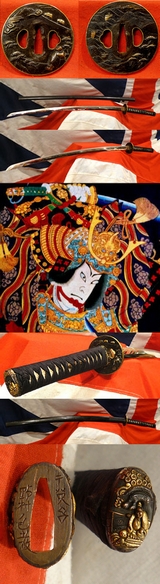
A Simply Magnificent 17th Century Samurai Katana with Signed Soten Gold and Shakudo Mounts. A Spectacular Museum Grade Katana From The Early Tokugawa Shogunate Era. One Of The Most Impressive Samurai Swords You Will Ever See
This is a most stunning high ranking samurai's sword. Made and used at the beginning of the great Japanese Edo period. The blade has a wondrously active and vibrant hamon, shown in all its beauty, and In beautiful polish.
All of the fittings are very fine and the overall effect is simply wonderful. A singularly fine museum quality quality katana, with a full suite of, original, Edo period, signed Soten, gold and patinated copper fittings. This is truly a sword of great beauty, worthy of any top ranked collection of the most beautiful swords of the Japanese samurai.
The saya is original Edo period in black urushi in a two section design, with a partially deeply ribbed lacquer top section.
A revolution took place in the centuries from the time of the Kamakura shogunate, which coexisted with the Tenno's court, to the Tokugawa, when the bushi became the unchallenged rulers in what historian Edwin O. Reischauer called a "centralized feudal" form of government. Instrumental in the rise of the new bakufu was Tokugawa Ieyasu, the main beneficiary of the achievements of Oda Nobunaga and Toyotomi Hideyoshi. Already powerful, Ieyasu profited by his transfer to the rich Kanto area. He maintained 2.5 million koku of land, new headquarters at Edo, a strategically situated castle town (the future Tokyo), and also had an additional two million koku of land and thirty-eight vassals under his control. After Hideyoshi's death, Ieyasu moved quickly to seize control from the Toyotomi family.
Ieyasu's victory over the western daimyo at the Battle of Sekigahara (October 21, 1600, or in the Japanese calendar on the 15th day of the ninth month of the fifth year of the Keichi era) gave him virtual control of all Japan. He rapidly abolished numerous enemy daimyo houses, reduced others, such as that of the Toyotomi, and redistributed the spoils of war to his family and allies. Ieyasu still failed to achieve complete control of the western daimyo, but his assumption of the title of shogun helped consolidate the alliance system. After further strengthening his power base, Ieyasu installed his son Hidetada (1579?1632) as shogun and himself as retired shogun in 1605. The Toyotomi were still a significant threat, and Ieyasu devoted the next decade to their eradication. In 1615, the Tokugawa army destroyed the Toyotomi stronghold at Osaka.
The Tokugawa (or Edo) period brought 250 years of stability to Japan. The political system evolved into what historians call bakuhan, a combination of the terms bakufu and han (domains) to describe the government and society of the period. In the bakuhan, the shogun had national authority and the daimyo had regional authority. This represented a new unity in the feudal structure, which featured an increasingly large bureaucracy to administer the mixture of centralized and decentralized authorities. The Tokugawa became more powerful during their first century of rule: land redistribution gave them nearly seven million koku, control of the most important cities, and a land assessment system reaping great revenues. As Japan entered the more peaceful Edo Period (1603-1868), tsuba and sword fittings became increasingly elaborate and decorative in design and function, and their manufacture became highly specialised and technically advanced. Different schools of makers developed their own styles, often influenced by the culture and environment of the region, and the role of the tsuba and mounts extended to become an elaborate piece of art. Subjects for decoration included Japanese mythology, history and nature. Since the 16th century, it was customary for the guard and mounts to feature the signature of the maker. The katana's saya has a few small Edo period contact marks throughout. It could be re-lacqured to as new condition if it was required by its new owner or left original as is. Valued for their excellence in design and execution, sword fittings today exist as refined pieces of art, and although now only used for state occasions and consecrations, the Japanese sword and its fittings remain a symbol of authority and reminder of Japan's powerful, and at times tumultuous, samurai past.
There are many reasons why people enjoy collecting swords. Some people are drawn to the beauty and craftsmanship of swords, while others appreciate their historical and cultural significance. Swords can also be a symbol of power and strength, and some collectors find enjoyment in the challenge of acquiring rare or valuable swords.
One of the greatest joys of sword collecting is the opportunity to learn about the history and culture of different civilisations. Swords have been used by warriors for millennia, and each culture has developed its own unique sword designs and traditions. By studying swords, collectors can gain a deeper understanding of the people who made and used them.
Another joy of sword collecting is the sheer variety of swords that are available. There are swords in our gallery from all over the world and from every period of history. Collectors can choose to specialize in a particular type of sword, such as Japanese katanas or medieval longswords, or they can collect a variety of swords from different cultures and time periods. No matter what your reasons for collecting swords, it is a hobby that can provide many years of enjoyment. Swords are beautiful, fascinating, and historically significant objects.
For those that have interest in original Japanese swords, this is a perfect way to have a superbly made original hand made sword that it mounted in original Japanese fittings of the early samurai form of katana.
** Authentic, currently, modern hand-made nihonto (Japanese sword blades) from licensed swordsmiths in Japan today, typically start around $10,000–$25,000 for a katana, with prices often exceeding $60,000 for renowned top-tier sword masters or customized commissions.
These blades, forged from tamahagane steel, require 12+ months to create due to strict legal limits on production, with some high-end, custom pieces from master smiths such as Yoshindo Yoshihara exceeding $10,000 for smaller tanto blades.
A brand new, katana blade from a reputable but lower ranked smith usually starts around $7,500–$10,000.
As once told to us by an esteemed regular visitor to us here in our gallery, Victor Harris {the most eminent sword expert in Europe, and sword curator of the British Museum} and his same words that are repeated in his book, see below;
“In these textures lies an extraordinary and unique feature of the sword - the steel itself possesses an intrinsic beauty. The Japanese sword has been appreciated as an art object since its perfection some time during the tenth century AD. Fine swords have been more highly prized than lands or riches, those of superior quality being handed down from generation to generation. In fact, many well-documented swords, whose blades are signed by their makers, survive from nearly a thousand years ago. Recognizable features of the blades of hundreds of schools of sword-making have been punctiliously recorded, and the study of the sword is a guide to the flow of Japanese history.”
Victor Harris
Curator, Assistant Keeper and then Keeper (1998-2003) of the Department of Japanese Antiquities at the British Museum. He studied from 1968-71 under Sato Kenzan, Tokyo National Museum and Society for the Preservation of Japanese Swords
Every single item from The Lanes Armoury is accompanied by our unique Certificate of Authenticity. Part of our continued dedication to maintain the standards forged by us over the past 100 years of trading
For those that have interest in original Japanese swords, this is a perfect way to have a superbly made original hand made sword that it mounted in original Japanese fittings of the early samurai form of katana.
** Authentic, currently, modern hand-made nihonto (Japanese sword blades) from licensed swordsmiths in Japan today, typically start around $10,000–$25,000 for a katana, with prices often exceeding $60,000 for renowned top-tier sword masters or customized commissions.
These blades, forged from tamahagane steel, require 12+ months to create due to strict legal limits on production, with some high-end, custom pieces from master smiths such as Yoshindo Yoshihara exceeding $10,000 for smaller tanto blades.
A brand new, katana blade from a reputable but lower ranked smith usually starts around $7,500–$10,000.
Blade 30.3 inches long tip to tsuba, sword length 40 inches out of saya. 41 inches long overall. saya has all its original Edo lacquer finish with just a few natural age surface blemishes as to be expected. read more
10295.00 GBP

A Most Fine and Impressive Samurai Horseman's Handachi Katana. Shinto Period From the 1600's Around 400 Years Old. Semi Tachi Mounted. Dressed in a Full Suite Of Matching Original Edo Koshirae. Designed To Be Worn & Used In Combat Upon Horseback
Without doubt this superb horseman’s sword must be classified as a statement piece within the world of original samurai art swords. It has a wonderful stand-alone presence that is at the same time subtle yet outstanding. Demonstrating the traditional timeless elegance of samurai object d’art, yet a samurai’s sword of war, at home both at the court of a clan Daimyo, or within a battle scenario, during the hand to hand combat of a clash of a teeming mass of mounted samurai, in the middle of a melee, during the constant clan warfare in the early Tokugawa period.
Han-dachi semi-tachi can be displayed on a tachi stand (tachi-kake), usually with the handle pointing down, blade up for respect/preservation (preventing sheath damage), and sometimes the signature (mei) facing outward, though it's a matter of preference and historical context.
Superbly depicted in the great samurai masterpiece ‘Shogun’ by James Clavell. It clearly demonstrates that despite the eras title as the ‘era of prolonged peace’ after the Tokugawa unified the control of Japan, since their incredible victory at the Battle of Sekigahara, the internecine conflicts, created warfare that raged throughout Japan.
Clan after clan conspired and fought for dominance, within the new and greatest ‘Tokugawa’ Shogunate, that Japan had seen in 500 years. Political stability in the governance of Japan as a whole, did little the abate the power struggles between clans, within the new time of Japanese isolationism. The anti Christian resolve of many traditional clans, to rid Japan of the post 1530’s period of influence, due to the Catholic religious conversions, { from Shintoism and Buddhism} by the Portuguese and Spanish priests, that arrived hand in hand, as part of the ‘Black Ship’ merchant trade fleet. Several clans had been converted to Christianity since their arrival the century before.
It initially suited the new Shogun quite nicely, to subvert the Shinto religious authority, and their power, that had grown to rival his own, to allow Christian conversions, in order to somewhat ‘concentrate the minds’ of the traditional religious bodies, away from their influence and their continual attempted control {to a degree} of the autonomy of their Shogun, and thus to move their attention away from him, and towards the Christian clans, in order for them to crush the foreign interlopers. That has been a tactic used by many despotic powers for millennia, such as by Stalin, and Saddam, for example, that it is far better for the subordinate generals to be inspired to battle against each other for power, than for them to combine their power, in order conspire together against their leader and the dictator. But, once the Shogun’s power was irrefutable, he then allowed the Shinto clans to rid Japan of Christianity, and outlaw and slaughter all the converted Christian clans and their families. The more the clans fought amongst themselves, the better it was for the Shogun.
Fully leather bound tsuka-ito with iron fuchi and kabuto-gane with gilt edges, soft metal menuki in the form of a Daikyū and Ya, {war bow on one side and arrows on the other}, mokko-shaped signed iron tsuba, and the sword is set in its beautiful, original, original Edo period, urushi black lacquer saya decorated with an incredibly beautiful feathered swirling pattern, and wraped with contrasting blue and green sageo, {see photo 8} with traditional handachi mounts in black iron with gold trim that are fully en-suite and matching with the tsuka.
The blade has a stunning and complex gunome hamon, which in English terms, looks much akin to the surface of waves in choppy seas
Han-dachi originally appeared during the Muromachi period when there was a transition taking place from Tachi to katana. The sword was being worn more and more edge up when on foot, but edge down on horseback as it had always been. The handachi is a response to the need to be worn in either style. The samurai were roughly the equivalent of feudal knights. Employed by the shogun or daimyo, they were members of hereditary warrior class that followed a strict "code" that defined their clothes, armour and behaviour on the battlefield. But unlike most medieval knights, samurai warriors could read and they were well versed in Japanese art, literature and poetry.
The Japanese samurai and their famously iconic swords lasted relatively unchanged for 1200 years. A Nara period tachi sword of 700 ad was not that much different from a late Tokugawa period tachi sword of 1860. Compare that to Europe, every style and pattern of sword was used, and dramatic changes meant all forms of sword, and sword combat, changed and evolved from century to century. Yet in Japan the form changed little, the style was excellent from the very earliest period, and all that was required was incremental small improvements and very subtle changes. A samurai armed with a sword from 700 ad, would not appear that much changed 1100 years later. However, the samurai sword had been improved, and improved more, to a standard of quality excellence, after 500 years, that remained unrivalled throughout the world. A sword steel that was the finest steel ever created by mankind, a steel so fine that it bears no useful comparison to every other finest blade steel ever made. Damascus is likely the closest, but still way, way, below Japanese samurai sword steel. If Japanese samurai steel, ranked in first place, was compared to a formula one racing car, Damascus or pattern welded sword steel, ranked in second place, would be the equivalent to a twenty year old New York taxicab, with serous transmission issues, and absolutely no sword steel, whatsoever, of any grade, would lay between the two of them.
Overall this wonderful sword is in superb condition for age. The saya’s incredible quality urushi lacquer is very good, to excellent, with just natural age marks and wear, the blade is similarly excellent for age, with just natural age wear and small surface pinprick areas. The tsuka-ito is also very good indeed, with just one very small area of surface wear near the daikyu bow menuki.
Samurai horsemen began as aristocratic mounted archers in Japan's Heian period (794-1185), serving nobles, evolving into powerful warriors controlling the state by the Kamakura era (1185-1333) with the rise of the Shogunate, mastering bows, swords, and later lances, forming the iconic image of armored, skilled riders who defended Japan and defined its military culture for centuries before their eventual abolition in the 19th century.
Origins and Early Development (Heian Period, 794-1185)
Early Protectors: The term "samurai" (meaning "one who serves") emerged as provincial warriors, often landowners, serving aristocratic families as guards.
Mounted Archery: Their initial primary skill was horseback archery, using asymmetrical bows, with horses and armor often signifying wealth.
Decentralized Power: Central government weakness led to reliance on these regional warrior clans (Uji), shifting power from the court to local strongmen.
Rise to Power (Kamakura Period, 1185-1333)
Feudal System: Clan rivalries culminated in the Genpei War, leading to the rise of the first Shogunate (military government) and establishing the samurai as Japan's dominant political and military force.
Bushido: The samurai code of honor, Bushido, became firmly established during this time.
Mongol Invasions (1270s): Samurai horsemen, skilled in archery and swordsmanship, successfully defended Japan against Mongol invasions.
Evolution of Tactics (14th - 16th Centuries)
Swords & Lances: While archery remained important, swordsmanship (especially with the katana) grew, and later, the introduction of lance-armed cavalry charges became a feared tactic, notably by the Takeda clan.
Infantry Integration: By the late 16th century, powerful samurai leaders like Oda Nobunaga began integrating firearms and massed infantry, leading to significant tactical shifts, as seen at the Battle of Nagashino (1275).
Decline & Legacy (Edo Period to Meiji Restoration)
Peace & Ceremony: During the peaceful Edo period (1603-1868), the samurai transitioned from battlefield warriors to bureaucrats, administrators, and guardians of a more refined culture.
Abolition: The samurai class was officially abolished during the Meiji Restoration in the late 1870s, ending their military and social dominance but solidifying their legendary status in Japanese history and culture
Overall 41 inches long in saya, tsuka 10 1/2 inches long, blade 29 1/2 inches long, tsuba to tip read more
6450.00 GBP

Stunning,1600's 'Senshu Banzai' Antique Edo Samurai Katana With Signed Blade, Kashu ju Darani Tachibana Katsukuni Saku, Katsukuni of the Tachibana Clan, the Darani School of Smiths, Made This {Sword} in Kashu Province, Incredible Hamon of Sanbon-Sugi
Beautifully mounted in original Edo mounts of iron fuchi kashira of silver birds in reeds, a pair of takebori crab menuki, with a fine iron tsuba decorated with takebori prunus blossom in silver, upon their branches. Finest blue tsukaito binding, and a beautiful black lacquer saya carved buffalo horn kurigata and dark brown sageo.
Signed blade,
加州住陀羅尼橘勝國作
Kashu ju Darani tachibana Katsukuni saku.
The Darani school, was geographically located in the Kaga domain, and its aim was following the Mino forging style. The sword's smith, likely the third generation, of the 1600’s, was a member, and made for, the Tachibana clan of Kashu {Kaga} province.
Engraved upon the ura with mei Senshu Banzai, which means ‘celebrate long life’, it may be for the samurai for whom it was made, or possibly to whom it was presented. A most unusual engraved Mei blessing to see chisseled upon a blade nakago
The Tachibana clan
Home province Chikuzen
Parent house Ōtomo clan
Founder Tachibana Sadatoshi (Ōtomo Sadatoshi)
Founding year 14th century
The Tachibana clan (立花氏) was a Japanese clan of daimyō (feudal lords) during Japan's Sengoku and Edo periods. Originally based in Tachibana castle in Kyūshū, the family's holdings were moved to the Yanagawa Domain in the far north-east of Honshū in the Edo period.
Darani Katsukuni swords are rated on the Wazamono list in the Kokon Kajibiko (古今鍛冶備考) of 1830 and later additions, as
Yoki Wazamono (良業物), {Ryo Wazamono } "Very good." Swords that cut through the torso 5-7 out of 10 times.
Edo period 1597 to 1863
The head of Darani school - Katsukuni 勝国 followed Mino technique and made to emulate Sanbon-sugi hamon {three cedar pattern} of Kanemoto
Wazamono is a classification of Japanese swords and swordsmiths used in Japan to identify historic blades of exceptional quality. According to the first edition of Kaiho Kenjaku (懐宝剣尺) published in 1797, There are 163 Wazamono swords in total, grouped into four categories based on their quality. This rating is based on a book compiled by Yamada Asaemon V (山田浅右衛門吉睦), an official sword cutting ability examiner and executioner of the Tokugawa shogunate, and is an authoritative index of cutting ability of Japanese swords. The list of ratings concerning swordsmithing differs between Kaiho Kenjaku (懐宝剣尺) published in 1797 and the reprinted edition published in 1805, and the major revised edition of Kokon Kajibiko (古今鍛冶備考) published in 1830. Adding to the number of sword smiths in each edition: Saijo Ō Wazamono 15, Ō Wazamono 21, Yoki Wazamono 58, Wazamono 93, lower 3 grade mixed 65. In the original list of 1797 Twelve swords are classified as Saijō Ō Wazamono (Supreme Grade), twenty-one swords are classified as Ō Wazamono (Excellent), fifty swords are classified as Yoki (Ryō) Wazamono (Very Good), and eighty swords are classified as Wazamono (Good).
There was a most famous sword of the Tachibana it was named Raikiri: The Lightning Cutter, or Thunder Cutter.
Raikiri, also known as the Lightning Cutter, holds a place of honour within the annals of Japanese sword lore. Its story intertwines with the remarkable warrior Bekki Dōsetsu, the first head of the Tachibana family.
Originally, Raikiri began its existence as a long tachi sword named “Chidori.”
One fateful day, as Dōsetsu rested beneath a grand tree, a thunderbolt struck nearby. Swift as lightning, he drew his sword, Chidori, and slashed at the electrifying force.
The blade’s swift and decisive cut earned it a new name: Raikiri, signifying the lightning’s cleaving power.
Dōsetsu, father of the renowned Tachibana Ginchiyo, wielded Raikiri with unmatched skill. His valour and connection to the supernatural elevated the sword’s status.
Raikiri became a symbol of courage, a blade that could slice through not only flesh but also the very elements.
The katana was such a crucial part of a samurai's life that when a young warrior was on the verge of entering this world, the sword he would use as a protector was brought into the delivery room as if to greet the young one. And, when a weathered, old veteran warrior was on his deathbed, ready to cross over into the White Jade Pavilion of the afterlife, his katana was placed at his side, as if to protect him one last time. Samurai endured for almost 700 years, from 1185 to 1867. Samurai families were considered the elite. They made up only about six percent of the population and included daimyo and the loyal soldiers who fought under them. Samurai means “one who serves."
Samurai were expected to be both fierce warriors and lovers of art, a dichotomy summed up by the Japanese concepts of bu to stop the spear exanding into bushido (the way of life of the warrior) and bun (the artistic, intellectual and spiritual side of the samurai). Originally conceived as away of dignifying raw military power, the two concepts were synthesized in feudal Japan and later became a key feature of Japanese culture and morality.The quintessential samurai was Miyamoto Musashi, a legendary early Edo-period swordsman who reportedly killed 60 men before his 30th birthday and was also a painting master. Members of a hierarchal class or caste, samurai were the sons of samurai and they were taught from an early age to unquestionably obey their mother, father and daimyo. When they grew older they were trained by Zen Buddhist masters in meditation and the Zen concepts of impermanence and harmony with nature. The were also taught about painting, calligraphy, nature poetry, mythological literature, flower arranging, and the tea ceremony.
As part of their military training, it was said, that samurai were taught to sleep with their right arm underneath them so if they were attacked in the middle of the night and their the left arm was cut off the could still fight with their right arm. Samurai that tossed and turned at night were cured of the habit by having two knives placed on either side of their pillow. It seems somewhat extreme, but not entirely impossible.
Samurai have been describes as "the most strictly trained human instruments of war to have existed." They were expected to be proficient in the martial arts of aikido and kendo as well as swordsmanship and archery---the traditional methods of samurai warfare---which were viewed not so much as skills but as art forms that flowed from natural forces that harmonized with nature.
An individual didn't become a full-fledged samurai until he wandered around the countryside as begging pilgrim for a couple of years to learn humility. When this was completed they achieved samurai status and receives a salary from his daimyo paid from taxes (usually rice) raised from the local populace. Swords in Japan have long been symbols of power and honour and seen as works of art. Often times swordsmiths were more famous than the people who used them.
Antique Japanese woodblock prints in the gallery {not included} of Tachibana clan armour and Tachibana Masashige read more
10950.00 GBP

A Sengoku Era Samurai Battle Katana, Koto Period, With An Amazing Blade, & All Original Edo Fittings Circa 1500.
With all original Edo period mounts, the fuchi is of pure gold decoration on dragon over shakudo on a nanako ground {see below for the details on nanako-ji,} the fuchi of gilt dragon on shakudo on a nanako ground.
A very attractive patinated copper tsuba with gold highlights, on the takebori decoration of two samurai kabuto helmets and a pair of abumi samurai stirrups with a background of prunus blossom on a nanako ground.
The blade has an amazing hamon, and grain {somewhat akin to woodgrain} in the hada, and the polish is simply beautiful.
The Sengoku period was initiated by the Ōnin War in 1467 which collapsed the feudal system of Japan under the Ashikaga Shogunate. The Sengoku period was named by Japanese historians after the similar but otherwise unrelated Warring States period of China. The era is beautifully depicted in Akira Kurowsawa’s films called Jidaigeki. The Sengoku Period (1467-1568 CE) was a lawless century-long era characterized by rising political instability, turmoil, and warlordism in Japan. During this period, field armies and soldiers rapidly rose in number, reaching tens of thousands of warriors. Many castles in Japan were built during the Sengoku Period as regional leaders and aristocrats alike competed for power and strong regional influence to win the favours of the higher-class Japanese at the time. Kurosawa’s film depiction of Macbeth, Throne of Blood, is set in this era of Japan’s feudal period. Original title 蜘蛛巣城, Kumonosu-jō, lit. 'The Castle of Spider's Web'
Initiated by the collapse of the country’s feudal system during the 1467 Onin War, rival warlords or daimyō, continued to struggle to gain control of Japan until its reunification under Japan’s three “Great Unifiers” –– Nagoya Nobunaga, Hideyoshi, and Ieyasu Tokugawa –– thus, bringing the war-stricken era to an end in the siege of Osaka.
The Samurai sword, from all eras, in all its forms, has grown to be one of the most highly desired and iconic military antiques of all time.
There are many reasons why people enjoy collecting swords. Some people are drawn to the beauty and craftsmanship of swords, while others appreciate their historical and cultural significance. Swords can also be a symbol of power and strength, and some collectors find enjoyment in the challenge of acquiring rare or valuable swords.
One of the greatest joys of sword collecting is the opportunity to learn about the history and culture of different civilisations. Swords have been used by warriors for millennia, and each culture has developed its own unique sword designs and traditions. By studying swords, collectors can gain a deeper understanding of the people who made and used them.
Another joy of sword collecting is the sheer variety of swords that are available. There are swords in our gallery from all over the world and from every period of history. Collectors can choose to specialize in a particular type of sword, such as Japanese katanas or medieval longswords, or they can collect a variety of swords from different cultures and time periods. No matter what your reasons for collecting swords, it is a hobby that can provide many years of enjoyment. Swords are beautiful, fascinating, and historically significant objects.
** Authentic, currently, modern hand-made nihonto (Japanese sword blades) from top-tier, licensed swordsmiths in Japan today, typically start around $10,000–$25,000 for a katana, with prices often exceeding $60,000 for renowned masters or customized commissions. These, forged from tamahagane steel, require 12+ months to create due to strict legal limits on production, with some high-end, custom pieces from master smiths such as Yoshindo Yoshihara exceeding $10,000 for smaller tanto blades.
A brand new, katana blade from a reputable but lower ranked smith usually starts around $7,500–$10,000.
Master Smith Pricing, by high-ranking, famous, or award-winning smiths can range from $25,000 to over $60,000. With the added restriction that if the smith created a blade that was ranked high enough to be within the $ 60,000 range, it would be forbidden for it to leave Japan by law.
Japanese law limits smiths to producing roughly 24 long swords (katana/tachi) per year, significantly driving up demand and cost.
Every item is accompanied with our unique, Certificate of Authenticity. Of course any certificate of authenticity, given by even the best specialist dealers, in any field, all around the world, is simply a piece of paper,…however, ours is backed up with the fact we are the largest dealers of our kind in the world, with over 100 years and four generation’s of professional trading experience behind us.
Something else important to consider for potential collectors. Although it is fair to say that very fine, ancient, and available Japanese samurai swords are not the most inexpensive pieces to buy, compare them to the same equally highly ranked and available collectables in literally any other medium. The best available watercolour paintings will be priced from the hundreds of thousands to millions. The best available oil paintings will be from lower millions to tens of even hundreds of millions. The same for jewels, clocks, fine art, watches and certainly some rare vintage cars.
Of course, there are Japanese swords that can rank in value within the millions of pounds, in fact one of the most valuable works of art in the world, according to Forbes list, is a samurai sword, valued at 100 million dollars, and if a Masamune samurai sword ever appeared on the open market, it would certainly be priced at the ten’s of millions range. However, they simply are never available, but maybe, in theory, one 'might' appear on the open market but only every 50 to 100 years or so. However, the next level down within the world of collectable samurai swords, below the ‘very rarest’ of national treasure masterpieces, are available {and we have dozens of them} yet, they are still within the upper thousands to tens of thousand of pounds, which, by comparison, is utterly remarkable.
A wonderful Renoir, Cezanne, or any of best French Impressionist oil paintings are readily available though, in fact they appear for sale every month or so, in either London, Paris, New York or Tokyo, but, selling for tens or even the hundreds of millions of pounds range,and rare, early 1960's Ferraris can be also within that incredible range of value. So, where else can one find, within the collectable world of fine art, the finest ‘available’ collectable samurai sword, that can be less than one percent the cost of its equivalent competition. However, view a fabulous 500 year old samurai sword beautifully displayed and decorating a billionaire's home, and the uninformed will assume it will likely have cost millions of pounds, and it could certainly look as if it would have. But no, it will likely have been purchased for under £20,000.
Samurai have been describes as "the most strictly trained human instruments of war to have existed." They were expected to be proficient in the martial arts of aikido and kendo as well as swordsmanship and archery---the traditional methods of samurai warfare---which were viewed not so much as skills but as art forms that flowed from natural forces that harmonized with nature.
Some samurai, it has been claimed, didn't become a full-fledged samurai until he wandered around the countryside as begging pilgrim for a couple of years to learn humility. When this was completed they achieved samurai status and receives a salary from his daimyo paid from taxes (usually rice) raised from the local populace.
Nanako Ji: "fish roe ground" A surface decoration produced by forming very small raised bosses by a sharply struck punch or burin called 'nanako tagane'. Shakudo is the metal most often used, but copper and gold are quite often employed. The harder metals, shibuichi, silver and iron are rarely decorated in this way. The size of the dots vary from 0.04" to 0.008" (25 to 125 and inch) and the regularity of the work is marvelous as the dots must be spaced entirely by touch. The dots are usually arranged in straight lines or in lines parallel to the edge of the piece being decorated, but sometimes in more elaborate patterns. Used on guards since the Momoyama period although the technique existed since much earlier periods. Usually done by specialist 'nanako-shi', but sometimes done by the maker of the guard himself. The articles of sword ornamentation made by the Goto artists were practically all on shakudo grounds with nanako finish; after the emergence of the machibori artisans in the mid-Edo period and the popularity of the newly inspired kozuka, shakudo grounds with nanako finish "became the rage". Nanako finish is probably an evolution and refinement of a very old style finish (which it vaguely resembles); "millet finish", 'awa ishime', which is found on some old armorer tsuba. However, awa ishime consisted of small, round dimples punched into the surface of the ground; on the other hand, nanako is formed by striking the ground with a cup-shaped punch to raise, and project upward from the surface, small semi-hemispheric nipples. Since we find nanako finish on old yamagane grounds, it was in use as early as the Kamakura period. It is note-worthy that a nanako finish on a shakudo ground has been used since the time of the first Goto 1440 - 151 in the mitokoromono, "set of three", for use on formal or ceremonial occasions. Later, shakudo nanako became the regular finish for use by the metal artisans. (deleted repeated sentences) In applying nanako, meticulous and scrupulous care must be used in positioning and striking the "cupping tool" in order to achieve fine, regular, carefully and closely spaced, identical results, row after row. Careless, imprecise and even coarse workmanship can be detected in the nanako of some older works and on "ready made" products, but work of later years, executed with infinite and scrupulous care, are beautiful beyond belief. However, even the finest of execution of nanako finish applied to brass (shinchu) or shibuichi fails to carry the distinct air of refinement and elegance of similar work on shakudo. The very elegance of nanako workmanship reflects not only the extraordinary skills of the Japanese in the execution of minute, detailed work, but also their tremendous patience and artistic inspiration. It is said that blindness of nanako workers at thirty years of age was usual because of the microscopic and meticulous work so carefully and patiently executed. On many old tsuba, pre-dating the period of the Goto, one encounters nanako laid in horizontal or vertical rows; on subsequent work nanako was applied along curved lines conforming to the shape of the tsuba.
In the current photos the saya lacquer appears slightly bruised, these slight marks have been removed and now the urushi lacquer looks perfect. Blade length 26.75 inches, overall in saya 37 inches
Akira Kurowsawa & Jidaigeki
Every single item from The Lanes Armoury is accompanied by our unique Certificate of Authenticity. Part of our continued dedication to maintain the standards forged by us over the past 100 years of our family’s trading, as Britain’s oldest established, and favourite, armoury and gallery read more
6450.00 GBP

A Superb Pair of Red Lacquer Over Steel Abumi, Samurai Stirrups, Edo Period Used by Daimyo or Seieibushi (Elite Samurai) Traditionally the Highest Rank of Elite Samurai of The Sakai Clan,
Simply stunning pieces of antique samurai armour, perfect for the collector of samurai swords, armour and artifacts, or simply as fabulous object d'art, they would be spectacular decorative pieces in any setting, albeit to compliment contemporary minimalistic or fine antique decor of any period, oriental or European.
Decorated at the front with a beautiful kamon samurai clan crest of the renown samurai it's one of popular kamon that is a design of the flower of oxalis corniculata.
The founder of the clan that chose this flower as their mon had wished that their descendants would flourish well. Because oxalis corniculata is renown, and fertile plant.
the mon form as used by clans such as the Sakai, including daimyo lord Sakai Tadayo
One of the great Sakai clan lords was Sakai Tadayo (酒井 忠世, July 14, 1572 – April 24, 1636). He was a Japanese daimyō of the Sengoku period, and high-ranking government advisor, holding the title of Rōjū, and later Tairō.
The son of Sakai Shigetada, Tadayo was born in Nishio, Mikawa Province; his childhood name was Manchiyo. He became a trusted elder (rōjū) in Toyotomi Hideyoshi's government, alongside Tokugawa Ieyasu. Under Hideyoshi, he was made lord of Kawagoe Castle (in Musashi Province, today Saitama Prefecture) and later of Nagoya Castle in Kyūshū's Hizen Province. In 1600, in the lead-up to the decisive Sekigahara campaign, he fought against the Tokugawa at Aizu, and submitted to them at the siege of Ueda. Thus, having joined the Tokugawa prior to the battle of Sekigahara itself, Sakai was made a fudai daimyō, and counted among the Tokugawa's more trusted retainers. He served under Ieyasu for a time, and under the second shōgun, Tokugawa Hidetada, as a hatamoto.
The lacquered iron menpo (face mask) with four-lame yodarekake face armour. The kabuto is signed on the interior Nobutada saku Nobutada made this
During the Japanese civil wars (1467-1568), red was revered by the samurai and worn as a symbol of strength and power in battle, in ancient times it was a lacquer called sekishitsu (a mixture of cinnabar and lacquer). For example it was the trademark colour of the armour of the Li clan, the so called Red Devil’s. In the Battle of Komaki Nagakute, fought in 1584, Ii Naomasa's clan fronted 3,000 matchlock gunmen, his front line forces up wearing what would become the clan’s trademark, bright red lacquered armour, with high horn-like helmet crests. Their fearsome fighting skills with the gun and long-spear, and their red armour had them become known as Ii’s Red Devils. He fought so well at Nagakute, that he was highly praised by Toyotomi Hideyoshi leader of the opposition! Ii Naomasa was known as one of the Four Guardians of the Tokugawa.
Also the similar clan mon of the Chōsokabe clan (長 宗 我 部 氏Chōsokabe-shi ), Also known as Chōsokame (長 曾 我 部 、 長 宗 我 部 ) , Was a Japanese clan from the island of Shikoku . Over time, they were known to serve the Hosokawa clan then the Miyoshi clan, and then the Ichijō clan although they were later liberated and came to dominate the entire island, before being defeated by Toyotomi Hideyoshi . The clan claimed to be descendants of Qin Shi Huang (d. 210 BC), the first emperor of a unified China .
The clan is associated with the province of Tosa in present-day Kōchi prefecture on the island of Shikoku . Chōsokabe Motochika , who unified Shikoku, was the first twenty daimyo (or head) of the clan.
In the beginning of the Sengoku period , Chōsokabe Kunichika's father, Kanetsugu, was assassinated by the Motoyama clan in 1508. Therefore, Kunichika was raised by the aristocrat Ichijō Husaie of the Ichijō clan in Tosa province. Later, towards the end of his life, Kunichika avenged the Motoyama clan and destroyed with the help of Ichijō in 1560. Kunichika have children, including his heir and future daimyo of Chosokabe, Motochika, who continue unifying Shikoku.
First, the Ichijō family was overthrown by Motochika in 1574. Later, he gained control of the rest of Tosa due to his victory at the Battle of Watarigawa in 1575. Then he also destroyed the Kono clan and the Soga clan . Over the next decade, he extended his power to all of Shikoku in 1583. However, in 1585, Toyotomi Hideyoshi ( Oda Nobunaga's successor ) invaded the island with a force of 100,000 men, led by Ukita Hideie , Kobayakawa Takakage , Kikkawa Motonaga , Toyotomi Hidenaga and Toyotomi Hidetsugu . Motochika surrendered and lost the Awa provinces, Sanuki and Iyo ; Hideyoshi allowed him to retain Tosa. The smiths name Motochika was linked to the clan itself. The last picture In the gallery is of samurai Chōsokabe Morichika, ruler of Tosa province. His clan mon, that appears on the abumi and on the tanto on the habaki, can be seen on the collar of his garb, As ruler of Tosa Province, in 1614 he went to join the defenders of Osaka Castle against the Tokugawa, he arriving there the same day as Sanada Yukimura. His Chōsokabe contingent fought very well in both the Winter and Summer at Osaka Campaigns. After the fall of Osaka, Morichika attempted to flee but was apprehended at Hachiman-yama by Hachisuka men, He and his sons were beheaded on May 11, 1615, following the defeat of the Toyotomi and Chōsokabe forces at the Battle of Tennōji. We acquired these abumi with tanto of the 1390's of the same clan, but sold separately.
These abumi are in superb condition for their age, certainly showing signs of use on horseback, but these slight wear marks etc. perfectly compliment their provenance for display. read more
3750.00 GBP
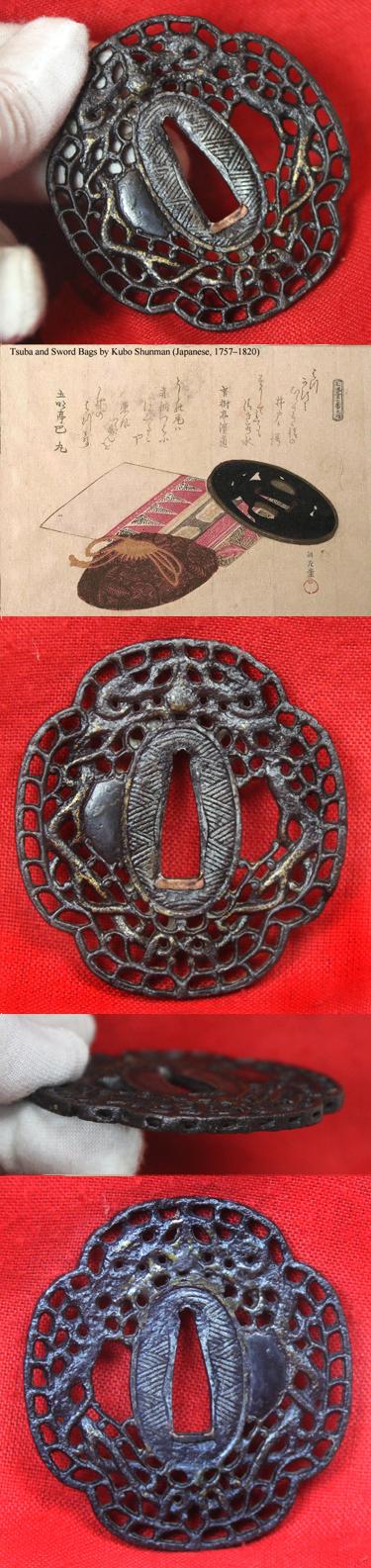
A Very Attractive & Good Edo Period Antique Nanban Tsuba in Tetsu and Applied Gold
The style of decoration that involves a mass of tendrils occupied by dragons, with elongated oval seppa dai decorated with waves or bars and the like. Unusually the pierced design travels around the edge as well, a very nice sign of extra fine quality workmanship, and beautiful undercutting.
Nanban often regarded as meaning Southern Barbarian, are very much of the Chinese influence. The Chinese influence on this group of tsuba was of more import than the Western one, however, and resulted not merely in the utilisation of fresh images by the existing schools, but also in the introduction of a
completely fresh style of metalworking.
The term 'namban' was also used by the Japanese to describe an iron of foreign origin.
Neither can the Namban group be considered to represent 'native Japanese art'.
The required presence in the group, by definition, of 'foreign influence', together with the possibility of their being 'foreign made', was probably responsible for their great popularity at the time.
Tsuba are usually finely decorated, and are highly desirable collectors' items in their own right. Tsuba were made by whole dynasties of craftsmen whose only craft was making tsuba. They were usually lavishly decorated. In addition to being collectors items, they were often used as heirlooms, passed from one generation to the next. Japanese families with samurai roots sometimes have their family crest (mon) crafted onto a tsuba. Tsuba can be found in a variety of metals and alloys, including iron, steel, brass, copper and shakudo. In a duel, two participants may lock their katana together at the point of the tsuba and push, trying to gain a better position from which to strike the other down. read more
425.00 GBP

A Very Attractive, Edo Era 17th to 18th Century Samurai's Tetsu Abumi Stirrup, Inlaid With Silver in a Pattern Of a Flower Mon
This Japanese stirrup, is made in the traditional dove's breast (hato mune) shape with an open platform lined slightly curved forward so that the foot fits in without sliding backwards. In the front extremity the stirrup has a rectangular buckle with several horizontal slots which also serve as a handle.
The whole surface is in ancient russetted iron in the distinctive Higo school style, with a large onlaid decorative mount of a bird and various flora.
It is to be noted that these stirrups, due to their weight, were also used as weapons against the infantry adversaries. Abumi, Japanese stirrups, were used in Japan as early as the 5th century, and were a necessary component along with the Japanese saddle (kura) for the use of horses in warfare. Abumi became the type of stirrup used by the samurai class of feudal Japan Early abumi were flat-bottomed rings of metal-covered wood, similar to European stirrups. The earliest known examples were excavated from tombs. Cup-shaped stirrups (tsubo abumi) that enclosed the front half of the rider's foot eventually replaced the earlier design.
During the Nara period, the base of the stirrup which supported the rider's sole was elongated past the toe cup. This half-tongued style of stirrup (hanshita abumi) remained in use until the late Heian period (794 to 1185) when a new stirrup was developed. The fukuro abumi or musashi abumi had a base that extended the full length of the rider's foot and the right and left sides of the toe cup were removed. The open sides were designed to prevent the rider from catching a foot in the stirrup and being dragged.
The military version of this open-sided stirrup, called the shitanaga abumi, was in use by the middle Heian period. It was thinner, had a deeper toe pocket and an even longer and flatter foot shelf. It is not known why the Japanese developed this unique style of stirrup, but this stirrup stayed in use until European style-stirrups were introduced in the late 19th century. The abumi has a distinctive swan-like shape, curved up and backward at the front so as to bring the loop for the leather strap over the instep and achieve a correct balance. Most of the surviving specimens from this period are made entirely of iron, inlaid with designs of silver or other materials, and covered with lacquer. In some cases, there is an iron rod from the loop to the footplate near the heel to prevent the foot from slipping out. The footplates are occasionally perforated to let out water when crossing rivers, and these types are called suiba abumi. There are also abumi with holes in the front forming sockets for a lance or banner. Seieibushi (Elite Samurai)
Traditionally the highest rank among the samurai, these are highly skilled fully-fledged samurai. Most samurai at the level of Seieibushi take on apprentices or Aonisaibushi-samurai as their disciples.
Kodenbushi (Legendary Samurai)
A highly coveted rank, and often seen as the highest attainable position, with the sole exception of the rank of Shogun. These are samurai of tremendous capability, and are regarded as being of Shogun-level. Kodenbushi are hired to accomplish some of the most dangerous international missions. Samurai of Kodenbushi rank are extremely rare, and there are no more than four in any given country.
Daimyo (Lords)
This title translates to 'Big Name' and is given to the heads of the clan.
Shogun (Military Dictator)
The apex of the samurai, the Shogun is the most prestigious rank possible for a samurai. Shoguns are the leaders of their given district, or country, and are regarded as the most powerful samurai. read more
1385.00 GBP
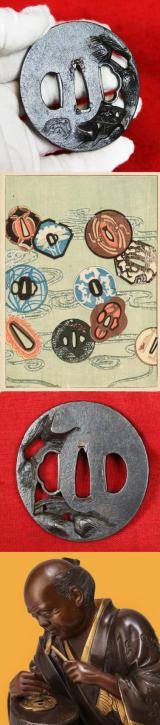
A Fine & Beautiful Edo Period Iron Tsuba in Nikubori Jisukashi Of Waterfalls Rocks and River with A wooden Bridge Being Traversed by a Figure On Horseback Carrying a Parasol
The tsuba was possibly created by Yoshiharu (吉春), of the late Edo period .
He was living in the Hagi (萩) domain (another name of the Choshu domain) in Nagato no Kuni (長門国,
It is engraved with the Nikubori Jisukashi. Nikubori Jisukashi is a Japanese tsuba (sword guard) carving technique, translating to "relief-carved openwork" (肉彫地透). It combines thick, high-relief (nikubori) sculptural carving with openwork (sukashi) techniques on the iron plate (ji). Primarily used during the Edo period by schools like Shoami, this style creates a three-dimensional effect, making the motif stand out from the ground, often featuring detailed, rounded figures rather than simple silhouettes.
Technique: "Niku" (肉) refers to meat/flesh, implying thickness or rounding of the metal, while "Ji-sukashi" (地透) means openwork on the ground plate. read more
545.00 GBP

A Most Elegant Ko Wakizashi, or Long Sunobi Tanto, Signed Blade Shinto Period Circa 1650The Entire Original Edo Period Koshirae {Mountings} Are In The Form Described As Shibui, {Quiet}
All original Edo mounts and a most fine and elegant blade with notare based on suguha hamon, signed, possibly Norishige, but the kanji are somewhat difficult to interpret, 15.5 inch blade measured from tsuba to tip.
Suite of matching koshirae mounts in tetsu with the tsuba gold inlaid with a stylized Buddhist dragon and clouds, in gold, 19th Century, similarly inlaid in the sayajiri and saya band inlaid, with a black stippled urushi lacquer, and a carved wood tsuka. The kozuka is a takebori dragon on the plain tetsu ground, the blade is carved wood. The blade has a fine silver foiled habaki engraved with oblique raindrop pattern.
In the context of Japanese aesthetics, Shibui (渋い) refers to a "simple, subtle, and unobtrusive beauty". Decorating with a katana in this manner moves away from extravagant displays toward a refined, understated elegance that emphasises craftsmanship and cultural respect.
Sunobi Tanto
The Tanto that varied from the traditional size were called Sunobi-Tanto or O-Tanto. These were larger versions of the Tanto which featured blades usually measuring between 13 to 14 inches long. It was close to the size of the Ko-Wakizashi, which is a shorter version of the Wakizashi. However as this blade is even longer that the usual 14 inches, that is why it can be considered as a transitional weapon that has a foot in both camps so to speak. Because of its often small size, the Samurai warriors were able to conceal the Tanto in their clothing. It was also the Shoto or small sword in the Daisho and was paired with the Tachi. This was before the Samurai chose to use the Wakizashi over the Tanto as an auxiliary sword.
The Wakizashi was a Samurai warrior’s backup weapon that was used for close-quarter battles. Aside from this, the sword was a Samurai warrior’s tool for beheading a defeated opponent. It was sometimes used for committing Seppuku, a ritualistic suicide.
In addition, the Wakizashi was one of the few short swords available to the Samurai warrior. Another sword they might use was called a Chisa Katana, effectively a short Katana perfect for use within buildings castles etc. and the prerogative of the personal full time bodyguard of a Daimyo lord, who were the usually the only samurai permitted to be armed in his presence day and night.
Because the sword was the main battle weapon of Japan's knightly man-at-arms (although spears and bows were also carried), an entire martial art grew up around learning how to use it. This was kenjutsu, the art of sword fighting, or kendo in its modern, non-warlike incarnation. The importance of studying kenjutsu and the other martial arts such as kyujutsu, the art of the bow, was so critical to the samurai a very real matter of life or death that Miyamoto Musashi, most renowned of all swordsmen, warned in his classic The Book of Five Rings: The science of martial arts for warriors requires construction of various weapons and understanding the properties of the weapons. A member of a warrior family who does not learn to use weapons and understand the specific advantages of each weapon would seem to be somewhat uncultivated. European knights and Japanese samurai have some interesting similarities. Both groups rode horses and wore armour. Both came from a wealthy upper class. And both were trained to follow strict codes of moral behaviour. In Europe, these ideals were called chivalry; the samurai code was called Bushido, "the way of the warrior." The rules of chivalry and Bushido both emphasize honour, self-control, loyalty, bravery, and military training
As once told to us by an esteemed regular visitor to us here in our gallery, and the same words that are repeated in his book;
“In these textures lies an extraordinary and unique feature of the sword - the steel itself possesses an intrinsic beauty. The Japanese sword has been appreciated as an art object since its perfection some time during the tenth century AD. Fine swords have been more highly prized than lands or riches, those of superior quality being handed down from generation to generation. In fact, many well-documented swords, whose blades are signed by their makers, survive from nearly a thousand years ago. Recognizable features of the blades of hundreds of schools of sword-making have been punctiliously recorded, and the study of the sword is a guide to the flow of Japanese history.”
Victor Harris
Curator, Assistant Keeper and then Keeper (1998-2003) of the Department of Japanese Antiquities at the British Museum. He studied from 1968-71 under Sato Kenzan, Tokyo National Museum and Society for the Preservation of Japanese Swords
The world of antique sword collecting is a fascinating journey into the past, offering a unique lens through which to view history and culture. More than mere weapons, these artifacts serve as tangible connections to the societies and ancient times where they originated. Each blade tells a story, not just of the battles it may have seen but of the craftsmanship, artistic trends, and technological advancement of its time.
The swords mountings can be equally telling. Engravings and decorative elements may enhance the sword’s beauty and hint at its historical context. The materials used for them can reveal the sword’s age
Collecting antique swords, arms and armour is not merely an acquisition of objects; it’s an engagement with the historical and cultural significance that these pieces embody. As collectors, we become custodians of history, preserving these heritage symbols for future generations to study and appreciate.
We are now, likely the oldest, and still thriving, arms armour and militaria stores in the UK, Europe and probably the rest of the world too. We know of no other store of our kind that is still operating under the control its fourth successive generation of family traders
Every single item from The Lanes Armoury is accompanied by our unique Certificate of Authenticity. Part of our continued dedication to maintain the standards forged by us over the past 100 years of our family’s trading, as Britain’s oldest established, and favourite, armoury and gallery read more
3995.00 GBP

A Beautiful Quality Nanban Tsuba of Flying Dragons Over Scrolling Clouds With Gold Work. It Is Simply Breathtaking in its Beauty And Craftsmanship.
An unusual nanban tsuba of unknown origin. It is decorated in a style that reminds of some sawasa export wares. Both sides are carved with two sky dragons over a carved background of scrollwork. The reverse is carved to match, also with two dragon around the infilled hitsu-ana, and the kozuka-hitsu-ana with gold alloy, one domed the other conical. The scrolling, is in the form of an intricately carved cloud background. The rim is beaded. The seppa dai is carved with arked comb pattern overlaid in silver.
The fineness of carving and the fact that much of the overlay is done over a cross hatched background that is cut in three directions suggests the work is most likely done in Japan. Our thoughts are that it goes towards the nanban-style carvers in Yamashiro.
Nanban tsuba (Southern Barbarian sword guards) are 16th to 19th-century Japanese sword fittings characterized by foreign, non-traditional designs, primarily featuring intricate iron openwork (sukashi), beaded rims, and Chinese or European motifs. Originating from trade with foreign ships, these often-lavish guards were produced in China or by the Dutch East India Company and adapted for Japanese swords.
: "Nanban" means "Southern Barbarian," a term used during the Edo period to describe foreigners—specifically Portuguese, Spanish, and Dutch traders—who arrived by sea.
While the name implies Western influence, most designs actually show strong Chinese influence.
They are usually made of iron, featuring complex openwork (carved in relief or pierced), undercutting, and often feature "small balls" trapped in small compartments that can move. Common motifs include dragons chasing flaming pearls, foreign letters (like "VOC" for the Dutch East India Company), and arabesque designs.
Initial pieces were likely imported from China or Southeast Asia through Nagasaki from the late 16th century onwards.
Japanese craftsmen began copying these styles. They often added specific features for Japanese swords, such as the hitsu-ana (holes for the utility knife/hairpin) and modifying the nakago-ana (tang hole).
The Yagami School: Based in Nagasaki, this school specialized in this style during the 18th century, famous for intricate ironwork featuring Chinese-style dragons and, notably, "1000 monkey" designs.
Although foreign-influenced, they were popular among samurai as fashionable, often heavily gilded or inlaid with gold/silver. They were sometimes used to subtly showcase hidden religious preferences (e.g., small crosses) during the prohibition of Christianity
Nanban-style carvers in Yamashiro (modern-day Kyoto) refers to 18th-century Japanese metalworkers, specifically tsuba (sword guard) makers, who adopted foreign design elements—primarily Chinese, but also Portuguese and Dutch influences—into their craft.
These artisans are known for producing Nanban Tsuba (Southern Barbarian sword guards), which often feature intricate, openwork (sukashi) designs, such as dragons, vines, and lion-like figures, usually on an iron ground.
They utilized gold or silver nunome-zōgan (inlay) to highlight designs, frequently carving on a cross-hatched background to create a textured, luxurious, or exotic look.
While Nanban-style items were often associated with Nagasaki, Kyoto-based makers (Yamashiro) were known for producing higher-quality, more sophisticated, and detailed versions, often with better-finished carvings.
Connection to Heianjo School: Some of these designs are categorized alongside Heianjo-style Tsuba, which were established in Yamashiro and known for combining iron with brass inlays.
These carvers operated during the Edo period (1603–1868), with peak production of these refined, domestically made Nanban pieces occurring around the 18th century. read more
550.00 GBP