
Japanese


A Stunning Edo Period Tettsu {iron Plate} Kirishitan {Christian.} Tsuba, Of The Holy Cross, Heavenly Eight Pointed Stars in Gold, & The River Of Life in Silver. In Superb Condition & From A Very Fine Collection of Tsuba.
A stunning Kirishitan sukashi piercing of the cross with a silver river and gold eight pointed star inlays. With a kozuka hitsu-ana, and kogai hitsu ana
The Bible starts with an account of a river watering the Garden of Eden. It flowed from the garden separating out into four headwaters. The rivers are named, flowing into different areas of the world,
Eight pointed stars symbolise the number of regeneration and of Baptism. The Stars and The River as Christian Symbols, are images or symbolic representation with sacred significance. The meanings, origins and ancient traditions surrounding Christian symbols date back to early times when the majority of ordinary people were not able to read or write and printing was unknown. Many were 'borrowed' or drawn from early pre-Christian traditions.
The Hidden Christians quieted their public expressions and practices of faith in the hope of survival from the great purge. They also suffered unspeakably if captured and failed to renounce their Christian beliefs. Some were executed by being slowly sawn in half, vertically, from the groin upwards.
In Silence, Endo depicts the trauma of Rodrigues’ journey into Japan through his early encounter with an abandoned and destroyed Christian village. Rodrigues expresses his distress over the suffering of Japanese Christians and he reports the “deadly silence.”
‘I will not say it was a scene of empty desolation. Rather was it as though a battle had recently devastated the whole district. Strewn all over the roads were broken plates and cups, while the doors were broken down so that all the houses lay open . . . The only thing that kept repeating itself quietly in my mind was: Why this? Why? I walked the village from corner to corner in the deadly silence.
...Somewhere or other there must be Christians secretly living their life of faith as these people had been doing . . . I would look for them and find out what had happened here; and after that I would determine what ought to be done.”
- Silence, Shusaku Endo
Two images in the gallery are drawings of bronze fumi-e in use during the 1660s in Japan, during the time of the persecution. Each of these drawings mirrors actual brass fumi-e portraying Stations of the Cross, which are held in the collections of the Tokyo National Museum. Picture seven in the gallery shows a samurai Christian convert wearing adapted papal armour taking a blessing from a missionary priest.
The current FX series 'Shogun' by Robert Clavell is based on the true story of William Adams and the Shogun Tokugawa Ieyesu, and apart from being one of the very best film series yet made, it shows superbly and relatively accurately the machinations of the Catholic Jesuits to manipulate the Japanese Regents and their Christian convert samurai Lords.
Oda Nobunaga (1534–82) had taken his first step toward uniting Japan as the first missionaries landed, and as his power increased he encouraged the growing Kirishitan movement as a means of subverting the great political strength of Buddhism. Oppressed peasants welcomed the gospel of salvation, but merchants and trade-conscious daimyos saw Christianity as an important link with valuable European trade. Oda’s successor, Toyotomi Hideyoshi (1537–98), was much cooler toward the alien religion. The Japanese were becoming aware of competition between the Jesuits and the Franciscans and between Spanish and Portuguese trading interests. Toyotomi questioned the reliability of subjects with some allegiance to the foreign power at the Vatican. In 1587 he ordered all foreign missionaries and their guard to leave Japan but did not enforce the edict harshly until a decade later, when nine missionaries and 17 native Kirishitan were martyred.
After Toyotomi’s death and the brief regency of his adopted child, the pressures relaxed. However, Tokugawa Ieyasu, who founded the great Tokugawa shogunate (1603–1867), gradually came to see the foreign missionaries as a threat to political stability. By 1614, through his son and successor, Tokugawa Hidetada, he banned Kirishitan and ordered the missionaries expelled. Severe persecution continued for a generation under his son and grandson. Kirishitan were required to renounce their faith on pain of exile or torture. Every family was required to belong to a Buddhist temple, and periodic reports on them were expected from the temple priests.
By 1650 all known Kirishitan had been exiled or executed. Undetected survivors were driven underground into a secret movement that came to be known as Kakure Kirishitan (“Hidden Christians”), existing mainly in western Kyushu island around Nagasaki and Shimabara. To avoid detection they were obliged to practice deceptions such as using images of the Virgin Mary disguised as the popular and merciful Bōsatsu (bodhisattva) Kannon, whose gender is ambiguous and whom carvers often render as female.
The populace at large remained unaware that the Kakure Kirishitan managed to survive for two centuries, and when the prohibition against Roman Catholics began to ease again in the mid-19th century, arriving European priests were told there were no Japanese Christians left. A Roman Catholic church set up in Nagasaki in 1865 was dedicated to the 26 martyrs of 1597, and within the year 20,000 Kakure Kirishitan dropped their disguise and openly professed their Christian faith. They faced some repression during the waning years of the Tokugawa shogunate, but early in the reforms of the emperor Meiji (reigned 1867–1912) the Kirishitan won the right to declare their faith and worship publicly.
Some wear to the gold and silver inlays on the reverse side. read more
1495.00 GBP

An Incredibly Rare Samurai Nanban-Do Gusoku {Southern Barbarian Steel} Armour 16th-17th Century Cuirass Dou {Body Armour} Made From The Cuirass of a 1530's Spanish or Portuguese 'Black Ship' Trader. The First Europeans To Arrive in Japan
Another really rare museum piece from the collection of likely the world's greatest authority, and author on Japanese polearms & their use in combat.
A superb, really rare and valuable, piece of early, original, samurai armour, created from the earliest armour worn by the first European visitors to Japan, that arrived in the 'Black Ships', as depicted in the fabulous historical novel {and films} 'Shogun' by James Clavell.
Such armour, was, and is, very rare indeed, it is incredibly sought after, and can be valued ten to twenty times the price that traditional, old, original samurai domestic armour.
An armour cuirass or dou {in Japanese} that is fitted with a complete sashimono mounting system, and, an incredible two sections of early engraved script, of thirty five kanji, in seven rows, and one section on the front right is highlighted in gold lacquer colour.
We sent a scan to our dear friend in Japan and requested assistance in order to translate it, and, we received a very kind, and prompt, reply. He believes it’s an ancient form of kanji thus difficult to read {unless one has been taught specifically how to, one conjectures} but, it is some kind of divine text to ask assistance from the gods to embolden the samurai’s strength, alongside additional divine power requested from those same gods.
We have never seen its like before.
Sashimono Mounting System Components;
The banner was held in place by a specialized, two-part system attached to the back of the armour's main chest piece, the dō (dou):The ukezutsu (socket) is a tube, often square-shaped, that held the bottom of the banner pole. This was typically located at the lower rear of the cuirass.
Called a gattari (bracket) is a metal fixture situated at shoulder level on the back of the dō, often hinged, designed to secure the pole in an upright position, and fold back down when not in use holding the sashimono
European armour was brought into Japan through trade with Spain and Portugal in the 16th century. Later the Japanese would adapt them and imitate them and began producing them in Japan, which were collectively called Nanban Dogusoku (Nanban Armour). The yoroi armour we show in photo 9 in the gallery, was given to Sakakibara Yasumasa by Tokugawa Ieyasu right before the Battle of Sekigahara (1600) and has since been handed down to the Sakakibara family. That suit nanban armour would be priceless, but similar suits of nanban armour, of the same period, but without the history that the Sakakibara gosuko armour has, are valued up to 100K today or even more. with that photo is a Japanese print showing how the sashimono flag was mounted upon the samurai do cuirass armour.
Tokugawa Ieyasu also wore a nanban armour at the battle of sekigahara. Ieyasu's armour is composed of an Italian peascod cuirass {dou} from circa 1580, a gorget fitted over the cuirass as a "manchira" (derived from the Spanish term 'mantilla', i.e., "mantle" or "cloak"), and a helmet of the Spanish cabasset type
The story of the traders is beautifully conveyed in the novel Shogun James Clavell. William Adams was the principle character, based on the first English real life 17th century navigator adventurer who traveled to Japan, depicted in James Clavell's epic masterpiece "Shogun". Sadly for him, he was never again allowed to leave Japan and return to his family in England.
It is a wonderful and historical part of rare samurai plate armour. English navigator, William Adams, who became a close advisor to the Shogun, and known in Japan as Anjin. However, John Adams became such a highly regarded 'foreigner' within the shogun's court. A picture in the gallery is a print of the Tokugawa's Red Seal ships based on the navigators own ship, and a period print of Richard Adams being presented to the shogun, alongside a contemporary map of Japan as it was detailed on European maps in the early 1600's.
William Adams English navigator, also known in Japan as Miura Anjin, was born in 1564 in Gillingham England
(born 1564, Gillingham, Kent, England—died May 26, 1620, in Hirado, Japan), he was a navigator, merchant-adventurer, and the first Englishman to visit Japan.
At the age of 12 Adams was apprenticed to a shipbuilder in the merchant marine, and in 1588 he was master of a supply ship for the British navy during the invasion of the Spanish Armada. Soon after the British victory, he began serving as a pilot and ship’s master for a company of Barbary merchants. In June 1598 he shipped out as pilot major with five Dutch ships bound from Europe for the East Indies (present-day Indonesia) via the Strait of Magellan. The trouble-ridden fleet was scattered by storms, and in April 1600 Adams’s ship, the Liefde (“Charity”), its crew sick and dying, anchored off the island of Kyushu in southern Japan, the first northern European ship to reach that country.
Adams and the other survivors were summoned to Osaka, where Tokugawa Ieyasu—soon to become the shogun of Japan—interrogated mainly Adams about a variety of political, religious, and technological topics. Ieyasu was so impressed with Adams’s knowledge, especially of ships and shipbuilding, that he made the Englishman one of his confidants. Adams was given the rank of hatamoto (“bannerman”), a retainer to the shogun, and was awarded an estate at Miura, on the Miura Peninsula south of Edo (now Tokyo). Despite those honours, in the early years of his sojourn Adams repeatedly expressed his desire to return to England (where he had a wife and family, whom he eventually was able to continue to support) but was refused permission. He thus became permanently settled in Japan, married a Japanese woman, and came to be known by the name Anjin (“Pilot and Navigator later called Miura Anjin.
Adams oversaw the construction of Western-style ships, wrote letters on behalf of the shogun encouraging Dutch and English traders to come to Japan, and then officiated between the shogunate and the traders who began visiting the country. In 1613 he helped to establish an English factory (trading post) for the East India Company at Hirado, in Kyushu northwest of Nagasaki. Adams was allowed to undertake several overseas voyages between 1614 and 1619, traveling as far as Southeast Asia. His name is still revered in Japan with a district of his estate still bearing his name and his story is detailed in the magnificent epic book and film Shogun by James Clavell. read more
6500.00 GBP

Beautiful Edo Jingasa Samurai Horserider's War Hat With Clan Mon of Kamei Korenori (亀井 茲矩; 1557 – February 27, 1612) Was a Japanese Daimyō. From The Collection of Likely The World's Greatest Authority, Author On Japanese Polearms & Their Use
Edo period original jingasa of the Kamei clan. in black urushi lacquer, large gold Kamei mon, and two ishime stone finish lacquer bands, either side of a gilt band. Some interior padding present
Their mon (family crest) is famously known as the Oi-katsubishi (追いかつ菱), which consists of two overlapping or "chasing" diamond shapes (hishimon). The clan, based in Tsuwano han during the Edo period, used this distinctive geometric crest.
These geometric kamon were popular during the Sengoku period because they were easy to recognize on battlefields.
Kamei Korenori (亀井 茲矩; 1557 – February 27, 1612) was a Japanese daimyō who lived through the early Edo period. He was first a retainer under the Amago clan of Izumo Province, but eventually became a daimyō in his own right.
Chūgoku Campaign (from 1578): After the fall of the Amago, he joined Hashiba (Toyotomi) Hideyoshi, fighting against the Mōri clan, specifically taking part in the Siege of Tottori Castle.
Receiving Shikano castle in Inaba Province as a reward for his notable service in 1578, Korenori ascended to higher rank as he assisted in Hideyoshi's 1587 invasion of Kyūshū.
Kyushu Campaign (1587): Participated in Toyotomi Hideyoshi's campaign to subdue the Kyushu region.
Invasions of Korea (1592–1598): Involved in the campaigns against Korea under the Toyotomi banner.
Battle of Sekigahara (1600): Fought for the Eastern Army under Tokugawa Ieyasu. He helped attack the Western Army's Minakuchi Okayama Castle.
Siege of Minakuchi Okayama (1600): Following the Battle of Sekigahara, he joined forces with Ikeda Nagayoshi to capture Natsuka Masaie at Minakuchi Okayama Castle.
Burning of Tottori Castle Environs: During his time in Inaba Province, he was involved in burning the village around Tottori Castle in conjunction with Masahiro Saimura.
Failed Ryukyu Expedition (1590): Though not a battle, Korenori prepared a fleet to target the Ryukyu Islands but was blocked by the Shimazu clan.
Korenori's descendants were eventually made daimyō (lords) of the Tsuwano Domain, which they ruled until the Meiji Restoration (1868).
Overall in jolly nice condition, the top of the helmet, off centre, has a small impact dent about the size of a pound coin {see photo 4}. Very small age losses to the lacquer read more
1250.00 GBP

A Simply Magnificent, Huge, Ozutso Samurai Hand Cannon Teppo Matchlock Gun, of Negishi Sukenobu, Inlaid With Silver and Gold Dragon With Both the Clan Mon of Kamei Kenenori and Tokugawa Ieyasu.
Their mon (family crest) is famously known as the Oi-katsubishi (追いかつ菱), which consists of two overlapping or "chasing" diamond shapes (hishimon). The clan, based in Tsuwano han during the Edo period, used this distinctive geometric crest.
These geometric kamon were popular during the Sengoku period because they were easy to recognize on battlefields.
Signed Japanese red oak stock. The huge uncompromising barrel is inlaid with twin, large silver clan mon of Kamei Kanenori and and gold-copper triple leaf Aoi, clan mon of Tokugawa Ieyasu at the breech, as they were alligned, it has a pinhole block site, extravagant gold and silver scrolling dragon inlay, up through the length of the barrel, terminating in a multi sided and stunning tulip form muzzle. Within the channel of the stock is a beautiful hand scripted signature of the samurai owner, Negishi Sukenobu no Tutu. Translation; Negishi Sukenobu's gun tutu is an old Japanese name for a matchlock gun
It has a sinchu matchlock mechanism with a long engraved match arm, inlaid with speckles of silver, traditional spring release utilising the ball trigger. the stock has engraved, silver cherry blossom form inlaid, barrel retaining mekugi-ana apertures, for the long copper mekugi to retain the barrel..
Part of a fine collection that arrived O-Zutsu hand cannon tanegashima, it is huge and incredibly heavy, of around 10 monme, 18mm bore
It is often the case were early samurai weaponry bear twin mon decoration, often demonstrating a co-joining or allegiance between two samurai clans. This example represents its a hand cannon of Kamei Kanerori and the Tokugawa clan mon as he fought for the clan at Sekigahara and beyond .
Kamei Korenori (亀井 茲矩; 1557 – February 27, 1612) was a Japanese daimyō who lived through the early Edo period. He was first a retainer under the Amago clan of Izumo Province, but eventually became a daimyō in his own right.
Chūgoku Campaign (from 1578): After the fall of the Amago, he joined Hashiba (Toyotomi) Hideyoshi, fighting against the Mōri clan, specifically taking part in the Siege of Tottori Castle.
Receiving Shikano castle in Inaba Province as a reward for his notable service in 1578, Korenori ascended to higher rank as he assisted in Hideyoshi's 1587 invasion of Kyūshū.
Kyushu Campaign (1587): Participated in Toyotomi Hideyoshi's campaign to subdue the Kyushu region.
Invasions of Korea (1592–1598): Involved in the campaigns against Korea under the Toyotomi banner.
Battle of Sekigahara (1600): Fought for the Eastern Army under Tokugawa Ieyasu. He helped attack the Western Army's Minakuchi Okayama Castle.
Siege of Minakuchi Okayama (1600): Following the Battle of Sekigahara, he joined forces with Ikeda Nagayoshi to capture Natsuka Masaie at Minakuchi Okayama Castle.
Burning of Tottori Castle Environs: During his time in Inaba Province, he was involved in burning the village around Tottori Castle in conjunction with Masahiro Saimura.
Failed Ryukyu Expedition (1590): Though not a battle, Korenori prepared a fleet to target the Ryukyu Islands but was blocked by the Shimazu clan.
Korenori's descendants were eventually made daimyō (lords) of the Tsuwano Domain, which they ruled until the Meiji Restoration
Resembling the Portuguese arquebus, the first matchlock gun to be seen in Japan, this massive and handsome weapon expresses the Japanese desire for powerful, finely made firearms.
A 17th century Japanese tradition relates that after the accidental arrival of three Portuguese mariners on Tanegashima Island in 1543, the sword-smith Kiyosada gave his daughter to their captain in order to learn the secrets of musket manufacture.
The actual guns were snap matchlocks made in Malacca, a Portuguese colony, and by 1550 were in production on a large scale. Known as ‘Tanegashima’ or ‘Teppō’ they were used by the Samurai and their foot soldiers and changed the way war was fought in Japan forever.
Large carbines such as this example were known as ‘ozutsu’ or cannon and were mounted on castle walls, used on merchant ships to repel pirates, on horseback in war or as assault weapons to blast through door hinges.
They could also launch incendiary or explosive arrows known as ‘Hiya’ to set fires during sieges. When fired these powerful weapons had a large recoil, and bales of rice were used to support the gunners back from injury.
Ammunition consisted of heavy round lead balls with differing sizes described as ‘Monme’. Made to take between 10 to 30 ‘Monme’ shots, this carbine is one of the largest examples of Japanese Edo Period handheld firearm
One woodblock in the gallery of a samurai holding an ozutso, and another of the great Takeda Shingen contemplating a small teppo matchlock gun, and it’s dramatic effect on the future of samurai warfare. The shape and form of ours is the same as the one contemplated by Takeda Shingen in the print, but ours is around four times the size, not a long gun but of incredible mass, beauty and presence. Somewhat like a dragon, a beast to admire for its breathtaking beauty, but to fear and respect for its power and presence.
The Amago clan, descended from the Emperor Uda (868–897) by the Kyogoku clan, descending from the Sasaki clan (Uda Genji).
Kyogoku Takahisa in the 14th century, lived in Amako-go (Omi Province), and took the name 'Amago'. The family crest, is also the one of the Kyogoku clan.
They were Shugodai (vice-Governors) of Izumo and Oki provinces for generations, for the Kyogoku Shugo branch , and their seat was Gassan Toda castle.
In 1484, Amago Tsunehisa (1458–1541), was deprived of the position of Shugodai by Kyogoku Masatsune, who was the Shugo, because he did not obey the request of tax from the Muromachi bakufu, and was expelled from Gassan Toda castle. Although Enya Kamonnosuke was dispatched to Gassan Toda castle as the new Shugodai, Tsunehisa recaptured Gassan Toda castle by a surprise attack in 1486, took control of Izumo, and developed the Amago clan into a Sengoku Daimyo clan.
The Amago fought the Ouchi clan or the Mori clan (who had been among their vassals), during Japan's Sengoku period.
For much of the next hundred years, the clan battled with the Ouchi and Mori, who controlled neighbouring provinces, and fell into decline when Gassantoda Castle fell to the Mori in 1566.
Amago Katsuhisa tried to regain prestige for the clan by joining the forces of Oda Nobunaga, invaded Tajima and Inaba provinces, but was defeated and died in the siege of Kozuki by the Mori in 1578.
Kamei Korenori (亀井 茲矩, 1557 – February 27, 1612) was a Japanese daimyō who lived through the early Edo period. He was first a retainer under the Amago clan of Izumo Province, but eventually became a daimyō in his own right. Receiving Shikano castle in Inaba Province as a reward for his notable service in 1578, Korenori ascended to higher rank as he assisted in Hideyoshi's 1587 invasion of Kyūshū. Following Hideyoshi's death in 1598, entered the service of Tokugawa Ieyasu. Following the Sekigahara Campaign of 1600, his income was raised from 13,000 to 43,000 koku as a reward for his service to the Tokugawa clan. Korenori died of natural causes in 1612.
Korenori's descendants were eventually made daimyō (lords) of the Tsuwano Domain, which they ruled until the Meiji Resoration.
Weight an impressive and formidable 6.6 kilos, length overall, 42 inches, barrel 30.5 inches read more
9750.00 GBP

Superb & Rare 10 Plate Tetsu Steel Jingasa Samurai Battle Hat Helmet of The 1700's Traces Of Silver Inlay of Insects Such As Crickets, Catydids & A Spider Web From The Collection of Likely The World's Greatest Authority, Author On Japanese Polearms
From The Collection of Likely The World's Greatest Authority and Author On Japanese Polearms & Their Use
The tetsu jingasa (iron or steel battle hat) was a common form of head protection used in combat in feudal Japan, particularly by foot soldiers (ashigaru) during the Sengoku period (1467–1615) and by both soldiers and samurai during the Edo period (1603–1868). Unlike the elaborate kabuto helmets, the jingasa was lightweight, and shaped like a cone or shallow bowl, often with a wide brim to protect against overhead cuts and rain.
It was mainly worn by ashigaru as part of their okashi gusoku (loaned armour) to protect against overhead strikes, arrows, and musketry. Howeve, being of much higher quality and inlaid with silver decoration this beautiful example was clearly the war hat of a high rank samurai
While offering less protection than a kabuto (traditional helmet), it was highly favored for its light weight and mobility, which were crucial during long, intense battles.
The steel hats were typically lacquered and bore the mon (family crest) of the lord, which allowed identification of allies and enemies in the chaos of battle.
Weapon Usage (Improvised): Some martial arts schools, such as the Yagyu Shingan-ryu, taught that the steel jingasa could be removed and used as a makeshift shield or a striking weapon (similar to a buckler) when in close combat, though this was generally an emergency tactic.
What an incredible, early Edo, original samurai iron jingasa helmet this is. Only a very small percentage of jingasa war hats are made of plate steel but this one is rarer still in that is was inlaid with representation decor of silver insects, some of which are still viewable. including a cricket, a catydid and a superb spiders web.
Insects in general have been celebrated in Japanese culture for centuries. The Lady Who Loved Insects is a classic story of a caterpillar-collecting lady of the 12th century court; the Tamamushi, or Jewel Beetle Shrine, is a seventh century miniature temple, once shingled with 9,000 iridescent beetle forewings. In old Japanese literature, poems upon insects are to be found by thousands, Daisaburo Okumoto is director of the Fabre Insect Museum. An avid insect collector and a scholar of French literature, he has translated many of Fabre's works. He ascribes the popularity of insects in Japan to national character. It seems like Japanese eyes are like macro lenses and Western eyes are wide-angle, he says. A garden in Versailles, it's very wide and symmetrical. But Japanese gardens are continuous from the room and also very small. We feel calm when we look at small things. The medieval Japanese monk Yoshida Kenko put it this way: “If man were never to fade away like the dews of Adashino, never to vanish like the smoke over Toribeyama, how things would lose their power to move us”
A similar metal example, dated to the 19th century, was included in the 2010 exhibition Kyoto-Tokyo: Des Samourais aux Mangas at the Grimaldi Forum in Monaco in 2010. read more
1560.00 GBP

A Beautiful Edo Period Higher Ranking Samurai Folding, Dragon Mon Kusari Katabira Armour. From The Collection of, Likely, The World's Greatest Authority and Author On Japanese Polearms & Their Use & The Henry Russell Robinson Collection
Edo period samurai karuta tatami dou in the hara-ate style. The decorated tatami armour, such as this beautiful example, was usually worn by the high-class Samurai, while the lower class wore more simple versions.
This fabulous armour was previously in two famous collections, first, Henry Russell Robinson's Collection, then, later, sold to the Roald Knutsen Collection. Henry Russell Robinson was Keeper of Armour at the Tower of London, and likely displayed this armour coat in the Tower of London for his exhibition on Japanese Armour there. The Japanese Armour exhibition in 1965, which featured samurai artefacts arranged to demonstrate evolving defensive technologies and cultural contexts, drawing thousands of visitors to the Tower.
The lower ranking samurai would likely wear a folding mail helmet with tatami kusari folding armour. When worn by a higher rank samurai, or daimyo, it would be likely worn with a fine jingasa helmet, such as our example, item code 26208, that came from the same collection.
Kusari Katabira (Chain Mail Armour Coat) is a style of tatami yoroi or "folding armour" used by Daimyo, samurai warriors, their retainers and ashigaru (foot soldiers) during the feudal Sengoku and slightly more peaceful Edo era of Japan.
A simply stunning black urushi lacquer, and pure gold decorated, Nichiren-shu Ryu no Maru dragon mon centre panel. Many types of this form of combat armour are plain black, however this is one of the most beautiful we have ever seen.
Two woodblock prints in the gallery of samurai in combat wearing kusari chain mail armour
The beauty of this form of samurai armour is that it can also be amazingly displayed, wall mounted, within a large bespoke frame, in the same manner as a silk kimono.
Kusari tatami armour (chain mail folding armour) is a lightweight, portable Japanese defense featuring mail (kusari) sewn onto cloth or leather, often reinforced with small plates. Used during the Sengoku/Edo periods, it allowed for quick deployment, easy transport, and was worn by samurai, retainers, and ashigaru (foot soldiers) for combat.
Part of the tatami (folding) armor family, it was designed to be collapsed or folded for easy storage.
Kusari (Mail): Japanese mail typically consisted of riveted or butted iron rings in a 4-in-1 pattern, often connected to small, square/rectangular plates (karuta) or hexagonal plates (kikko).
The mail was commonly stitched onto hemp linen or leather backing, forming armored jackets known as kusari katabira or yoroi katabira.
Included kusari tatami dō (cuirass), karuta tatami dō (plate-and-mail cuirass), and kusari gusoku (full suit of mail).
Ideal for scouts, high-ranking samurai on the move, or for wear under regular clothing by guards.
Variations in Tatami Armour
Karuta Tatami: Focuses on small iron or leather squares (karuta) connected by mail, often backed with cloth.
Kikko Tatami: Uses small, hexagonal plates (kikko) hidden or exposed within the mail/cloth structure.
It was formerly part of the Henry Russell Robinson's private collection. (7 May 1920, Hackney, London - 15 January 1978) He became Keeper of Armour at The Tower Of London, and it is likely this suit was part of a display of Japanese armour he organised for display in the Tower of London. The Japanese armour exhibition in 1965, which featured samurai artefacts arranged to demonstrate evolving defensive technologies and cultural contexts, drawing thousands of visitors to the Tower.
He was a British military armourer and historian.He served in the RAF during the Second World War making models interpreting aerial photographs. This was when he met Sir James Mann, Master of the Armouries at the Tower of London. Robinson joined the staff of the Tower Armouries in 1946 as a Temporary Assistant, before rising to Assistant Keeper and finally, in 1970, Keeper of Armour.
Robinson was a founder member and president of the Arms and Armour Society. In 1965, he was elected a Fellow of the Society of Antiquaries of London. In 1977, he was awarded an honorary MA by the University of Newcastle upon Tyne.
Between 1967 and 1969, he (a practical armourer) worked with Charles Daniels to interpret and reconstruct the Roman armour nowadays known as 'lorica segmentata'. He produced a series of reconstructions of the two sub-types of armour from the Roman site at Corbridge and one from Newstead in time for them to be exhibited at the 1969 Congress of Roman Frontier Studies held in Cardiff.
His work on the armour featured in one of his best-known books, The Armour of Imperial Rome. Published in 1975 by Lionel Leventhal at the Arms and Armour Press, it included line illustrations by his friend, Peter Connolly. Robinson's system of categorizing Roman helmets has been widely adopted in the UK and USA but never really found favour in Europe.
Robinson was not only known for Roman armour, since he worked on an exhibition of Japanese armour at the Tower Armouries and subsequently wrote two books on the subject. He was also an authority on Native American artefacts and was responsible for the production of the replica of the revised reconstruction of the Sutton Hoo helmet and wrote a guide to the Stibbert Museum. read more
6950.00 GBP

A Fabulous, Samurai Late Koto To Shinto Period Wakazashi Sword In Very Fine, All Original, Edo Period Handachi Koshirae. With Original Urushi Ishime Lacquer Saya In Chitosemidori, A Thousand Year Green. Samurai War Pony Menuki. With A Remarkable Blade
Overall this sword is is superb condition, all the handachi mountings are original Edo period, as is the saya and its urushi ishime lacquer. The tsuka-ito has a geometric weave pattern, and also original Edo period. The delightful Edo tsuba is iron, with a relief Aoi leaf pattern, and signed. The pair of Edo menuki are pure gold over shakudo of deep takebori samurai war ponies in fully saddled riding tack, without riders..
The kozuka, side knife, has a Higo school iron handle depicting two Minogame turtles, particularly the minogame (straw-raincoat turtle), represent wisdom and are said to live so long that algae grows on their shells, resembling a tail.
Chitosemidori is a traditional Japanese colour that resembles the dark green colour of Japanese pine needles. The name “Chitosemidori” comes from the Japanese pine, symbolizing longevity due to its evergreen nature. This colour is significant because it represents enduring beauty. According to legend, it remains unchanged even after 1,000 years, reflecting the timeless nature of the Japanese pine.
Japanese lacquer, or urushi, is a transformative and highly prized material that has been refined for over 7000 years.
Cherished for its infinite versatility, urushi is a distinctive art form that has spread across all facets of Japanese culture from the tea ceremony to the saya scabbards of samurai swords
Japanese artists created their own style and perfected the art of decorated lacquerware during the 8th century. Japanese lacquer skills reached its peak as early as the twelfth century, at the end of the Heian period (794-1185). This skill was passed on from father to son and from master to apprentice.
Some provinces of Japan were famous for their contribution to this art: the province of Edo (later Tokyo), for example, produced the most beautiful lacquered pieces from the 17th to the 18th centuries. Lords and shoguns privately employed lacquerers to produce ceremonial and decorative objects for their homes and palaces.
The varnish used in Japanese lacquer is made from the sap of the urushi tree, also known as the lacquer tree or the Japanese varnish tree (Rhus vernacifera), which mainly grows in Japan and China, as well as Southeast Asia. Japanese lacquer, 漆 urushi, is made from the sap of the lacquer tree. The tree must be tapped carefully, as in its raw form the liquid is poisonous to the touch, and even breathing in the fumes can be dangerous. But people in Japan have been working with this material for many millennia, so there has been time to refine the technique!
Flowing from incisions made in the bark, the sap, or raw lacquer is a viscous greyish-white juice. The harvesting of the resin can only be done in very small quantities.
Three to five years after being harvested, the resin is treated to make an extremely resistant, honey-textured lacquer. After filtering, homogenization and dehydration, the sap becomes transparent and can be tinted in black, red, yellow, green or brown.
Once applied on an object, lacquer is dried under very precise conditions: a temperature between 25 and 30°C and a humidity level between 75 and 80%. Its harvesting and highly technical processing make urushi an expensive raw material applied in exceptionally fine successive layers, on objects such as bowls or boxes.After heating and filtering, urushi can be applied directly to a solid, usually wooden, base. Pure urushi dries into a transparent film, while the more familiar black and red colours are created by adding minerals to the material. Each layer is left to dry and polished before the next layer is added. This process can be very time-consuming and labour-intensive, which contributes to the desirability, and high costs, of traditionally made lacquer goods. The skills and techniques of Japanese lacquer have been passed down through the generations for many centuries. For four hundred years, the master artisans of Zohiko’s Kyoto workshop have provided refined lacquer articles for the imperial household.
Han-dachi originally appeared during the Muromachi period when there was a transition taking place from Tachi to katana. The sword was being worn more and more edge up when on foot, but edge down on horseback as it had always been. The handachi is a response to the need to be worn in either style. The samurai were roughly the equivalent of feudal knights. Employed by the shogun or daimyo, they were members of hereditary warrior class that followed a strict "code" that defined their clothes, armour and behaviour on the battlefield. But unlike most medieval knights, samurai warriors could read and they were well versed in Japanese art, literature and poetry.
The Japanese samurai and their famously iconic swords lasted relatively unchanged for 1200 years. A Nara period tachi sword of 700 ad was not that much different from a late Tokugawa period tachi sword of 1860. Compare that to Europe, every style and pattern of sword was used, and dramatic changes meant all forms of sword, and sword combat, changed and evolved from century to century. Yet in Japan the form changed little, the style was excellent from the very earliest period, and all that was required was incremental small improvements and very subtle changes. A samurai armed with a sword from 700 ad, would not appear that much changed 1100 years later. However, the samurai sword had been improved, and improved more, to a standard of quality excellence, after 500 years, that remained unrivalled throughout the world. A sword steel that was the finest steel ever created by mankind, a steel so fine that it bears no useful comparison to every other finest blade steel ever made. Damascus is likely the closest, but still way, way, below Japanese samurai sword steel. If Japanese samurai steel, ranked in first place, was compared to a formula one racing car, Damascus or pattern welded sword steel, ranked in second place, would be the equivalent to a twenty year old New York taxicab by comparison.
Picture 7 in the gallery is of the tsukaito over the war pony menuki. They appear to difference shades of green, but this is an illusion created by the camera photo light. There is no actual difference in colour at all
Overall 27 1/4 inches long in saya, blade 19 3/4 inches long read more
4750.00 GBP
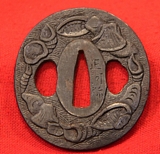
A Good Antique Edo Period Round Signed Tetsu Wakazashi Tsuba Embossed Seashells
A delightful iron round tsuba takebori patterned with various shells over a water pattern background, with ana openings for kozuka and kogai. The Tsuba can be solid, semi pierced of fully pierced, with an overall perforated design, but it always a central opening which narrows at its peak for the blade to fit within. It often can have openings for the kozuka and kogai to pass through, and these openings can also often be filled with metal to seal them closed. For the Samurai, it also functioned as an article of distinction, as his sole personal ornament 61 mm read more
225.00 GBP

A Superb, Ancestral, 600 Year Old Signed Blade, Kyu Gunto Mounted Sword For An Officer In Sino Japanese War, The Boxer Rebellion, In China, The Russo-Japanese War & Further Used In WW1 and WW2 Usually By Very Senior Ranking Samurai Family Officer
If one needs an exceptional example, this must be the one, of this very scarce form of very early samurai family Japanese sword {signed Masa kiyo, possibly Mihara school} with Meiji era koshirae mounts.
It has a super blade, with suguha midare hamon, that was first initially used by its first samurai owner before the Sengoku and Onin wars in 15th century Japan, continually right through the next 500 years by dozens of family samurai, until after the Tokugawa shogunate was deposed, and into the last samurai war, of the Meiji emperor, known as the Satsuma Rebellion.
That was the last war and battles of the ancient caste of samurai. And then, this sword was used by a samurai family, in the Meiji period of the 19th century, by a young officer {mounted in finest quality military fittings} permitted to use his ancestral early samurai blade.
Used in the First Sino-Japanese War (1894–1895): Fought primarily over control of Korea, this war demonstrated the effectiveness of Japan's modernization. Japan decisively defeated China, resulting in the Treaty of Shimonoseki, which gave Japan control over Taiwan, the Pescadores Islands, and the Liaodong Peninsula (though Russia later forced them to return the latter).
Japanese Invasion of Taiwan (1895): Following the Sino-Japanese war, Japan officially occupied and colonized Taiwan, facing significant armed resistance from the local population.
The Boxer Rebellion (1899–1901) where Japan joined the Eight-Nation Alliance (including Britain, Russia, and the US) to suppress an anti-foreign uprising in China. Japan provided the largest contingent of troops, earning international respect for its military organization.
Then, after a few years in the Russo Japanese War {1904-1905}, and it was further permitted to be used, often by veteran samurai born family officers, in the later WW1 and WW2.
A great and rare form of Japanese sword. However, it also has an ancient 600 year old ancestral, pre Sengoku period blade, so this is a great rarity, amongst rarities. One would be hard pressed to ever find another better example of such beauty, age and condition.
Dating from 1467-1603, the Sengoku or ‘Warring States’ period is known as the bloodiest in Japan’s history; an era of continuous social upheaval and civil war which transformed the country. Shogun-led authority was shattered and 150 years of murder and betrayal followed as fearsome warlords ruled local territories with unflinching ruthlessness.
Bear in mind this swords blade was hand made around the time that Henry Vth was fighting Agincourt in France
Almost all the original gilding is present to the hilt, the ancient blade is in original polish, and the habaki has deluxe cat scratch décor in gold and silver. Wooden saya from WW2, with sayagaki, bearing the signature {kanji} of the blade appraiser, and an elegant elongated hilt tsuka with knucklebow and original wire bound pristine samegawa {giant rayskin}.
The first standard sword of the Japanese military was known as the kyū guntō. The kyū guntō was used from 1875 until 1934, it closely resembled European and American swords of the time, with a wraparound hand guard (also known as a D-Guard) and chrome plated scabbard (saya), the steel scabbard is said to have been introduced around 1900
The Kyu gunto was a sword that began to cross the divide between the traditional Samurai sword, that was banned in the era of the Meiji Emperor, and the modern Western style sabre, but occasionally permitted to be fitted with a family ancestral samurai sword blade. The Kyu gunto style was adopted by the Imperial Japanese Army in the 1870's. By the early 1900's the Japanese officer class began more and more to see themselves as the reincarnated embodiment of the old Samurai warrior class, and the desire for the return to the traditional Bushido warrior code was becoming a powerful force. Modern Western styles had been faithfully adopted and the Imperial Japanese military had joined the rest of the civilised world in all it's advancements and technology in weaponry and uniforms that it had to offer. However, the officer class saw a threat to their long felt superiority over all others as their dress made them all but indistinguishable from soldiers of other inferior nations. A resurgence in the Samurai ethic needed a connection to the modern uniform, so a return to the Samurai sword was achieved in combat, but still with the visible connection to more modern Western dress form.
This sword, that bridged the gap between modern and ancient sword styles, was popular and adopted with great keeness. In fact Japanese military sword styles progressed even further in the subsequent decades, so that by the 1930's the standard officer's sword was a near identical copy of the ancient Samurai Tachi, with very little deference to modern sword patterns. The mounts are very good indeed, and the blade is also superb.
Three photos in the gallery {numbers 7,8,9,} of Admiral Togo with his Kyu-gunto mounted ancestral sword, with the Russo Japanese war service scabbard, and photo number 10 with a WW2 Japanese officer with his Kyu-gunto sword but its WW2 service saya {scabbard} like this one.
Tōgō Heihachirō (東郷 平八郎; 27 January 1848 – 30 May 1934), served as a gensui or admiral of the fleet in the Imperial Japanese Navy and became one of Japan's greatest naval heroes. As Commander-in-Chief of the Combined Fleet during the Russo-Japanese War of 1904–1905, he successfully confined the Russian Pacific naval forces to Port Arthur before winning a decisive victory over a relieving fleet at Tsushima in May 1905. Western journalists called Tōgō "the Nelson of the East". He remains deeply revered as a national hero in Japan, with shrines and streets named in his honour.
Overall in saya 34.25 inches long, katana blade 25.25 inches long, hilt 7.5 inches long read more
5950.00 GBP

A Museum Grade Wakazashi By Toshizane, With Fine Samurai Sword Pure Gold & Shakudo, Soten School Mounts. Edo, Sōheishi Nyūdō Sōten Sei. Taira Atsumori (1169-1184) Riding On Horseback Through Crashing Waves To Escape Kumegai & The Minamoto Samurai
Superb and beautiful blade, now returned from artisan surface cleaning, and thus re-photographed, is signed by a remarkable master smith, showing a stunning sanbonsugi {three cedar} hamon with yakideshi, The whole sword is representing the great samurai heroic story from the Gempei War, depicting the 15 year old samurai commander in chief of the Taira, Taira Atsumori (1169-1184) riding on horseback through crashing waves to escape Kumegai and the Minamoto warriors.
Effectively several great samurai sword masters were combined to create this wonderful sword of immense quality combined with incomparable beauty, including Sōheishi Nyūdō Sōten Sei, and Hamabe Toshizane. The saya {scabbard} and its urushi lacquer work is also a master-work, but, sadly, there is no way of knowing his name and such workmanship was never signed.
The koshirae are without doubt, in our opinion, first division Soten school fittings, decorated in pure hammered gold embellished solid shakudo mounts. Soten, alongside Goto, are the two great Japanese schools of sword fittings. The signed fittings, by renowned artisan Mogarashi Nyudo Soten, a master craftsman from Hikone in Goshu Province.
The signed tsuba 藻柄子入道 * 宗典製 * 江州 * 彦根住
Sōheishi Nyūdō * Sōten sei * Kōshū * Hikone jū tsuba is similarly truly wonderous, depicting Taira Atsumori fleeing Kumegai crashing through the waves holding his yumi bowstring through his clenched teeth. Remarkably, the bowstring is a chiseled out, micro thin, separate but integral, piece of solid shakudo metal, and the whole design is all decorated in pure hammered gold upon *nanako ji ground. A representation of the tsuba maker's incredible skill, learnt by a master over a lifetime of his craft. All the koshirae exemplifies the artistry and skill of the masterful Soten school at its best.
The fabulous blade, by an Hamabe school master smith is 文化 dated Bunka, 11th year, February 1814. By, Hamabe Gihaichirou Toshizane of Inshu. To illustrate the skill of this master swordsmith, one of his pupils became one of the world's recognised great master swordsmiths under Toshizane's pupilage, and his blades today can fetch between $300,000 to $2,000,000. By comparison, imagine being able to acquire a painting by master artist who was the mentor and master that taught the legendary Van Gogh how to paint, and being able to acquire it for just thousands of pounds, compared to 100 million pounds for his pupils painting.
因 州 Inshuu , 住. Jyuu 濱 Hama 部 Be 義八郎 ,儀八郎 Gihachirou, {Correct character is 儀.}
壽Toshi 實Zane.
He was a master smith of Hamabe school, but remained in Inaba province and took the name Minryushi. He was the teacher of both Kiyomaro and Masao. A Kiyomaro sword {by Toshizane's pupil} sold a few years ago for $2million.
The stunning fittings are Soten school, late, Edo period {1615-1868} By Sōheishi Nyūdō Sōten Sei. It is rare to find Soten work in shakudo or any soft metals, other than fuchigashira, as they typically worked in iron.
The matching kozuka side knife is also by Soten, of pure gold decorated figures in takebori relief carving, of Taira Atsumori, holding his yumi, involved in his full chase, with another samurai Kumegai in full armour, also with his yumi { war bow} over a micro hammered nanako ground. The back of the kozuka is decorated with a layer of pure gold with a scored oblique decoration in a rain pattern.
The deep takebori Soten shakudo and gold tsuba depicts Taira Atsumori (1169-1184) Riding On Horseback Through Crashing Waves To Escape Kumegai & The Minamoto. Kumagai Naozane and Taira no Atsumori. Atsumori was the legendary and heroic 16 year old samurai commander-in-chief, and flute player, who was beheaded after hand to hand combat by Kumegai, and Kumegai wept as he had no choice but to execute such a young, noble and honourable, 16 year old warrior. The same age as his son.
The all matching koshirae mounts {Gempei kassen} are detailing a scene from the Gempei wars
The Genpei Kassen (源平合戦) is the theme of all the fittings. It is also called the Jishou Juei-no Ran (治承・寿永の乱) and stretched over six years from 1180 until 1185. This is the battle between the Minamoto (源) clan (Genji family) and the Taira (平) clan (Heike family). By the call of Mochihito Ou (以仁王), many Samurai raised armies to overthrow the Taira family. It was the trigger of this conflict. Mochihito Ou was unfortunately beaten by the Taira family and passed away in 1180. However, after that, Samurai who fought for Minamoto family side defeated the Taira side armies one after another. Finally, the Minamoto side won the battle and overthrew the Taira clan in 1185 at Dan-no Ura (壇ノ浦). It was the final battle of the Genpei Kassen, which led to the destruction of the Taira clan, who reached the height of glory. In this tsuba there is Taira Atsumori who rides on a horse with his yumi war bow, and another also with his yumi. Each person’s facial expressions are carefully carved, and the liveliness and tension on the battlefield are beautifully expressed in this work.
Its original Edo saya is fabulous, in finest ishime {stone finish} urushi lacquer, with carved buffalo horn fittings. The saya bears four, very small defensive sword edge cuts at the base, which have been left completely untouched as they are honourable combat scars despite bieng very small.
The whole sword is depicting Taira Atsumori (1169-1184) Riding On Horseback Through Crashing Waves To Escape The Minamoto Warriors. We show a woodcut in the gallery of this battle. By Toyokuni Utagawa,
The founder of the
Soten school, Kitagawa Sōteen I (also called Shūten and possibly Sōheishi Niūdō), flourished about 1650 and, like his successors, worked at Hikone, whence the name Hikone-bori for the style they evolved. The signature of his son, Sōten II (Sōheishi Niūdō), is that most frequently found on tsuba sword guards of this school.
The Sōten style may be summed up as the marubori-zōgan with the addition of elaborate landscape details. The figures, whether large or small, are either modeled completely in the round, the ground being more or less cut away and the whole enclosed by a border; or else they are in high relief on a solid ground. The work is nearly always in iron, with the nude portions encrusted in silver or copper, the patterns of the garments and the minute botanical details of the landscape being richly overlaid with gold.
The favourite subjects are taken from Chinese history and legend, or represent Japanese battle-scenes, especially from the Gempei campaigns of the 12th century and the Korean expeditions of the Empress Jingō and the Taikō Hideyoshi.
According to The Tale of the Heike, the Taira were scattered by Yoshitsune's attack from the Ichi-no-Tani cliff. Kumagai no Jirō Naozane, while scanning the beach for fleeing soldiers, spotted the young Atsumori swimming towards the fleeing vessels.
Ukiyo-e of Kumagai Naozane and Taira no Atsumori
Kumagai beckoned Atsumori with his fan, taunting Atsumori by saying, “I see that you are a commander-in-chief. It is dishonorable to show your back to an enemy. Return!”
Atsumori returned and they grappled on the beach. Kumagai was stronger. He knocked off Atsumori's helmet to deliver the finishing blow, only to be struck by the beauty of the young noble. Atsumori was “sixteen or seventeen years old, with a lightly powdered face and blackened teeth—a boy just the age of Naozane's own son...”
Kumagai, wishing to spare the life of the boy, asked for Atsumori's name, but the youth refused. He simply said that he was famous enough that Kumagai's superiors would recognize his head when it was time to assign rewards. At that moment, other Minamoto warriors arrived, and Kumagai knew that if he did not kill Atsumori, the other warriors surely would. Kumagai reasoned that it was better if he was the one to kill Atsumori, because he could offer prayers on his behalf for the afterlife.
Kumagai while crying beheaded the youth, searched the body for something to wrap the head in, he came across a bag containing a flute. He realized that Atsumori must have been one of the soldiers playing music before the battle and thought, “there are tens of thousands of riders in our eastern armies, but I am sure none of them has brought a flute to the battlefield. Those court nobles are refined men!”
It is said that the beheading of Atsumori is what led Kumagai to take priestly vows and become a Buddhist monk.
* Nanako Ji: "fish roe ground" A surface decoration produced by forming very small raised bosses by a sharply struck punch or burin called 'nanako tagane'. Shakudo is the metal most often used, but copper and gold are quite often employed. The harder metals, shibuichi, silver and iron are rarely decorated in this way. The size of the dots vary from 0.04" to 0.008" (25 to 125 and inch) and the regularity of the work is marvelous as the dots must be spaced entirely by touch. The dots are usually arranged in straight lines or in lines parallel to the edge of the piece being decorated, but sometimes in more elaborate patterns. Used on guards since the Momoyama period although the technique existed since much earlier periods. Usually done by specialist 'nanako-shi', but sometimes done by the maker of the guard himself.
Shakudo is a billon of gold and copper (typically 4-10% gold, 96-90% copper) which can be treated to form an indigo/black patina resembling lacquer. Unpatinated shakudo Visually resembles bronze; the dark color is induced by applying and heating rokusho, a special patination formula.
Shakudo Was historically used in Japan to construct or decorate katana fittings such as tsuba, menuki, and kozuka; as well as other small ornaments. When it was introduced to the West in the mid-19th century, it was thought to be previously unknown outside Asia, but recent studies have suggested close similarities to certain decorative alloys used in ancient Egypt, Greece, and Rome. The lacquer surface of the saya has some age bruising etc. due to its vintage
See photo 9 in the gallery of a similar subject fuchigashira in the Metropolitan Museum of Art
Sword-Hilt Collar and Pommel (Fuchigashira)
Japanese ca. 1615–1868 Fuchi inscribed: 藻柄子入道宗典製 Sōheishi Nyūdō Sōten sei (Made by the lay priest Sōheishi Sōten)
Donated by Herman A. E. and Paul C. Jaehne, New York and Coco Beach, Florida (by 1915–43; their gift to MMA). read more
12750.00 GBP