


Stunning & Very Rare Kings Royal Rifles Corps Officer's 'Battle Honour Blade' Presentation, Wilkinson Sword Co. Combined Combat and Dress Sword, Used In WW2. A Deluxe Grade Bespoke Beauty. Ideal For Current Service Use In ‘The Rifles’
This is likely the finest British battle honour bladed sword we have ever had the privilege to acquire and possess. In near mint condition and better than any we have ever seen in the numerous museum collections, such as the National Army Museum and the Imperial War Museum.
The next owner of this sword would be likely the bearer of the finest, historical issue, KRRC {now known as The Rifles} officer’s sword still in existence today. Yet it is ‘parade ground’ ready for any currently serving, or yet due to serve, officer of The Rifles today.
With KRRC battle honour embellished blade, etched with the regiments battle honours awarded to the regiment up to the close of WW1 in 1918. Made in 1931 by Wilkinson Sword Co. and used by an officer in the KRRC through WW2. It is very rare to find a KRRC ‘Battle Honour’ presentation pattern sword, in fact this is the first we have seen in over 20 years.
Despite being almost 100 years old it is still the current service pattern of sword for a Rifles officer today. Especially as it now has the same pattern of hilt currently in use bearing King Charles’ crown { the same crown symbolising his late beloved grandfather King George VIth.}
The King's Royal Rifle Corps was an infantry rifle regiment of the British Army that was originally raised in British North America as the Royal American Regiment during the phase of the Seven Years' War in North America known as 'The French and Indian War.' Subsequently numbered the 60th Regiment of Foot, the regiment served for more than 200 years throughout the British Empire.
The King's Royal Rifle Corps (KRRC) served extensively in World War II as a motorized infantry regiment, fighting in France (1940), North Africa, Greece, Italy, and Northwest Europe (1944–45). Key actions included the defense of Calais, the battle of Sidi Rezegh, and operations with armored divisions, winning 41 battle honors.Key Theatres and Battalions:1940 (France): The 2nd Battalion was captured at Dunkirk after fighting in the defense of Calais, while other territorial battalions (Queen Victoria's Rifles, The Rangers, Queen's Westminsters) also served.North Africa (1940–43): The 1st Battalion served with the 7th Armoured Division, and later the 2nd Battalion joined the campaign. They were heavily involved in the motorized, fast-moving, and intense tank battles.Italy (1943–45): 1st and 2nd Battalions fought throughout the Italian campaign, protecting tanks and conducting operations in close, mountainous country.North-West Europe (1944–45): The 2nd Battalion landed in Normandy, fighting in the Battle of Normandy and Operation Market Garden.
In the First World War the 1st Battalion landed at Rouen as part of the 6th Brigade in the 2nd Division in August 1914 for service on the Western Front. It saw action at the Battle of Mons in August 1914, the First Battle of the Marne and the First Battle of the Aisne in September 1914 and First Battle of Ypres in October 1914. It fought at the Battle of Festubert in May 1915, the Battle of Loos in September 1915 and the Battle of the Somme in Autumn 1916 before taking part in the advance to the Hindenburg Line, the Battle of Arras in November 1917, the Battle of Cambrai in November 1917, the Second Battle of the Somme in Autumn 1918 and the Battle of the Selle in October 1918.
The 2nd Battalion landed at Le Havre as part of the 2nd Brigade in the 1st Division in August 1914 for service on the Western Front and saw action at the Battle of Aubers Ridge in May 1915.
The 3rd Battalion landed at Le Havre as part of the 80th Brigade in the 27th Division in December 1914 for service on the Western Front and saw action at the Second Battle of Ypres in April 1915.
The 4th Battalion landed at Le Havre as part of the 80th Brigade in the 27th Division in December 1914 for service on the Western Front and saw action at the Second Battle of Ypres in April 1915 but moved to Salonika in November 1915 before returning to France in June 1918.
New armies
The 7th (Service) Battalion landed at Boulogne-sur-Mer as part of the 41st Brigade in the 14th (Light) Division in August 1914 for service on the Western Front and saw action the Second Battle of Ypres in May 1915, the Battle of Delville Wood in July 1916 and the Battle of Flers Courcelette in September 1916 as well as the advance to the Hindenburg Line, the Battle of Arras in April 1917, the Battle of Langemark in August 1917, the First Battle of Passchendaele in October 1917 and the Second Battle of Passchendaele in November 1917 before taking part in the Battle of St Quentin in March 1918 and the Battle of the Avre in April 1918.
The 8th (Service) Battalion landed at Boulogne-sur-Mer as part of the 41st Brigade in the 14th (Light) Division in May 1915 for service on the Western Front and saw action most of the same battles as the 7th Battalion. The 9th (Service) Battalion landed at Boulogne-sur-Mer as part of the 42nd Brigade in the 14th (Light) Division in May 1915 for service on the Western Front and saw action most of the same battles as the 7th and 8th battalions.
The 10th (Service) Battalion and 11th (Service) Battalion landed at Boulogne-sur-Mer as part of the 59th Brigade in the 20th (Light) Division in July 1915 for service on the Western Front and saw action at the Battle of Mont Sorrel in June 1916, the Battle of Delville Wood in July 1916 and the Battle of Guillemont in September 1916 as well as the Battle of Flers Courcelette in September 1916, the Battle of Morval in September 1916 and the Battle of Le Transloy in October 1916 before taking part in the advance to the Hindenburg Line, the Battle of Langemarck in August 1917, the Battle of the Menin Road Ridge in September 1917, the Battle of Polygon Wood in September 1917 and the Battle of Cambrai in November 1917.
The 12th (Service) Battalion landed at Boulogne-sur-Mer as part of the 60th Brigade in the 20th (Light) Division in July 1915 for service on the Western Front and saw action most of the same battles as the 10th and 11th Battalions. The 13th (Service) Battalion landed at Boulogne-sur-Mer as part of the 111th Brigade in the 37th Division in July 1915 for service on the Western Front and saw action at the Battle of Morval in September 1916, the advance to the Hindenburg Line and the Battle of Arras in April 1917 as well as the Battle of Passchendaele in Autumn 1917, the Battle of Cambrai in November 1917 and the Hundred Days Offensive in Autumn 1918 before taking part in the Battles of the Hindenburg Line and the Final Advance in Picardy.
Seven members of the regiment received the Victoria Cross. Complete with its field service leather scabbard
This below is the full list of the heroic ‘Battle Honours’ awarded to this most noble of regiments/corps.
Battle of Ahmed Khel
Aisne 1914
Albert 1916
Battle of Albuera
Battle of the Argenta Gap
Arras 1917
Arras 1918 (Battle honour)
Battle of Aubers
B
Siege of Badajoz (1812)
Battle of Arleux
Battle of Bailleul
Battle of Beaurevoir
Battle of Bellewaarde
Battle of Bethune
Battle of Courtrai (1918)
Battle of Drocourt-Queant
Battle of Épehy
Battle of Festubert
Battle of Flers–Courcelette
Battle of Frezenberg
Battle of Gheluvelt
Battle of Goojerat
Battle of Gravenstafel
Battle of Kemmel
Battle of Martinique (1762)
Battle of Menin Road
Battle of Nonne Bosschen
Battle of Rosières
Battle of St. Julien
Battle of the Ancre
Battle of the Canal du Nord
Battle of the Hindenburg Line
Battle of Bazentin Ridge
Battle of Broodseinde
Battle of Bussaco
C
Calais 1940
Battle of Cambrai (1917)
Battle of Cambrai (1918)
Chitral Expedition
D
Defence of Alamein Line
Defence of Ladysmith
Delhi 1857
Battle of Delville Wood
E
Egypt 1882
F
First Battle of the Marne
France and Flanders 1914–18
Battle of Fuentes de Oñoro
G
Battle of Gazala
Greece 1941
Battle of Guillemont
H
Battle of Havrincourt
I
Italy 1943–45
K
Kandahar 1880
L
Relief of Ladysmith
Battle of Langemarck (1917)
Battle of Le Transloy
M
Macedonian front
Martinique 1762
Martinique 1809
Battle of Morval
N
Battle of the Nive
Battle of Nivelle
North-West Europe 1940
O
Battle of Orthez
P
Pekin 1860
Battle of Pilckem Ridge
Battle of Poelcappelle
Battle of Polygon Wood
Battle of Pozières
Battle of the Pyrenees
Q
Quebec 1759
R
Battle of Roliça
S
Battle of St Quentin Canal
Battle of Salamanca
Capture of Schwaben Redoubt
Second Anglo-Afghan War
Battle of the Selle
South Africa 1851–53
South Africa 1879
South Africa 1899–1902
T
Battle of Talavera
Battle of Tell El Kebir
Battle of the Ancre Heights
Battle of the Sambre (1918)
Tobruk 1941
Battle of Toulouse (1814)
V
Battle of Vitoria
Y
Ypres 1914
Ypres 1915
Ypres 1917
A best quality modern example available today would cost ‘from’ £1450 but would not have the Battle Honour presentation blade, and naturally possess no antique historic value at all.
However, 21 years ago when Wilkinson Sword Co. ceased the manufacture of all sword making, a presentation, bespoke, Battle Honour sword would cost well north of £2000. plus vat. read more
1150.00 GBP

A Most Rare 18th-19th Century Nepalese Battle Kora With Highly Unusual Distinctive Flared Gold Inlaid Blade and Inside Cutting Edge and Skull Crusher Pommel
An exceptional example intended for both warfare and sacrifice, the hilt with guard and pommel in the form of flattened spheres, retaining all their original polish. The robust blade of characteristic form, with brass ferrule intact, expanding toward the cusped and obliquely-angled tip and sharpened on the convex edge. Grip retains original velvet fabric covering with silver wire binding applied.
The blade is beautifully engraved, including a sunburst and an armoured arm holding a kora in the hand.
.
The Kora is possibly the oldest form of sword of the Gurkhas and it may well be that their phenomenal military success was largely due to their possession of such a terribly effective weapon." 'Kora,' has an inner cutting edge, with which those who use it skilfully are enabled to cut a foe in two at a single blow." Its appearance reminds of the European Sabre but instead of curving upwards (back) it has a wide tip, a forward curved blade, single edged on its concave side, the latter two characteristic sit shares with the Kukri knife. When used correctly the forward curved blade concentrates the power/energy of the strike to the curved area thus allowing more force to be utilised at the point of contact in each blow. It is designed with its practical application in mind, to chop/slash and not for Classical fencing, yet its usually light enough if the need arises.
Like Nepal, the Kora & Kukri are strongly associated with the Gurkhas and was firstly illustrated in Col. William Kirkpatrick's work "An Account of the kingdom of Nepal” published in London, 1811 based on his travels in 1793 to Nepal. There both the Kukri and Kora is for the first time illustrated to the wider worlds public. The Kora was traditionally used warfare and personal protection, but also played and still plays a function in the religious sphere where it is used to behead sacrificial animals in one blow, otherwise believed to bring bad fortune and the sacrifice is considered useless. Thus both a skilled man and a formidable blade is needed, the Kora certainly passes the criteria!.
Photo 10 in the gallery is of the Bagbhairab Temple, Kirtipur, Kathmandu, Nepal. They are Koras used from the battle of Kirtipur during the 1760`s. read more
1100.00 GBP

A Superb Nobukuni 信国 Signed Mount Fuji Shinto Samurai Katana, Circa 1670, Signed on The Nakago Nobukuni Saku, With Mount Fuji Hamon Fuji-mi Saigyo and The Wave Fuchi Kashira.
This fabulous and unique 360 year old sword, by a high rated master swordsmith. A most substantial and incredibly impressive sword in super condition, with likely the most desirable and rarest form of hamon pattern.
It has a most rare, superb hamon that shows an horizon combined with Mount Fuji hamon, called the Fuji-mi Saigyo, with the incredibly desirable hamon temper line that depicts separate various views of the horizon with the snow topped Mount Fuji. The original Edo period Fuchigashira hilt mounts are carved iron, Higo style engraved with the representation of the crashing wave pattern that traditionally accompanies Mount Fuji, as can be seen the the world famous painting by Hokusai, 'The Wave' with Mount Fuji in the background.
The pierced early Edo iron tsuba is further complimentary with pierced clouds. Fully restored blue silk tsukaito binding, and the whole of the swords mounts have been cleaned and conserved to as good as new, with gilt dragon menuki beneath the silk ito.
In the most ancient swords, all hamon were of the straight-edge variety. Irregular patterns started to emerge around the 1300s, with famous smiths such as Kunimitsu, Muramasa, and Masamune, among many others. By the 1600--1700s, hamons with various shapes in them became very desirable, such as trees, flowers, clovers, pillboxes, and many others. Common themes included juka choji (multiple, overlapping clovers), kikusui (chrysanthemums floating on a stream), Yoshino (cherry blossoms on the Yoshino River), or Tatsuta (maple leaves on the Tatsuta River), and one of the most desirable of all, just as this sword has, was the design Fujimi Saigyo (Priest Saigyo viewing Mount Fuji)
Mount Fuji is a composite volcano, capped with snow, growing larger as layer upon layer of lava and ash built up on its slopes. Like its geologic history, Mount Fuji’s sacred history has also developed over time as different religions, beliefs and myths have added new layers. Since ancient times, the mountains of Japan have been revered as sacred places, giving rise to a tradition of beliefs and rituals that scholars call sangaku shinko, meaning “mountain creed.” When Shinto, the native religion of Japan, emerged sometime before the sixth century A.D., it wove this mountain creed into a wider veneration of nature. According to Shinto belief, natural features such as trees, lakes, streams, rocks and mountains are the dwelling places of spirits called kami, which hold influence over human affairs and respond to human prayer and ritual. Kami are believed to be concentrated in mountain areas, and shrines have been erected to mark sacred spots. The introduction of Buddhism from China in the sixth century further developed the practice of mountain worship as Buddhists, who viewed mountain climbing as a metaphor for the spiritual ascent to enlightenment, adopted Shinto sacred mountains as pilgrimage destinations. In the ninth century, a religious sect called Shugendo arose that based its doctrine and practice on mountain climbing itself, believing that practitioners could commune with deities on mountain summits and thereby obtain supernatural powers.
The name “Fuji” most likely came from an indigenous Ainu word meaning “deity of fire”—not surprising for a volcano that erupted often. In about 800 A.D., a shrine was built near the base of the mountain with the hope of placating the god that caused the volcano’s eruptions. Fuji later became regarded as the dwelling of the Shinto goddess Konohana Sakuya Hime, “the Goddess of the Flowering Trees.” Today, she is still the principal deity of the sacred mountain, revered in Shinto shrines at Fuji’s base and summit, including the one originally built for the older fire god, and honored in a fire ceremony at the end of each year’s climbing season. Buddhists found in Fuji an inspiring symbol of meditation and called its summit zenjo, a Buddhist term describing a perfect meditative state. Buddhists also came to regard Fuji as the abode of the Buddha of All-Illuminating Wisdom. In the 14th century, Shugendo practitioners established the first climbing route to lead pilgrims to Fuji’s summit.
As once told to us by an esteemed regular visitor to us here in our gallery, and the same words that are repeated in his book;
“In these textures lies an extraordinary and unique feature of the sword - the steel itself possesses an intrinsic beauty. The Japanese sword has been appreciated as an art object since its perfection some time during the tenth century AD. Fine swords have been more highly prized than lands or riches, those of superior quality being handed down from generation to generation. In fact, many well-documented swords, whose blades are signed by their makers, survive from nearly a thousand years ago. Recognizable features of the blades of hundreds of schools of sword-making have been punctiliously recorded, and the study of the sword is a guide to the flow of Japanese history.”
Victor Harris
Curator, Assistant Keeper and then Keeper (1998-2003) of the Department of Japanese Antiquities at the British Museum. He studied from 1968-71 under Sato Kenzan, Tokyo National Museum and Society for the Preservation of Japanese Swords
A most substantial blade, in nice condition for its age {of around 360 years} 28.25 inches long, from tsuba to tip overall 41 inches long including saya. read more
8550.00 GBP

A Wonderful Collection of Napoleonic War 'Grande Armee' Cuirassier & Officer's Pistols, & Cuirassier Dragoon Musket, Crimean War General's Sword, Waterloo Hussar's Sword. Antique 17th Lancers Helmet {Death} ‘Or Glory’ Arriving This Week
Plus, a Napoleonic Wars officers sword of a British Light Dragoon regiment, plus 19th century British swords, helmets and Japanese swords. Including, the sword of the Colonel of the 3rd Battalion Grenadier Guards in the Crimean War, {see pictures 8 and 9} later Major General, {see portrait picture 6}.
We show a Portrait of Major Hodge of the 7th Light Dragoons with his same mameluke sword {see portrait picture 7} Before 1815, during the Napoleonic Wars and the Battle of Waterloo, the Mameluke-hilted sword was a fashionable, often personal, choice for British light cavalry officers (such as Hussars) and high-ranking staff officers, rather than a standard infantry rifle officer's weapon.
The style was adopted following campaigns in Egypt and India, influenced by Napoleon's Mameluke units and the personal preference of the Duke of Wellington
Also due in, a good and rare Victorian 17th Lancers Helmet { a tchapka lance cap } One of the great British cavalry regiments that took part in the Charge of the Light Brigade in the Crimean War.
“When can their glory fade?
O the wild charge they made!”
These words were made famous by Alfred Lord Tennyson in his poem, ‘The Charge of the Light Brigade’, and refer to that fateful day on 25th October 1854 when around six hundred men led by Lord Cardigan rode into the unknown.
The charge against Russian forces was part of the Battle of Balaclava, a conflict making up a much larger series of events known as the Crimean War. The order for the cavalry charge proved catastrophic for the British cavalrymen: a disastrous mistake riddled with misinformation and miscommunication. The calamitous charge was to be remembered for both its bravery and tragedy.
The Grande Armée was formed in 1804 from the L'Armée des côtes de l'Océan (Army of the Ocean Coasts), a force of over 100,000 men that Napoleon had assembled for the proposed invasion of Britain. Napoleon later deployed the army in Central Europe to eliminate the combined threat of Austria and Russia, which were part of the Third Coalition formed against France. Thereafter, the Grande Armée was the principal military force deployed in the campaigns of 1806/7, the French invasion of Spain, and 1809, where it earned its prestige, and in the conflicts of 1812, 1813–14, and 1815. In practice, however, the term Grande Armée is used in English to refer to all the multinational forces gathered by Napoleon in his campaigns.
Upon its formation, the Grande Armée consisted of six corps under the command of Napoleon's marshals and senior generals. When the Austrian and Russian armies began preparations to invade France in late 1805, the Grande Armée was quickly ordered across the Rhine into southern Germany, leading to Napoleon's victories at Ulm and Austerlitz. The French Army grew as Napoleon seized power across Europe, recruiting troops from occupied and allied nations; it reached its peak of one million men at the start of the Russian campaign in 1812,3 with the Grande Armée reaching its height of 413,000 French soldiers and over 600,000 men overall when including foreign recruits.4
In summer of 1812, the Grande Armée marched slowly east, and the Russians fell back with its approach. After the capture of Smolensk and victory at Borodino, the French reached Moscow on 14 September 1812. However, the army was already drastically reduced by skirmishes with the Russians, disease (principally typhus), desertion, heat, exhaustion, and long communication lines. The army spent a month in Moscow but was ultimately forced to march back westward. Cold, starvation, and disease, as well as constant harassment by Cossacks and Russian partisans, resulted in the Grande Armée's utter destruction as a fighting force. Only 120,000 men survived to leave Russia (excluding early deserters); of these, 50,000 were Austrians, Prussians, and other Germans, 20,000 were Poles, and just 35,000 were French. As many as 380,000 died in the campaign.
Did you know, we now have five times as many traffic wardens in the UK than combat ready soldiers { 82000 traffic wardens compared to 18000 ‘combat ready’ soldiers.} When Hitler invaded, and occupied Norway, it was achieved with just 10,000 troops and barely 1,500 falshirmjager took Oslo, the capitol city. But it is very comforting to know London is a ‘perfectly safe’ city, as quoted by the mayor, who, interestingly has 15 permanent, fully armed 24/7 bodyguards. Goodness knows how many he would need if it wasn’t safe ?
Before WW1 the British Army stood at 700,000 men in 1914, which increased in total in the armed forces to 8.7 Million, and alongside the French, The Canadians, Australians, and The Indians, {another 11 million } thus, with an allied armed forces total of around 20 million, it still took 4 years of bloody conflict to beat the Germans. This was when Britain’s population was around half what is is today. read more
Price
on
Request

A Beautiful, Edo, Higo School of Armour. A 17th Century Samurai's Tetsu Abumi Stirrup, Clan Mon of Bird & Sakura Equestrian Armour of ‘Mono no Aware’, 物の哀れ, Protective Armour & Weapon To Kick Out At Foot Samurai While Galloping In Battle
This Japanese higo school armour stirrup, with a clan crest (mon) of a bird in a cherry blossom treee (sakura) ‘mono no aware’ 物の哀れ in sinchu , is made in the traditional dove's breast (hato mune) shape with an open platform lined with red lacquer, slightly curved forward so that the foot fits in without sliding backwards. In the front extremity the stirrup has a rectangular buckle with several horizontal slots which also serve as a handle.
Not only a fine example of early original samurai equestrian combat armour, for protecting the foot of a mounted combat samurai in battle, it is also a weapon and a beautiful work of art. It also represents a most inexpensive collector's item of original samurai armour, combined as a weapon of combat and war, and around 400 years old.
The whole surface is in ancient russetted iron in the distinctive Higo school style, with a large onlaid most decorative sinchu clan mon crest mount of a bird with sakura tree, the ‘Mono no Aware’
Cultural context for this samurai crest. In Japan, this image represents the concept of mono no aware (the pathos of things). 物の哀れ —a poignant awareness of the impermanence of life, as both the cherry blossoms and the birds’ activity are intense but fleeting.
It is to be noted as we previously detailed, that these stirrups, due to their weight, were also used as weapons against the enemy infantry samurai and ashigaru. A kick from this by the mounted samurai when riding past a standing samurai at full gallop would smash through even the strongest iron helmet kabuto, resulting in likely instant death. The same effect as hitting any object with a 12 pound steel club hammer at full swing
Abumi, Japanese stirrups, were used in Japan as early as the 5th century, and were a necessary component along with the Japanese saddle (kura) for the use of horses in warfare. Abumi became the type of stirrup used by the samurai class of feudal Japan Early abumi were flat-bottomed rings of metal-covered wood, similar to European stirrups. The earliest known examples were excavated from tombs. Cup-shaped stirrups (tsubo abumi) that enclosed the front half of the rider's foot eventually replaced the earlier design.
During the Nara period, the base of the stirrup which supported the rider's sole was elongated past the toe cup. This half-tongued style of stirrup (hanshita abumi) remained in use until the late Heian period (794 to 1185) when a new stirrup was developed. The fukuro abumi or musashi abumi had a base that extended the full length of the rider's foot and the right and left sides of the toe cup were removed. The open sides were designed to prevent the rider from catching a foot in the stirrup and being dragged.
The military version of this open-sided stirrup, called the shitanaga abumi, was in use by the middle Heian period. It was thinner, had a deeper toe pocket and an even longer and flatter foot shelf. It is not known why the Japanese developed this unique style of stirrup, but this stirrup stayed in use until European style-stirrups were introduced in the late 19th century. The abumi has a distinctive swan-like shape, curved up and backward at the front so as to bring the loop for the leather strap over the instep and achieve a correct balance. Most of the surviving specimens from this period are made entirely of iron, inlaid with designs of silver or other materials, and covered with lacquer. In some cases, there is an iron rod from the loop to the footplate near the heel to prevent the foot from slipping out. The footplates are occasionally perforated to let out water when crossing rivers, and these types are called suiba abumi. There are also abumi with holes in the front forming sockets for a lance or banner. Seieibushi (Elite Samurai)
Traditionally the highest rank among the samurai, these are highly skilled fully-fledged samurai. Most samurai at the level of Seieibushi take on apprentices or Aonisaibushi-samurai as their disciples.
Kodenbushi (Legendary Samurai)
A highly coveted rank, and often seen as the highest attainable position, with the sole exception of the rank of Shogun. These are samurai of tremendous capability, and are regarded as being of Shogun-level. Kodenbushi are hired to accomplish some of the most dangerous international missions. Samurai of Kodenbushi rank are extremely rare, and there are no more than four in any given country.
Daimyo (Lords)
This title translates to 'Big Name' and is given to the heads of the clan.
Shogun (Military Dictator)
The apex of the samurai, the Shogun is the most prestigious rank possible for a samurai. Shoguns are the leaders of their given district, or country, and are regarded as the most powerful samurai.
Picture in the gallery of Samurai Wagakawa Kiyohide riding his black horse into battle wearing his identical black and brass mounted abumi horse armour stirrup. read more
1450.00 GBP

A Good Imperial German WW1 Officer's Sword A Beautiful 1889 Pattern German Infantry Officer's Sword of The Great War. and Used into WW2 Until May 1945. Wonderful Condition For Age Kaiser Wilhelm's Crest Inset Within The Grip
1889 Pattern Prussian officers sword with cast eagle guard, excellent original multi wire bound grip, with kaisers crest insert, good condition double fullered bright polished blade and black lacquered steel combat scabbard. Kaiser Willhelm crest to grip. Folding spring loaded Prussian eagle guard. Used by a German infantry officer serving in the Great War, the Weimar period, and WW2. Taken as a WW2 souvenir in 1945.
Many of these swords were also used in the 3rd Reich by veteran officers serving in WW2. Numerous Vintage photographs of WW2 German Officers show them wearing this pattern of sword, including one in the gallery of Generalleutnant Hans von Donat with his identical sword.
The Imperial German Army (Deutsches Heer) entered the Great War in 1914 as the most professional and highly trained conscript force in the world. At its peak, it mobilised millions of men, evolving from a force designed for rapid, decisive offensives into a highly adaptable master of industrialised trench warfare.Organization and Early StrategyEstablished in 1871 after the unification of Germany, the army was a federal force dominated by Prussia, though the kingdoms of Bavaria, Saxony, and Württemberg maintained their own ministries and units.The General Staff: Unlike its rivals, Germany relied on a Great General Staff to institutionalise military excellence through academic training and strategic planning.The Schlieffen Plan: Strategy was initially dictated by the goal of avoiding a two-front war. The plan called for a massive, rapid right-wing sweep through neutral Belgium to knock France out of the war in weeks before turning to face Russia.Rapid Mobilisation: Upon the outbreak of war, the army expanded from roughly 700,000 peacetime troops to over 3.8 million men within a week.
As the war of movement stalled into trench warfare, the German Army became a leader in tactical innovation to overcome the deadlock.Stormtroopers (Stosstruppen): To break the stalemate, specialized shock units were trained in decentralized, aggressive "infiltration" tactics. These focused on bypassing enemy strongpoints to strike rear-area command and artillery.
By 1917, the army shifted from defending a single, rigid front line to a deep defensive system. This allowed attackers to penetrate forward zones only to be decimated by pre-planned counter-attacks and hidden machine-gun nests.
Tactics evolved to integrate infantry, heavy artillery (coordinated by masters like Georg Bruchmüller), aircraft, and early anti-tank measures into a single cohesive system
Despite nearly breaking the Allied lines during the 1918 Spring Offensive, the army ultimately succumbed to exhaustion, a lack of mobility to exploit breaches, and the overwhelming material superiority of the Allies.Dissolution: Under the Treaty of Versailles, the Imperial Army was abolished in 1919 and replaced by the Reichswehr, a professional force strictly limited to 100,000 men with no tanks, aircraft, or heavy artillery.The "Stab-in-the-Back" Myth: Following the surrender, a powerful myth grew that the army had remained undefeated on the battlefield but was betrayed by politicians, socialists, and revolutionaries at home—a narrative that later fueled the rise of the Nazi Party.
The great ‘Myth of German WW1 Reparations’ the financial penalty for losing WW1, that fuelled the rise of the National Socialists Workers Party { aka, the Nazis}.
Effectively, the German NAZI politicians blatantly lied that Germany was ruined financially by the allied powers taking all of Germany’s wealth. Can you imagine how shocking it must of been to discover their National Socialist Workers politicians actually lied in order to gain power, shocking indeed! Thank goodness that has never happened since.
Weimar and Nazi Germany in reality only paid just one eighth of the due ‘bill’ in reparations, but it received more, approximately 12 billion dollars more, in loans, from a group of New York American financiers, than it paid out. And, another surprise, the Nazis defaulted on those loans anyway, so the National Socialists kept all the {circa} 34 billion dollars in loan funds, that they then used to help pay for the next war, that Hitler planned all along. Bear in mind, in those days, a billion dollars was a lot of money.
Germany only actually paid approximately 20 billion to 21 billion gold marks (roughly $5 billion USD at the time) toward its World War I reparations before the debt was eventually settled or written off. While the original "bill" set by the Allies in 1921 was a staggering 132 billion gold marks ($33 billion USD), Germany actually paid only about one-eighth of that total.
The repayment process was ‘interrupted’ by the economic crises, the rise of the Nazi regime, and a second world war.
Between 1919–1932 Germany transferred between 19 billion and 21 billion gold marks in cash and "in-kind" payments, such as coal, timber, and livestock.
To make these payments however, Germany ‘borrowed’ roughly 33 billion to 35 billion marks from foreign investors (mostly American). This meant Germany actually received more in foreign loans than it paid out in reparations during the 1920s. A far, far greater sum than it had paid so far to the allies. However, In 1933, Adolf Hitler ceased all reparation payments and defaulted on the foreign loans used to fund them.
It is often reported that Germany "finished" paying for WWI on 3 October 2010. A considerable ‘bending’ of the truth. This final payment of $94 million (€69.9 million) was not for the reparations themselves, which had been cancelled in 1932 anyway. Instead, it settled the accrued interest on the private bonds and foreign loans Germany took out from the financiers in the 1920s to stay afloat.
Under the 1953 London Agreement, West Germany had agreed to pay these interest debts only after the country was reunified, which delayed the final instalment until the 20th anniversary of German reunification.
Light polished out surface pitting to the blade, good 95% original black lacquer paint to the steel, dent free scabbard read more
645.00 GBP
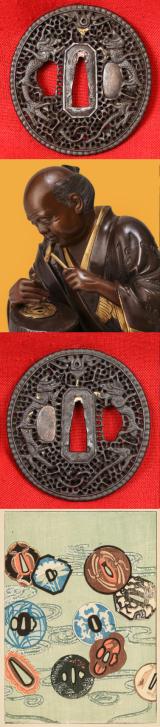
Openwork Iron Nanban Tsuba With A Pair of Dragons and Golden Nunome-Zogan Decor. A Most Fine Japanese 17th Century Sword Guard
Japanese sword hilt (tsuba) in cut iron and damascened with gold (nunome-zogan). The metal is finely carved with dragons chasing the sacred pearl in the Nanban style. The pearl is pierced and contains a small mobile ball which today comes out of its housing (see photos). Japanese work from the 17th century Edo period.
Nanban tsuba (Southern Barbarian sword guards) are 16th to 19th-century Japanese sword fittings characterized by foreign, non-traditional designs, primarily featuring intricate iron openwork (sukashi), beaded rims, and Chinese or European motifs. Originating from trade with foreign ships, these often-lavish guards were produced in China or by the Dutch East India Company and adapted for Japanese swords.
"Nanban" means "Southern Barbarian," a term used during the Edo period to describe foreigners—specifically Portuguese, Spanish, and Dutch traders—who arrived by sea.
While the name implies Western influence, most designs actually show strong Chinese influence.
They are usually made of iron, featuring complex openwork (carved in relief or pierced), undercutting, and often feature "small balls" trapped in small compartments that can move. Common motifs include dragons chasing flaming pearls, foreign letters (like "VOC" for the Dutch East India Company), and arabesque designs.
Initial pieces were likely imported from China or Southeast Asia through Nagasaki from the late 16th century onwards.
Japanese craftsmen began copying these styles. They often added specific features for Japanese swords, such as the hitsu-ana (holes for the utility knife/hairpin) and modifying the nakago-ana (tang hole).
The Yagami School: Based in Nagasaki, this school specialized in this style during the 18th century, famous for intricate ironwork featuring Chinese-style dragons and, notably, "1000 monkey" designs.
Although foreign-influenced, they were popular among samurai as fashionable, often heavily gilded or inlaid with gold/silver. They were sometimes used to subtly showcase hidden religious preferences (e.g., small crosses) during the prohibition of Christianity
Nanban-style carvers in Yamashiro (modern-day Kyoto) refers to 18th-century Japanese metalworkers, specifically tsuba (sword guard) makers, who adopted foreign design elements—primarily Chinese, but also Portuguese and Dutch influences—into their craft.
These artisans are known for producing Nanban Tsuba (Southern Barbarian sword guards), which often feature intricate, openwork (sukashi) designs, such as dragons, vines, and lion-like figures, usually on an iron ground.
They utilized gold or silver nunome-zōgan (inlay) to highlight designs, frequently carving on a cross-hatched background to create a textured, luxurious, or exotic look.
While Nanban-style items were often associated with Nagasaki, Kyoto-based makers (Yamashiro) were known for producing higher-quality, more sophisticated, and detailed versions, often with better-finished carvings.
Connection to Heianjo School: Some of these designs are categorized alongside Heianjo-style Tsuba, which were established in Yamashiro and known for combining iron with brass inlays.
These carvers operated during the Edo period (1603–1868), with peak production of these refined, domestically made Nanban pieces occurring around the 18th century.
Size 72x5mm Good condition. read more
495.00 GBP
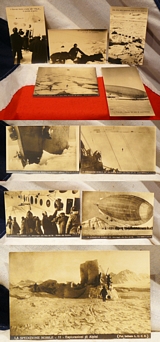
A Most Rare Set Of 12 Original Photographs Of The General Nobile 1928 Polar Airship Expedition
Original Polar Expeditions collectables are most highly desirable and we have been delighted to acquire two such connected lots. These are 12 original photographic postcards, published at the time, by two publishers, Traldi and Ballerini & Fratini. For example one is entitled "La Spedizione Nobile - 11 - Esplorazioni di Alpini."
Ed. A. Traldi, Milan, n.d. c. 1928. and another "General Nobile to edge of Italy before leaving."
Umberto Nobile January 21, 1885 ? July 30, 1978) was an Italian aeronautical engineer and Arctic explorer. Nobile was a developer and promoter of semi-rigid airships during the Golden Age of Aviation between the two World Wars. He is primarily remembered for designing and piloting the airship Norge, which may have been the first aircraft to reach the North Pole, and which was indisputably the first to fly across the polar ice cap from Europe to America. Nobile also designed and flew the Italia, a second polar airship; this second expedition ended in a deadly crash and provoked an international rescue effort.The N-class airship Italia was slowly completed and equipped for Polar flight during 1927-28. Part of the difficulty was in raising private funding to cover the costs of the expedition, which finally was financed by the city of Milan; the Italian government limited its direct participation to providing the airship and sending the aging steamer Citt? di Milano as a support vessel to Svalbard, under the command of Giuseppe Romagna.
This time the airship used a German hangar at Stolp en route to Svalbard and the mast at Vads? (Northern Norway). On May 23, 1928, after an outstanding 69 hour long flight to the Siberian group of Arctic islands, the Italia commenced its flight to the North Pole with Nobile as both pilot and expedition leader. On May 24, the ship reached the Pole and had already turned back toward Svalbard when it ran into a storm. On May 25, the Italia crashed onto the pack ice less than 30 kilometres north of Nordaustlandet (Eastern part of Svalbard). Of the 16 men in the crew, ten were thrown onto the ice as the gondola was smashed; the remaining six crewmen were trapped in the buoyant superstructure as it ascended skyward due to loss of the gondola; the fate of the six men was never resolved. One of the ten men on the ice, Pomella, died from the impact; Nobile suffered a broken arm, broken leg, broken rib and head injury; Cecioni suffered two badly broken legs; Malmgren suffered a severe shoulder injury and suspected injury to a kidney; and Zappi had several broken ribs.
The crew managed to salvage several items from the crashed airship gondola, including a radio transceiver, a tent which they later painted red for maximum visibility, and, critically, packages of food and survival equipment which quick-witted engineer Ettore Arduino had managed to throw onto the ice before he and his five companions were carried off to their deaths by the wrecked but still airborne airship envelope and keel. As the days passed, the drifting sea ice took the survivors towards Foyn and Broch islands.
A few days after the crash the Swedish meteorologist Malmgren and Nobile's second and third in command Mariano and Zappi decided to leave the immobile group and march towards land. Malmgren, who was injured, weakened and reportedly still depressed over his meteorological advice that he felt contributed to the crash, asked his two Italian companions to continue without him. These two were picked up several weeks later by the Soviet icebreaker "Krasin". However there were persistent rumors that Malmgren was killed and cannibalized by Zappi and Mariano
They would look incredible suitably bespoke framed with UV protected glass read more
675.00 GBP

A Wonderful 18th Century French Small-Sword of Parcel Gilt and Blued Steel A Simply Stunning Museum Grade Piece. A Stunning Example of This French Master Craftsman’s Artistry and Skill in Service in The Royal Court of King Louis XVth
A sword that is certainly worthy of a finest collection of all forms of object d'art, antiquities, antiques and militaria.
Likely made at Versailles, at the royal workshops, by a royal swordsmith of King Louis XVIth, such as the master swordsmiths of the king, Lecourt, Liger or Guilman. A very finest grade sword of the form as was made for the king to present to favoured nobles and friends. He presented a similar sword to John Paul Jones see painting in the gallery now in the US Naval Academy Museum.
Three near identical swords to this now reside in the Metropolitan
A simply superb small-sword, with stunningly engraved chiselled steel hilt, overlaid with pure gold over a fish-roe background, decorated with hand chiselled scenes in the rococo Italianate renaissance style depicting various hunting scenes, of hunting hounds and game birds.
The multi wire spiral bound grip is finest silver, in with Turks head finials. The blade is in the typical trefoil form, ideal for the gentleman's art of duelling.
The degree of craftsmanship of this spectacular sword is simply astounding, worthy of significant admiration, it reveals an incredible attention to detail and the skill of it's execution is second to none.
Other similar swords are in also in the British Royal Collection and in Les Invalides in Paris. Trefoil bladed swords had a special popularity with the officers of the French and Indian War period. Even George Washington had a very fine one just as this example. For example of the workmanship in creating this sword for such as the King and Marie Antoinette we show the keys for the Louis XVI Secretary Desk (Circa 1783) made for Marie-Antoinette by Jean Henri Riesener, one of the worlds finest cabinetmakers, and whose works of furniture are the most valuable in the world.
The steel and gold metalwork key for Marie Antoinette's desk, is attributed to Pierre Gouthoire (1732-1813), the most famous Parisian bronzeworker of the late eighteenth century who became gilder to the king in 1767. This sword bears identical workmanship and style to that magnificent key. This is the quality of sword one might have expected find inscribed upon the blade 'Ex Dono Regis' given by the King.
Very good condition overall, with natural aged patination throughout.
The painting in the gallery is titled John Paul Jones and Louis XVI, by the American artist Jean Leon Gerome Ferris depicts John Paul Jones and Benjamin Franklin at the court of Louis XVIth and being presented a similar sword now in US Naval Academy Museum.
39.1/4 inches long overall. read more
5995.00 GBP

A Museum Quality Original & Ancient, Crusades Period, King Edward Ist Medieval Knights Sword, 13th century. Used During The Time of Edward Longshanks, William Wallace and Robert The Bruce, Used By Both English & Scottish Knights During That Historic Era
The type known in academic circles as the Oakshott Type XII. What a fabulous original ‘statement piece’ for any collection or decor. In the world of collecting there is so little remaining in the world from this highly significant era in European and British history. And to be able to own and display such an iconic original representation from this time is nothing short of a remarkable privilege.
A wonderful example piece, from the ancient knightly age. Effectively, from this time of almost eight hundred years ago, from a collectors point of view, nothing else significant survives at all, only the odd small coin or very rarely seen, and almost impossible to own, carved statuary.A simply stunning historical original double-edged original knight's crusades period iron longsword of Oakeshott's Type XII (Oakeshott, 1991, p.105). Incredibly, still complete with its iron scabbard mount. Oakeshott is the standard that describes and by which defines Medieval swords, their types, and periods of use. The swords' broad, flat, evenly tapering blade is typical of specimens of its category, with the blade tending to widen below the hilt; incredibly the iron mouth of its original scabbard is also still present decorated with an openwork flower, but now in 2 pieces; the fuller is well defined, extending from below the guard for a little more than half of the blade's length;
This is the dominant style of knightly sword in use during the time of King Edward 1st of England Edward Longshanks such as in the first War with Scotland against Robert the Bruce and Sir William Wallace. The frequent myth is that the Scots mostly used the great sword Claymore, as seen in Braveheart, but the reality is very few of those were used, and even the so called William Wallace Claymore in the Wallace museum display in Stirlingshire, Scotland is iust an amalgam of various mixed sword parts, a Ship of Theseus of sorts.
The 'Great Seal of Robert The Bruce' shows him holding the very same type of sword.
This type was frequently made in Venice, by their great armourers, and many king's around all Europe had this form of sword. King Edward's sword, for example, was very similar to this sword, in its shape and form, but the king's sword would have been thinly coated with gold on the hilt. The Battle of Falkirk, (22 July 1298) was the initial Scottish victory over the English at the Battle of Stirling Bridge in 1297, but was soon avenged by Edward at the Battle of Falkirk. English rule was thus re-established over Scotland, forcing William Wallace to wage a lengthy guerrilla campaign until he was hunted down, betrayed, and eventually executed for treason in 1305. After the disaster of Stirling Bridge, King Edward I of England determined to crush the Scots once and for all. He headed north to invade the country in 1298, advancing with an army of around 2,500 mounted knights many using swords just as this one and 12,500 infantry, including large numbers of Welsh and English archers armed with longbows. In response, Wallace tried to avoid a pitched battle, because his own forces were smaller than the English, totalling around 1,000 mounted knights and 5,000 infantry. Wallace preferred to conduct guerrilla warfare against the invading army, but was eventually forced into battle at Falkirk.
On the morning of battle, Wallace formed his pikemen up into four schiltrons, hedgehog like circular formations of pikemen standing shoulder to shoulder with their pikes facing outward through an outer row of men in armour. The gaps between the schiltrons were filled with archers. The four schiltrons withstood the initial English cavalry and infantry attacks but then became vulnerable to steady fire from Edward?s longbowmen, the first time significant use had been made of this deadly weapon in battle. As the arrows poured down, supplemented by crossbow and slingshot, the schiltrons were soon broken up by the charging English cavalry. The Scots then fled into the neighbouring woods. Wallace escaped, although he lost many supporters. English losses, too, were high, testimony to the effectiveness of the schiltrons in battle.
Losses: English, 2,000 of 15,000; Scottish, 2,000 of 6,000. This sword's blade's cross-section, being of lenticular design, was originally from thirty to thirty-two inches long; the grip is a little longer than previous Oakshott type XI; the style of guard is short and straight, with a flattened cross-section at the edges; the pommel is a thick spherical piece, slightly flattened at the centre. Nice condition for age.
To see references on this sword see Oakeshott, J, R.E., The Archaeology of the weapons, London, 1960 (Woodbridge, 1999); Oakeshott, E. 'Records of the Medieval Sword', Woodbridge, 1991; Nicolle, D., 'Arms and Armour of the Crusading Era', 1050-1350, vol I,, London, 1999; Scalini, M., 'A bon droyt, spade di uomini liberi, cavalieri e santi', Milano, 2007.
Oakeshott considered this category of sword as one of the most difficult to interpret, because of the affinity of the hilt with the types X and XVI (Oakeshott, 1991, p.65). Characteristics are the noticeable taper blade, with acute point, and the grip quite short, never of hand-and-a-half length. The fuller is usually running for at least half of the length of the blade. The sword was the most typical chivalry weapon diffused in all the Europe, largely attested by archaeological finds and artefacts from historical collections. Among the most famous specimen of such sword we should remember the one of Sancho IV (El Bravo) of Castilla, died in 1295 AD see photo in the gallery, which show a slightly curved hilt, and a cross-guard also expanded at the edges (Nicolle, 1999, cat.391). Our sword finds a good parallel in a Venetian sword preserved in Padova Museum (inv. IG 321119, s. Scalini, 2007, pp.126-127, cat.19), realised by an unknown Italian craftsman. Many of these swords were taken as booty from the Muslims taken from the vanquished crusader knights initially and preserved until recent times in the Arsenal of the Imperial Palace in Istanbul. Such weapons were mainly of Venetian origin, with slightly broader blades than our specimen. Scalini has suggested that such swords could also have been employed during the XIII-XIV century by the Venetian infantry in the operations of the Aegean Sea against Muslims and Eastern Romans. If this is true, the importance of the weapon consists in its functional use, not only reserved to the European and British knights, but also army of the Venetian Republic. The early flat disc pommels appear in the Mediterranean Sea at the beginning of the 12th century (for similar pommels s. Oakeshott, 1991, p.69) and persist in use until the 15th century and even later, although with significant variations. In art and medieval iconography, the best samples of swords of XII types can be seen on the famous Bible of Maciejowski made in approximately 1250 (Nicolle, 1999, 49a-49 as). Many of the swords illustrated therein seem to indicate a full length fuller; this might seem to indicate a Type X. However, most of the illustrations feature far too much profile taper to be a true Type X. Given the period of the Bible's manufacture they are far more likely to indicate swords of Type XII design. There is also an Apocalypse in the library of Trinity College, Cambridge (Nicolle, 1999, 189a-b) that was made around twenty years earlier that features illustrations of the type. Many of the illustrations from the Royal Armouries Manuscript I.33 can be interpreted as being of type XII pattern. More specifically, the typology of our specimen is visible on the sculpture of a warrior in the Church of Saint Justyna in Padua, confirming again the Venetian origin of such swords.
"Most probably our specimen is from a battlefield or, most probably, a river find. Type XII (Oakeshott, 1960 (1999) p.206), is generally dated between about 1180 and 1320, It has a large blade, very similar in shape to the Ulfberht ones but generally with a more acute point, and a well-marked and slightly narrower fuller starting in the tang and running about halfway along the blade; this occasionally is of two or more grooves. The pommel is generally in the form of a thick disc, sometimes with the edges bevelled off, sometimes of the so-called "wheel" form. Its cross is generally straight, circular in section and widening at the ends, but it may be of a square section; or it may be curved or have decorated terminals. Inscriptions on examples of these swords dating after about 1220 are slightly different again; the letters are closer together, often so dose that it is nearly impossible to make them out; and instead of the clearly legible religious phrase there is a jumble of repetitive letters which seems meaningless. Typical of the High Middle Ages, these swords begin to show greater tapering of the blade and a shortened fuller, features which improve thrusting capabilities while maintaining a good cut. The Cawood sword is an exceptionally well preserved type XII specimen, exemplifying a full-length taper and narrow fuller, which terminates two thirds down the blade. A number of Medieval examples of this type survive. It certainly existed in the later 13th century, and perhaps considerably earlier, since the Swiss National Museum in Zurich possesses an example that has a Viking Age-type hilt but clearly a type XII blade." Above quote on this sword from Dr Raffaele D'Amato. Small hole damage to central fuller and extreme tip missing. As with all our items they are accompanied with a Certificate of Authenticity and thus Guaranteed for Life. Just under a kilo in weight, 74.5cm (29 1/4" inches long overall). As usual the wooden handle and scabbard leather perished centuries past. Almost every iron weapon that has survived today from this era is now in a fully russetted condition, as is this one, because only the swords of kings, that have been preserved in national or Royal collections are today still in a good state and condition. This sword will be accompanied by a complimentary wooden display stand. It could also be enhanced by affixing to a rectangular bespoke display panel.
Every single item from The Lanes Armoury is accompanied by our unique Certificate of Authenticity. Part of our continued dedication to maintain the standards forged by us over the past 100 years of trading read more
11275.00 GBP